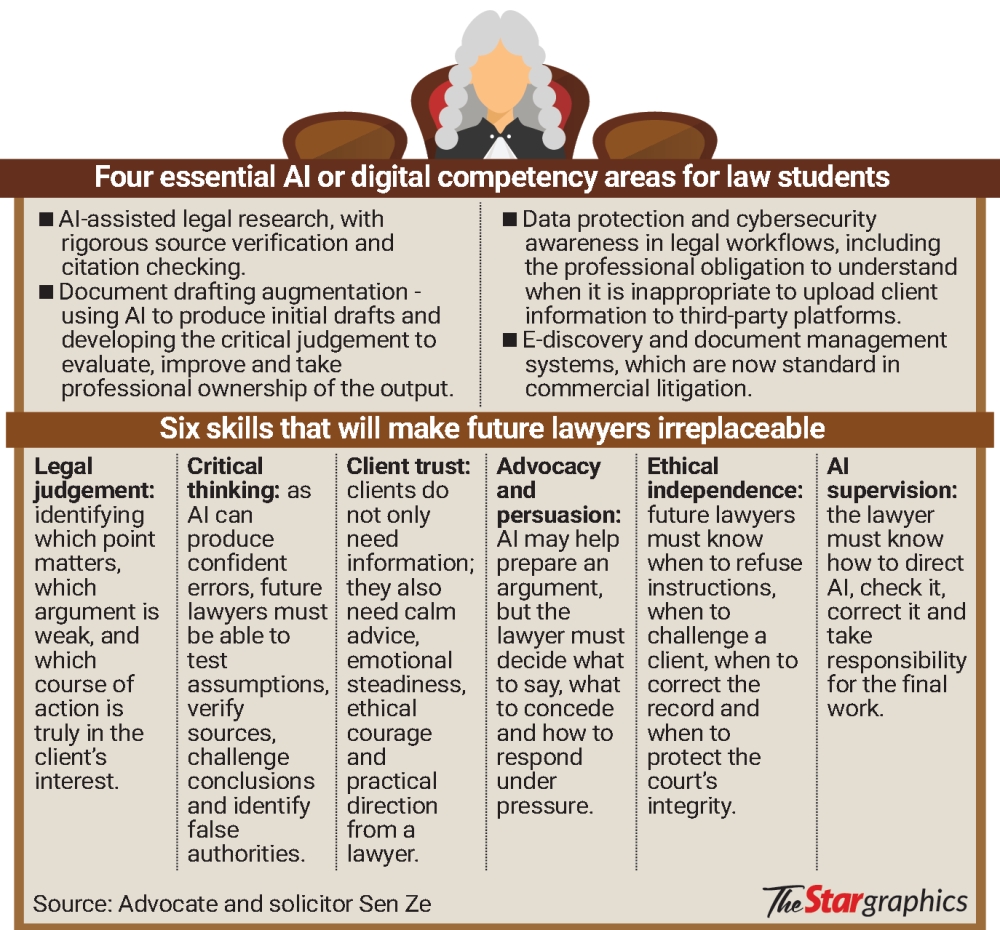
AS artificial intelligence (AI) becomes increasingly embedded in legal practice, law schools must ensure graduates are equipped not only to use these tools, but also to do so responsibly (see infographic), says Sen Ze (pic).
The advocate and solicitor, who is also the author of The Intelligent Lawyer, added that future lawyers will need a combination of legal expertise, critical thinking and technological literacy to thrive in an AI-driven profession.
“The irreplaceable lawyer will not be the one who merely knows more law. It will be the lawyer who combines legal knowledge, judgement, ethics, persuasion, client understanding and the intelligent use of technology,” he stressed.
On how legal education institutions can integrate AI without undermining foundational skills like legal reasoning and critical thinking, he said the answer lies in sequencing and honest pedagogy.
“Students need to develop the analytical infrastructure to evaluate AI output before they are permitted to rely on it.
“That means building legal reasoning skills through conventional methods first – closed-book problem questions, oral examinations and in-person simulations – and introducing AI tools only when students have the baseline competency to recognise when the AI is wrong,” he said.
He added that the most powerful pedagogical approach is to require students to audit AI output: to identify its errors, correct its reasoning and justify their editorial decisions.
“This makes AI a critical object of study rather than an invisible shortcut.
“Institutions must also model this themselves – if lecturers cannot critically engage with AI tools, they cannot teach students to do so either,” he said.