DURIAN farming in Penang is an industry built on generations of accumulated experience, instinct and tradition.
Data analytics and market modelling were rarely part of the equation until young couple Lee Jang Giap and Wong Sue Rene entered the fray.
They do not fit the stereotype of typical durian farmers.
One built a career in information technology. The other was a physiotherapist with the United Kingdom’s National Health Service (NHS).
However, after taking over their family orchard in Teluk Bahang in 2023, they are eager to modernise the business with science, data and fresh ideas.
Unlike growers who rely on methods honed over decades, Lee and Wong use hard numbers to guide operations at the 4ha Bahang Terraces farm.
Cultivation costs, harvest yields, market prices, seasonal fluctuations and other key data points are meticulously tracked and analysed.
The insights gathered help guide decisions ranging from optimal harvesting schedules to identifying durian varieties that offer the best returns at different stages of the annual season.
“My background is in science, marketing and data.
“Having spent years building information technology systems, I naturally approached farming the same way,” said Lee, 33, who graduated with a MSc in International Marketing from Sheffield Hallam University.
“Data allows us to better understand yields and pricing cycles.”
Wong, 32, took an equally unconventional path into the business.
She did her MSc in Physiotherapy at Manchester Metropolitan and worked with the NHS through the Covid-19 pandemic.
“Ironically, I was never much of a durian enthusiast.
“I occasionally had some when I was younger, but was never crazy about it.
“It wasn’t until I returned to Penang and got involved with the farm that I realised just how much complexity there was to the fruit,” she said.
Besides increasing profitability, the data also helped the couple better understand the increasingly volatile local durian market.
This season, owing to a bumper harvest, prices fell to their lowest levels in three to four years due to the glut of premium Musang King and Black Thorn varieties, especially those coming in from commercial farms of other states.
“Many trees planted during the boom nearly a decade ago have reached maturity, flooding the market with fruit.
“While the cheaper prices are great for consumers, it also exposes a deeper problem that Penang’s small-scale growers have to contend with,” Lee said.
Musang King and Black Thorn are considered index cultivars, with prices directly influencing market rates of other varieties.
When their prices plummet, so does everything else.
“Farmers that grow heritage varieties will have to offload their fruit to middlemen at drastically lower prices, even though costs remain the same.
“As a result, small farms are finding it increasingly tough to stay afloat,” he said.
These are aspects of durian farming that may not be readily apparent when aficionados visit stalls to indulge in the fruit.
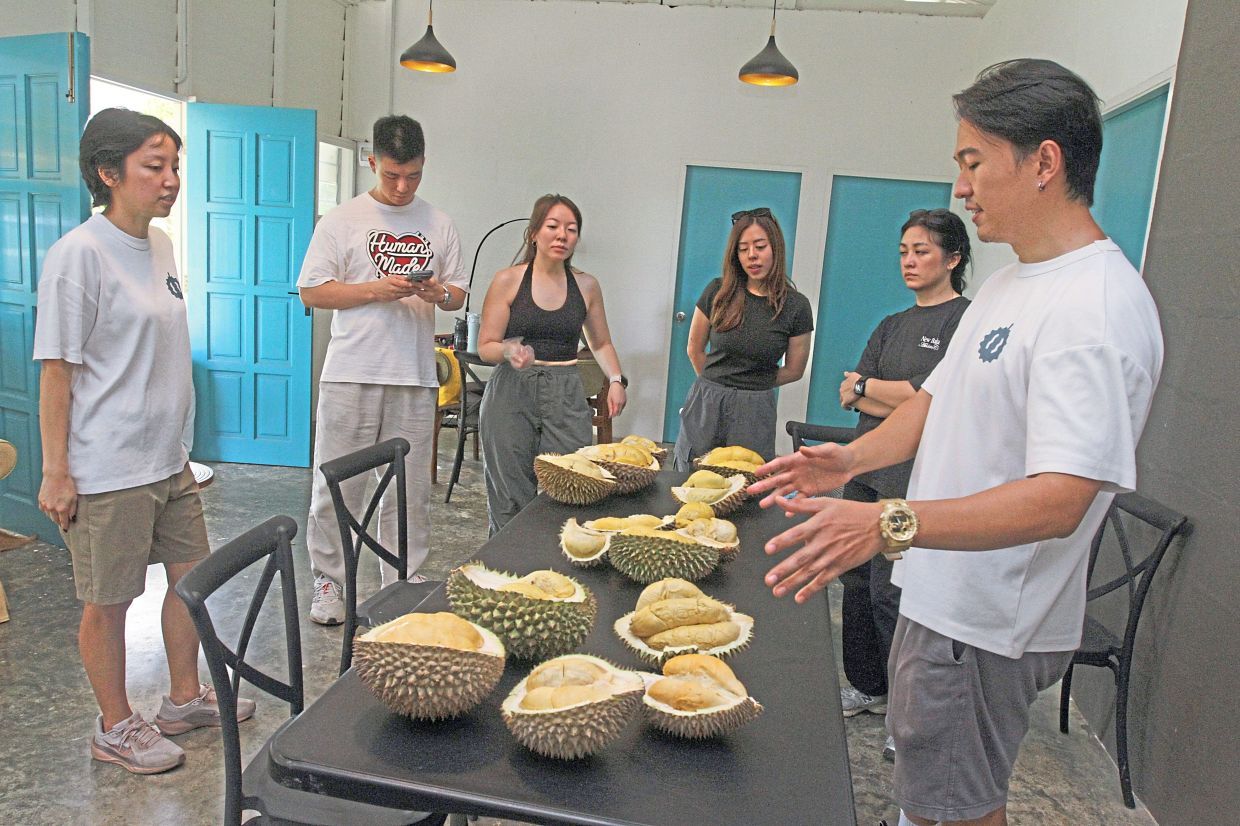
It is something Lee and Wong are trying to address with personalised farm tours at Bahang Terraces, where visitors are taken on a tour to see the inner workings of an orchard.
“By showing people how durian are cultivated, they get a better appreciation of the effort that happens from farm to consumer.
“At the end of the tours, we present durian sampling to cultivate an appreciation for different flavour profiles, much like the way people explore whisky or cheese.”
“Most guests discover things they never knew,” said Wong, adding that they hosted roughly 20 to 30 people each weekend.
The couple said the tours also serve a deeper purpose – to shift attention back towards Penang’s lesser-known heritage durian varieties such as the Red Prawn, Green Skin, Hor Lor, Capri, Susu, Lipan and 604 which grows on the farm.
“We’re trying to show people that Penang’s durian identity is much broader than just the commercialised varieties.
“There are so many artisanal types that are equally interesting if not more tasty, which don’t get the same attention.
“Worryingly, these varieties have become increasingly vulnerable as farmers respond to market pressures by replacing their trees with higher value Musang King and Black Thorn.
“Without intervention, some of these varieties could gradually disappear, and that is already happening,” said Lee.
For the couple, preserving this diversity has become central to their long-term vision for Bahang Terraces.
Rather than running it solely for yield and profit, they see it as a living archive of Penang’s durian ecosystem.
“Durian in Penang shouldn’t be just about Musang King, which is actually from Pahang,” Lee said.
“It’s about maintaining a whole ecosystem of varieties that tell the story of the island, and each of the durian breeds themselves.”