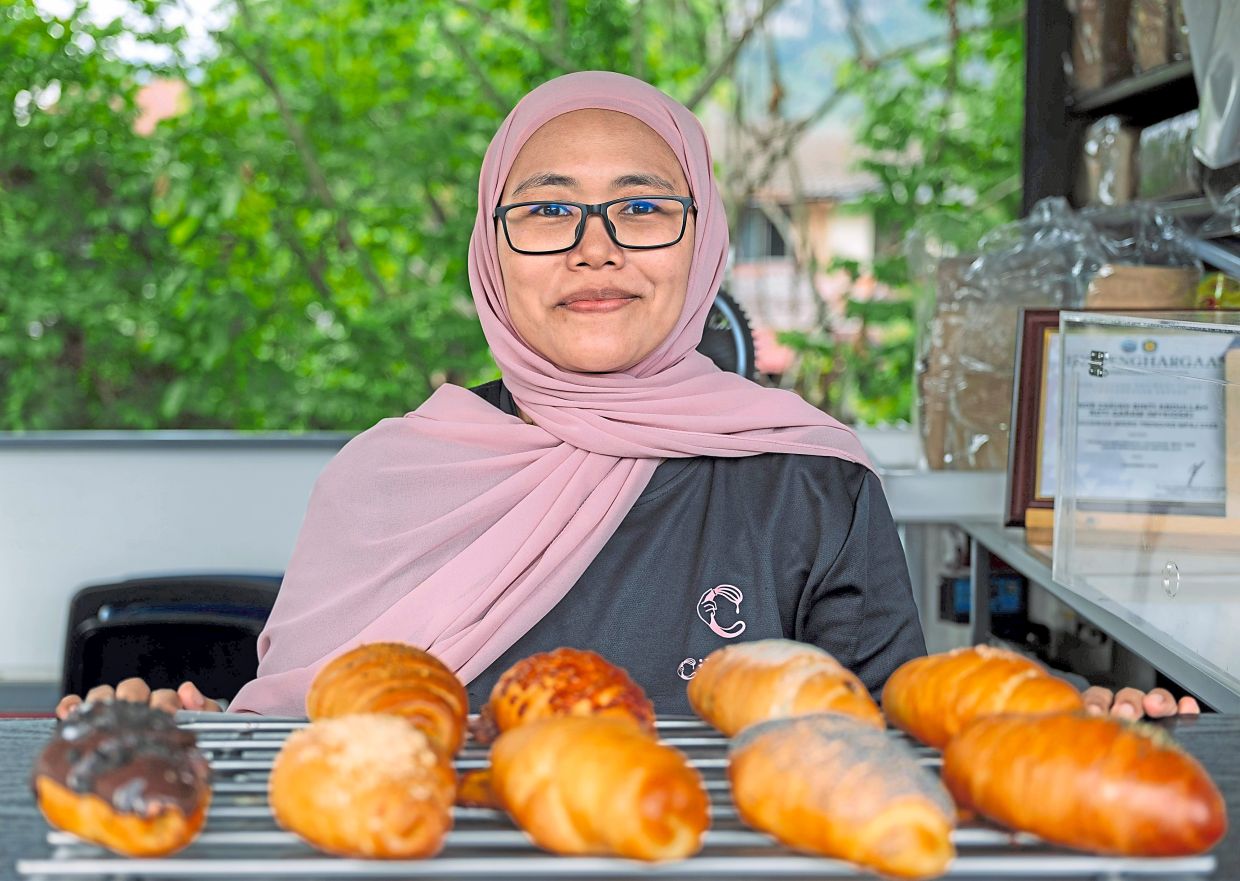
LONG before the 5pm weekday opening, crowds queue outside a tiny kiosk in Taman Melawati, Ampang in Selangor.
They are all after one thing: salt bread, a Japanese pastry taking the local food scene by storm.
Within two hours, Cikkiah Salt Bread sells out completely, sending latecomers home empty-handed.
Cikkiah owner Nor Zakiah Abdullah, who is in her 40s, has been in the cake and pastry business for more than a decade and introduced salt bread in 2024.
She said sales soared after moving her business into a MyKiosk unit.
The Housing and Local Government Ministry (KPKT) initiative helps micro-entrepreneurs transition from the roadside into safe, licensed and affordable spaces.
Nor Zakiah said she previously operated on a much smaller scale, baking and selling her products from her home in Sentul, Kuala Lumpur, and from a makeshift tent at the local market.
MyKiosk, she told Bernama, had significantly improved her operational efficiency and daily takings.

“Compared with setting up a tent every day, operating from a kiosk is so much easier.
“I simply unlock the kiosk and start selling,” she said.
Nor Zakiah said the six-month rental waiver offered under the programme also gave her valuable time to build a customer base while salt bread was still new to the market.
Her gross daily income, which previously ranged between RM500 and RM600, has now increased to between RM1,000 and RM1,500, with average monthly sales now reaching about RM20,000.
Nor Zakiah is now considering opening a central kitchen and moving to larger premises.
Rohana Salim, 51, owner of Ayam Gunting MITC at the MITC Hawker Centre in Melaka, has also benefitted from the MyKiosk programme.
Previously operating from a roadside tent, she said her business was now more stable, with total sales per day of between RM1,000 and RM1,300, up from RM700 to RM800.
“However, I hope this hawker site can be upgraded with electricity, piped water supply and a more comfortable dining area.
“Better facilities will allow us to operate at night to increase our income,” she added.
KPKT said MyKiosk provided licensed roadside facilities with a safer, more organised and comfortable business environment, while improving cleanliness at hawker areas.
“Providing standardised business spaces in high-traffic locations helps micro, small and medium-sized enterprises (MSMEs) become more competitive, improves the socioeconomic standing of small traders and creates opportunities for more entrepreneurs, including young people, to enter business through a more structured licensing system,” it said.
MyKiosk was officially launched in 2023 with an initial allocation of RM50mil to build about 3,000 kiosks.
The initiative was expanded under MyKiosk 2.0 in 2024, increasing the total number of kiosks nationwide to more than 7,000.
“As of May 2026, a total of 7,243 MyKiosk units have been developed nationwide, with an occupancy rate of nearly 90%, enabling more hawkers to operate from licensed business premises,” the ministry said.
It said the programme also benefitted 795 small-scale contractors involved in kiosk construction.
According to KPKT, a 2024 study found that MyKiosk traders operating in high-traffic locations recorded average income increases of at least RM500 per month.
To help MyKiosk traders establish a customer base, the ministry capped monthly rental at RM300 and provided a six-month rental exemption.
Although many MyKiosk success stories had been driven by operators’ products going viral on social media, KPKT stressed that location remained the single most important factor.
Among the challenges identified by KPKT are traders who discontinue operations after the rental exemption ends, as well as unsuitable locations.
“Relocating underperforming kiosks to areas with stronger commercial potential is therefore one of the key mechanisms to improve the programme’s effectiveness,” it said.
For Ampang Jaya Municipal Council (MPAJ), MyKiosk forms part of a broader effort to restructure the urban micro business sector and make it safer, more systematic and orderly.
MPAJ deputy president Hasrolnizam Shaari said the local council was responsible for identifying suitable trading sites, managing placement of Mykiosk units and ensuring hawkers’ operations did not compromise public safety, traffic flow and the surrounding environment.
In selecting suitable trading locations, MPAJ evaluates several factors including population density, daily traffic flow, customer accessibility and the area’s potential to attract customers.
He added that eligible traders could apply to join the MyKiosk programme, but applicants must first undergo a screening and interview process to ensure that the type of business they intended to operate was suitable for the location.
Hasrolnizam said the kiosks provided nationwide under the programme were permanent structures with a standardised design, creating a recognisable visual identity.
Each unit is equipped with storage space and solar-powered system.
In Ampang Jaya, the MyKiosk programme has expanded steadily since its launch.
What began with about 20 kiosks in the first phase has grown to around 94 units across several locations, including Taman Keramat, AU3/12 and Taman Melawati.
Hasrolnizam said MPAJ also encouraged MyKiosk traders to join Platform Selangor (PLATS), a digital platform that helps entrepreneurs market their products and grow their businesses.
The local council also promotes cashless payments, conducts regular monitoring and carries out ongoing maintenance to ensure the kiosks remain operational.
For Hang Tuah Jaya Municipal Council (MPHTJ) in Melaka, the success of MyKiosk depends not only on providing business space but also on continually reviewing locations, operations and facilities to ensure they meet the needs of traders and surrounding communities.
MPHTJ president Datuk Sapiah Haron said 28 of the 30 MyKiosk units under MPHTJ administration − rented out at RM100 each a month − were occupied as of mid-June, while the remaining two were being offered through a new round of tenancy applications.
MyKiosk traders at MITC and Jalan Ixora have seen particularly strong customer response, Sapiah said, noting that location remained the key determinant of success.
Kiosks situated near administrative centres, commercial areas and busy commuter routes consistently outperformed those in less visible areas, she said.
During the early stages of the programme, several kiosks that were not doing well, located within Zoo Melaka and at a school, were relocated to Jalan Ixora and Taman Saujana Section 2.
“This approach is consistent with KPKT’s emphasis that kiosk locations shall be reviewed regularly to ensure the infrastructure is being fully utilised.”
Sapiah said the municipal council had also adapted the programme to better suit traders’ operational needs.
For example, traders are allowed to cook at the rear or side of their kiosks, provided that they comply with hygiene and safety requirements.
To support business sustainability, traders are issued one-year licences costing RM120, compared with the standard hawker licence costing RM48.75 for three months and must be renewed each quarter.
MPHTJ is now seeking additional funding from KPKT to upgrade the hawker centre at MITC, which includes construction of a covered dining area.
Sapiah said the success of MyKiosk should not be measured solely by higher incomes for traders but also by its ability to create safer, more organised commercial spaces that stimulate local economic activity.