“How did you know this was the most premium train in the Chengdu Panda Train series? And you didn’t just take a short ride – you went straight for the full 16-day, 15-night journey across northern and southern Xinjiang.
“You really know your stuff,” said Katherine Zhang, the “chief butler” of the Jinxiu Tianfu Luxury Train, during our chat.
I understood why she was surprised that I knew about China’s rail experience.
China is vast, and by nature, it is a country made for long-distance train journeys. Yet for many years, most sightseeing trains in China simply evolved from the traditional green trains; there were no purpose-built ones.
To a certain extent, there was perhaps more emphasis on quantity than quality when it comes to the train service there.
China was never really a major player in the high-end rail travel scene, but it wasn’t that the country couldn’t do it.
The time simply hadn’t come.
Back in 2023, my travel buddies and I took the Hulunbuir Express (the service is currently suspended), journeying through Mohe, Heilongjiang and beyond. Even then, I had a feeling that it wouldn’t be long before China came up with a truly high-end sightseeing train capable of matching international standards.
Ever since then, I have carried a certain anticipation for luxury rail travel to start in China.
After all, over the years I have travelled on quite a number of these types of trains around the world: the Trans-Siberia, The Ghan, E&O and more.
This means that I already have a yardstick by which I could measure the quality of service, and compare the general experience.
When a China tourism expert named Liu Na seized the opportunity to start the “Panda Train” concept, naturally, I was excited. China’s luxury sightseeing train scene was finally taking shape.
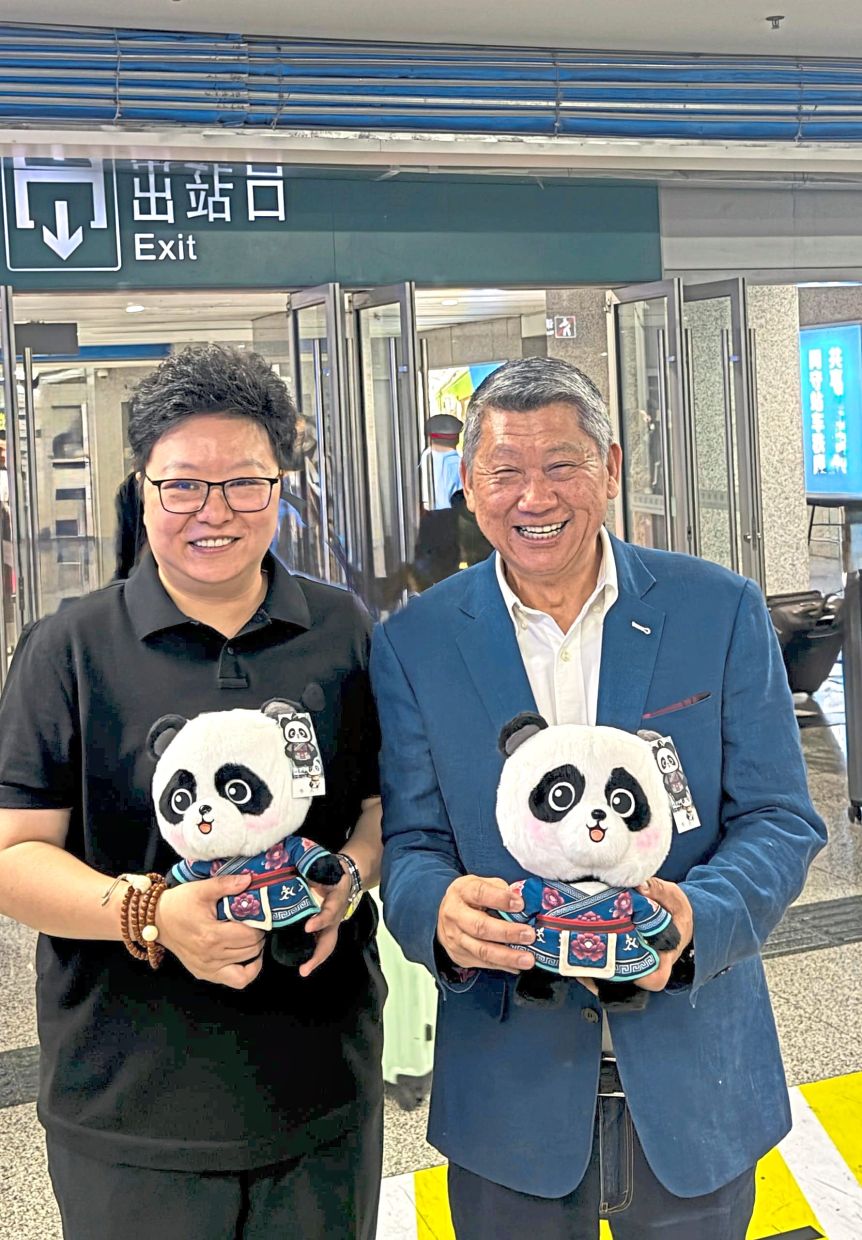
What impressed me more was Liu Na’s understanding of how to weave elements of traditional Chinese culture into the train service itself.
That is something many luxury trains overseas simply cannot replicate.
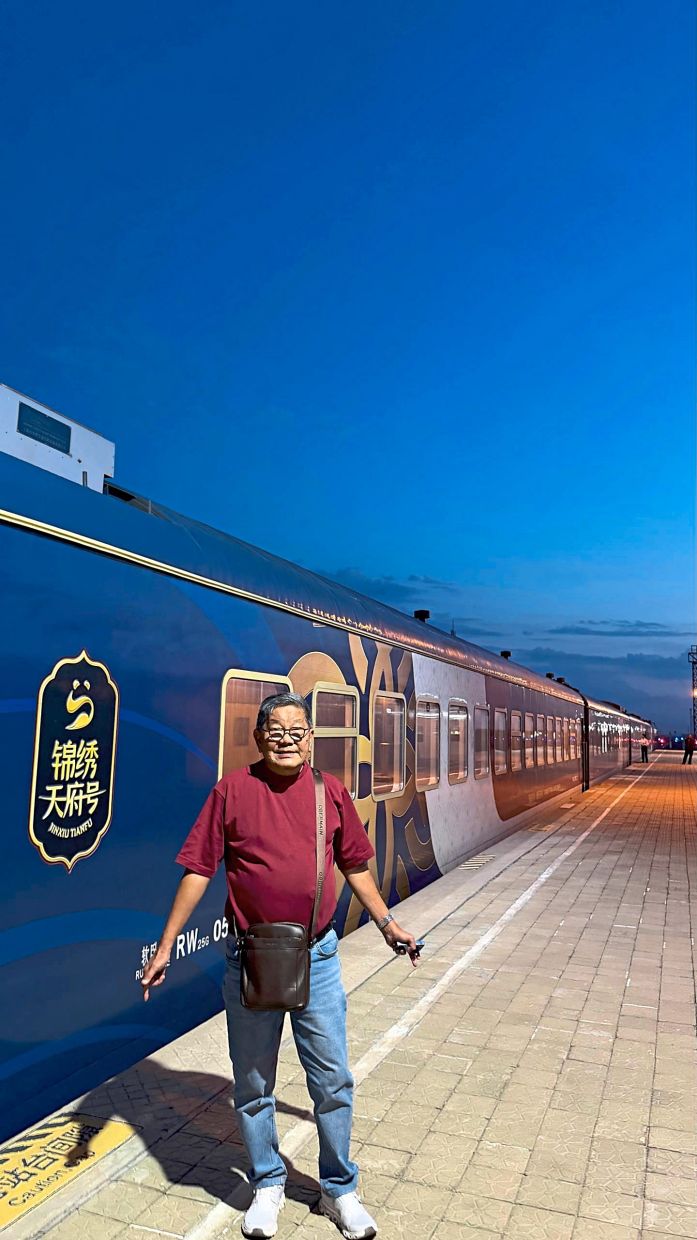
I finally boarded the Jinxiu Tianfu at Anjing Station in Chengdu in September.
My first impression? I was genuinely surprised.
Its 18 carriages – designed around aesthetics inspired by the Song Dynasty – finally made me feel that China’s sightseeing trains were beginning to look unmistakably Chinese.
From the carriage interiors and spatial aesthetics to the butler service and countless little details, I could sense a certain ambition behind it all – they were not merely trying to transport passengers from Point A to Point B.
They wanted to transform a “means of transportation” into a “travel destination” in itself.
What I had originally imagined was simply a five-star hotel on the move, travelling across the vast landscapes of northern and southern Xinjiang and taking away the exhaustion of long overland journeys.
Outside, scene after scene drifted past. Every train window seemed to be telling a story of the world beyond.
Yet the Jinxiu Tianfu managed to add even more little touches along the way.
Gradually, you begin to realise that this is perhaps more than just a train – it is a living cultural space. A scent. A beam of light. A sound. Even a simple sentence from a member of the crew seemed so special.
Any one of them might unexpectedly touch your heart.
And yes, it was very touching.
Zhang, the chief butler, spoke to me about the Song Dynasty design influence. I told her that it was exactly what I liked – restrained Eastern beauty.
There is just the right amount of empty space. Nothing loud, nothing excessive. Simple, yet beautiful.
And in a space like this, even a long 16-day, 15-night journey feels comfortable and warm.
I have always loved travelling by train. Especially in a vast region like Xinjiang. If you were to travel entirely by coach, you could easily find yourself “trapped” inside a bus for five to eight hours every day.
But train travel is different. The train moves at night, when you sleep.
The next morning, you arrive at another station, then you step off and continue exploring the new place until it is time to leave again.
I told Zhang that my feelings about the Jinxiu Tianfu could be summed up in one line:
“Luxury on the move, value in the journey”.
I would say that Liu Na truly understands the needs of international travellers. During our 16-day journey, apart from the thoughtful service of the butlers and the guidance of the land tour leaders, there were several details that particularly impressed me.
Before we arrived at certain destinations, staff would be sent ahead to set up refreshment stations along the route, inspect the restaurants, and even check the cleanliness of the public washrooms.
I was told that sometimes, they would even bring their own cleaning crew along. Now that surprised me, because this goes beyond what we normally call “five-star service”.
It means thinking from the traveller’s point of view: During a journey, what are the things most likely to make someone uncomfortable?
Well, dirty toilets happen to be one of them.
In the luxury travel scene around the world, service usually follows certain established standards.
But what lies beyond those standards can no longer be defined by the same SOP. That comes from genuine thoughtfulness and care.
One of our travel buddies relied on a wheelchair to get around. The Jinxiu Tianfu assigned him his own personal butler, providing one-to-one assistance and care throughout every sightseeing stop.
On the surface, it might seem like just another small service. But to me, it reflected a kind of warmth that goes beyond standards.
Even after travelling on many sightseeing trains around the world, this level of thoughtful and attentive service is something I rarely encounter.
After a few days being on the tracks, something even more interesting began to happen.
Almost every staff member who saw me would naturally call out: “Good morning, Leesan”, “Ni hao, Leesan”, “Leesan, would you like a cup of coffee?”.
In the beginning, it was standard service. Later, they remembered your name and more.
The difference may seem to be only a couple of words, yet to a traveller, the warmth changes the experience completely.
Perhaps this is what it really means to go “beyond standards”.
A luxury train can be built with money. A beautiful carriage can be replicated. But the warmth between people is much harder to write into a service manual.
Our journey finally came to an end at the Chengdu West Railway Station. Liu Na presented each of us with a certificate that read, “10,488km”.
Holding it in my hands, it somehow meant much more than I had expected.
Sure, that 10,488km was simply the distance we had travelled onboard the train. But to me, it also meant something else: Sixteen days. One train. A group of people. And all the warmth we had gathered along the way.
Before saying goodbye, I told Liu Na that China really does not need to copy sightseeing trains from any other corner of the world. Nor does it need to deliberately imitate the luxury trains of Europe or Japan.
China is vast. Its history runs deep and its culture, rich. It is more than capable of creating a path of its own.
Something with a Chinese flavour and a distinctly Chinese character.
With culture, warmth, and above all, with a human touch. That, I think, is already very good.
At the end of a journey, what we remember is often not how luxurious the train was.
What we remember is whether – somewhere along the way – someone remembered our name.
The views expressed here are entirely the writer’s own.
Leesan, founder of Apple Vacations and group executive chairman of KITA Tours, has travelled to seven continents and visited 168 countries/territories. He has written seven books, and shares his travel stories, experiences and insights.