
A destination that became famous around the world because it appeared in a film or television show is nothing unusual. What is remarkable is when the fascination for said place endures for years after the film is released.
That is the mark of a destination with genuine substance. Zhangjiajie National Forest Park in Hunan Province, China is one such natural wonder. Propelled into global fame by Hollywood’s Avatar films (2009, 2022 and 2025), the park has become one of China’s most recognisable landmarks.
As our group of 17 travellers stepped off our coach at the East Gate parking of the Wulingyuan Scenic Area, we were greeted by dozens of tour buses – most of them carrying tour groups from South Korea.
Naturally, everyone wondered: Why are there so many Koreans here?
We got even more curious when we entered the VIP access section. Korean conversations filled the air and signboards in Korean hangul were seen everywhere. For a moment, it felt as though we had walked into a tourist district in Seoul.
So why do Koreans love Zhangjiajie?
As it turns out, it is because of this popular saying that has been circulating in South Korea for years: “If you want to show filial piety to your parents, take them to Zhangjiajie.”
It may sound like a tourism slogan, but it actually isn’t. For many Koreans, visiting Zhangjiajie at least once in their life has become almost a national aspiration.
According to tourism statistics, South Korean visitors have long accounted for around 40% of Zhangjiajie’s international arrivals, totalling approximately 300,000 visitors annually.
Many Korean-speaking guides working in Zhangjiajie are ethnic Koreans from Yanji in northeastern China, gradually forming a sizeable Korean-Chinese community in the area.
But back to Wulingyuan’s best attraction, Zhangjiajie. The Avatar films introduced its extraordinary sandstone pillars to the world, and the landscape’s breathtaking beauty continues to draw visitors in to this day.
“Our luck is incredible whenever Leesan leads a tour,” said our guide, Wu, referring to the good weather in the area. Even the photographers who spend their days stationed among the towering peaks commented: “Visibility today is much better than yesterday. Come, let’s take a photo!”
Zhangjiajie enjoys a humid subtropical mountain climate. Most of its sandstone pillars rise to around 1,000m above sea level. Deep valleys, abundant rainfall, and constant moisture create rapidly changing weather conditions.
Locals often describe it as a place where you experience “a different weather every 10 steps”.
The area gets roughly 160 to 180 rainy days each year. Thick fog and mist frequently drift through the valleys, creating a spectacular sea of clouds.
During spring and summer mornings, especially after rain, the scenery often resembles the floating mountains depicted in the Avatar films.
Wu is no ordinary guide. She is a recipient of the prestigious “Best Tour Guide of Zhangjiajie” award in Hunan Province. For more than a decade, she has guided visitors from around the world through these mountains almost daily.
That morning, she said to us: “Later, I’ll take you to a hidden paradise. You’ll see the quietest and most beautiful side of Zhangjiajie.”
Needless to say, anticipation ran high in my group.
The spectacular sandstone peaks are primarily located around the East Gate section of the forest park, making it one of the main entrances for visitors.
Our group had pre-booked a VIP access package, allowing a dedicated shuttle to transport all 17 of us directly up the mountain.
The best part? The entire journey was conducted through VIP lanes, including access to the famous Bailong Elevator – we did not have to queue for anything.
This is about as luxurious as group travel gets.
The Bailong Elevator, which began operating in 2002, was built directly into a sheer cliff face. Half of its structure is embedded within the mountain, while the other half hangs dramatically from a steel framework attached to the rock wall.
Today, it is one of the defining symbols of Zhangjiajie.
Recognised by the Guinness World Records as the “world’s tallest outdoor elevator”, the system consists of three double-deck elevators operating simultaneously. It rises 326m, spanning a vertical height difference of 335m – equivalent to a building of more than 100 stories.
The ride from the valley floor to Yuanjiajie takes a mere 66 seconds.
In many ways, the Bailong Elevator feels like an experiment in which modern engineering has been inserted directly into a landscape shaped over hundreds of millions of years.
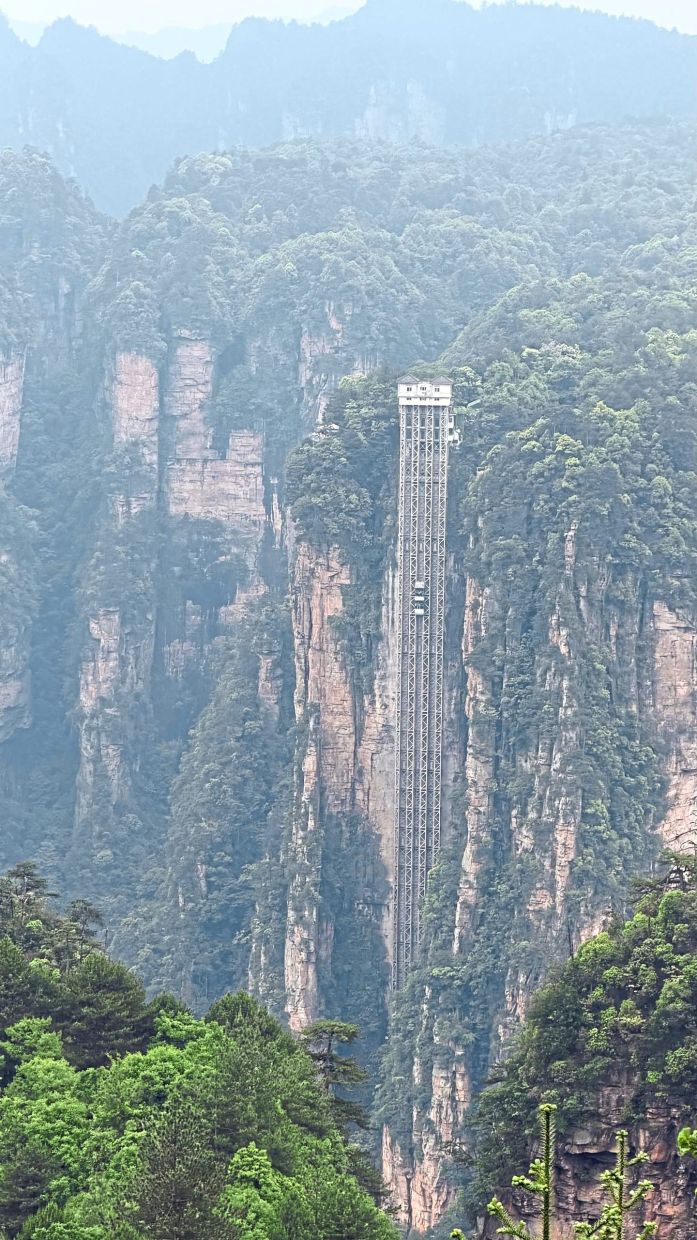
Yet when the lift moves up alongside the cliff face, revealing towering peaks, drifting clouds, and deep valleys below, one cannot help but feel humbled.
In Zhangjiajie, humanity has not conquered the mountains. It has merely attached an elevator gently to the edge of paradise.
It is beautiful beyond words.
Meanwhile, the Enchanting Platform (Mihun Tai) in Yuanjiajie is a spectacular viewpoint in Zhangjiajie.
Standing at the cliff’s edge, visitors are greeted by thousands of towering sandstone pillars rising dramatically from the ground. When wrapped in mist, the landscape resembles a celestial kingdom suspended between Heaven and Earth.
We were fortunate. The rain had just cleared, and a magnificent sea of clouds rolled through the valleys. The peaks emerged and disappeared among the mist, creating a scene that looked like a classic Chinese ink painting.
The name “Enchanting Platform” could not be more appropriate. The scenery is so unreal that one briefly wonders whether this is actually the mortal world or some mythical realm.
This viewpoint is also believed to be one of the inspirations behind Avatar’s famous “Hallelujah Mountains”; the platform was packed with visitors when we were there.
Suddenly, Wu announced, “Everyone onto the bus! We’ll need two more transfers. Our destination is Tianzi Mountain’s hidden gem – the Sky Garden.”
Upon arrival, I was stunned. How could there be terraced rice fields perched atop a lofty mountain platform surrounded by 1,000m-plus cliffs?
Yet there they were.
Covered in mist and suspended among the peaks, these isolated terraces appear to float in the sky, earning the name “Sky Garden”.
In spring, the flooded padi fields mirror the surrounding sandstone peaks. Summer transforms them into vibrant green carpets. By autumn, golden rice stalks ripple across the mountaintop, creating a striking contrast against the towering quartz sandstone walls.
It is no wonder people call it a “farmland growing in paradise”.
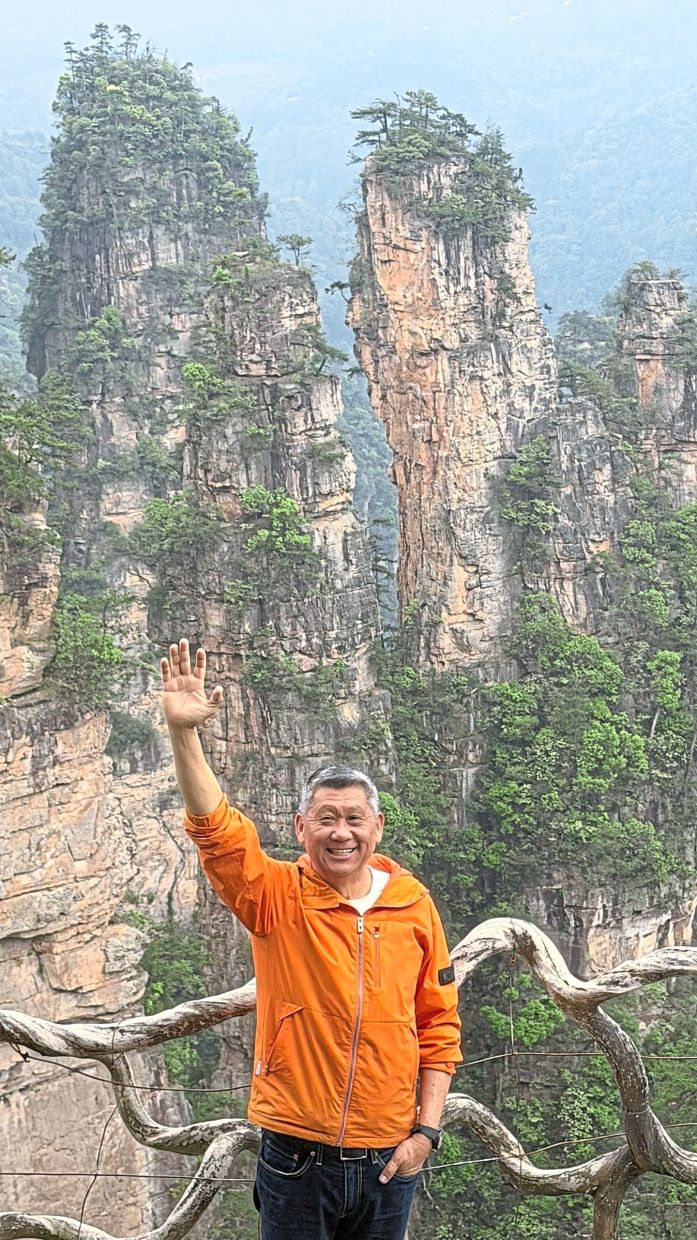
Zhangjiajie National Forest Park is a world of stone peaks sculpted by nature for more than 300 million years. Thousands of quartz sandstone pillars rise dramatically into the sky, often shrouded in clouds and mist, creating scenes that seem lifted straight from Avatar.
Yet Zhangjiajie offers far more than a spectacular mountain scenery. Hidden among its valleys are crystal-clear streams, ancient forests, and the rich traditions of the Tujia people.
A journey into Zhangjiajie is not merely about sightseeing. It is a rare encounter between humanity and the grandeur of the natural world.
The views expressed here are entirely the writer’s own.
Leesan, the globe-trotting traveller who has visited seven continents, including 164 countries and territories, enjoys sharing his travel stories and insights. He has also authored seven books.