
I was 71 years, 10 months and 14 days old when I stood under a signpost that read, “Annapurna Base Camp”, in Nepal. That was on Sept 23, 2025, a Tuesday.
I was probably the oldest Malaysian to have reached the spot during that climbing season. The owner of the lodge we stayed at was so impressed that he ordered a celebratory cake for me – it was flown in by helicopter from Pokhara!
It was a long, arduous trek that started from Ghandruk six days earlier. It was already quite tough for three members in my team who were in the 20s, so you can imagine how much harder it was for me.
But we soldiered on, going along some of the most challenging trekking routes in Nepal. There were times when it was quite literally an uphill battle for us, going up over 5,700 man-made stone steps.
We also walked along natural treks, among lush rhododendrons and colourful foliage.
We didn’t start on a “right note”, though. Our first day – from Ghandruk to Chhomrong – was particularly tough as it rained the whole day. The wet environment in the lowlands is like heaven for leeches.
And the cold temperature was only half the problem; the gradient was also steep and slippery.
The beauty of Chhomrong, one of the biggest human settlements in the highlands, was all but lost in the fog. The faraway snow-peaked mountains that are part of the landscape were shrouded in mist at all times.
Thankfully, during our trek to Upper Sinuwa the next day, we started to see parts of the Annapurna Conservation Area. Upper Sinuwa is 2,260m above sea level. The view there was stunning, though the route was rather demanding.
Our 12-member team was made up of three trekkers in their 20s, four in their 40s, three in their 50s, one aged 63, and myself. At any given rest areas, the youngest were as equally exhausted as I was at my age.
It was at Dovan (2,520m) that one had to check one’s ability to move further up. There is always a danger of suffering from Acute Mountain Sickness (AMS) when on a trek like this one. It can affect the brain and the lungs.
We took a longer time to climb to allow our bodies to acclimatise to the thinning air and depleting oxygen.
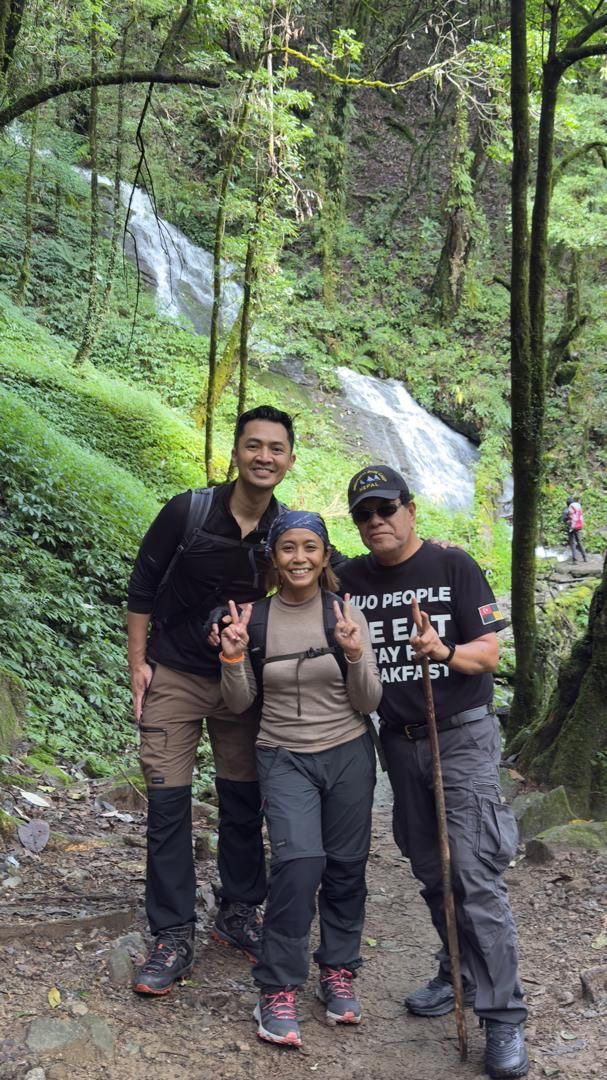
The other tough trek was to Deurali at 3,230m. As the scenery became more stunning, the walks got harder, too.
The next challenge was walking up to Machhapuchhre Base Camp or MBC at 3,700m. It was a strenuous journey. But the mountain – Machhapuchhre – was astounding and considered sacred among the Nepali, therefore making it off-limits to climbers.
Standing at over 6,900m, the mountain is well known for its incredible peak. The name Machhapuchhre means “fish tail” in the language of the Gurung people, the dominant tribe in the Annapurna region.
Just keep going
During our trek, we walked through some of the most stunning natural vistas in Nepal. The scenery was unlike anywhere else I had encountered in my years of trekking.
The Annapurna Base Camp (ABC) had always been on my bucket list. After successfully trekking Langtang Valley (4,773m) in Nepal in 2024, the ABC was naturally the next challenge for me.
I took on the Langtang Valley when I was almost 70. So, the ABC at 4,130m sounded doable.
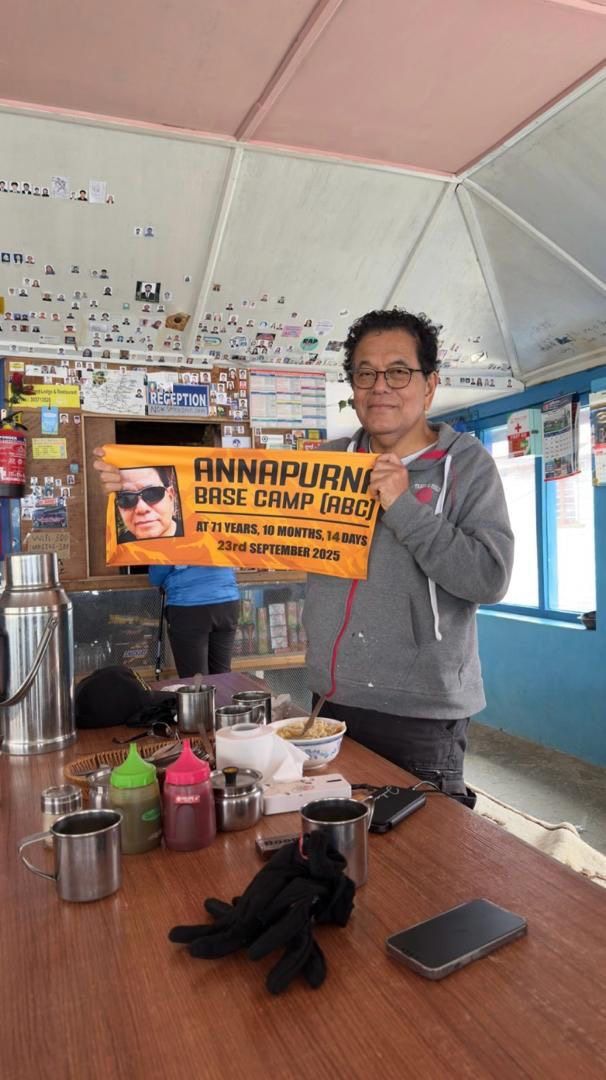
Hidden in my bag was a piece of cloth that I had earlier commissioned for printing back home. Printed on the cloth were the words: “Annapurna Base Camp (ABC) at 71 years, 10 months, 14 days, 23 September, 2025”.
I didn’t tell anyone about it. I knew the odds. And I could falter – at my age, sheer exhaustion could overwhelm me. I could succumb while climbing to cerebral edema (swelling of the brain caused by fluid accumulation) or pulmonary edema (excess fluid build-up in the lungs).
Or worse.
But when we made it all the way to the ABC that Tuesday morning, I was proud to show off my little banner.
We had gone through our final four-hour gruelling walk from the lodge. Behind us was the beautiful Machhapuchhre mountain, while in front of us stood the majestic Annapurna peaks (at least three of the six) and other equally grand mountains.
The walk was slow. Each one of us could feel our oxygen reserves depleting. In the first hour or so, we rested every few hundred metres. The laborious routine got easier as our lungs were accustomed to the thinning air.
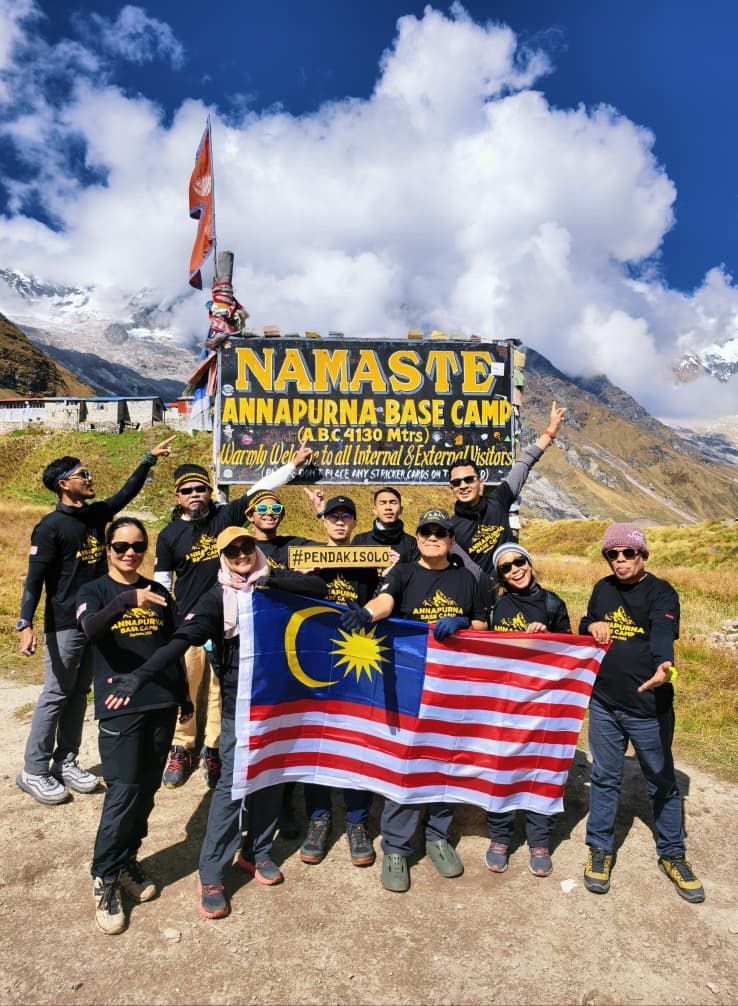
When we finally got to our final destination, we stood proudly under the signpost that read: “Namaste, Annapurna Base Camp (ABC) 4130”.
We certainly came a long way that morning. It took us six days and 182,149 steps to get here.
I had never felt so proud in my life!
Johan Jaaffar is a National Journalism Laureate and an avid trekker. He has trekked in many places, most notably Indonesia, Britain, Nepal, and of course, Malaysia.
This is the first of a four-part series. You can check out the remaining articles online (Lifestyle/Travel) from Feb 16.