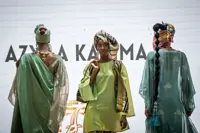
As Earth Day, on April 22, rolls around each year, fashion brands the world over spotlight eco-conscious materials, reduced waste and lower carbon footprints.
Increasingly, the conversation is shifting beyond the environment to how responsibility in the industry is measured, not just in emissions saved, but in how livelihoods are impacted.
According to the Department of Environment, Natural Resources and Environment Sustainability Ministry, Earth Day started in the United States in the 1970s and is an annual event observed by 192 countries.
Its purpose is to raise awareness and involve the public and businesses in efforts towards the preservation and conservation of the environment, as well as advocating for policy changes to protect human health and nature.
Frameworks developed by various organisations have emerged as one way to quantify a business’s impact across environmental, social and governance (ESG) factors, including the United Nations Global Compact and Global Reporting Initiative, which outlines how companies disclose their impact, while standards like the Global Organic Textile Standard and Fairtrade International focus on materials and labour.
B Lab’s B Corp certification is an independent, international standard that evaluates how a company operates beyond profit.
Businesses must undergo a rigorous audit to show that workers are paid fairly, materials are responsibly sourced and waste is monitored.
Building systems around people
The rise of certification frameworks has been more pronounced in Western markets.
French luxury label Longchamp, for instance, announced this year that they had achieved B Corp certification, signalling a shift towards more transparent and accountable business practices.
Similarly, British brand Mulberry has positioned its certification as part of a broader strategy encompassing responsible sourcing, carbon reduction and circular design.
In Malaysia, homegrown brands are increasingly setting their sights on achieving globally-recognised ESG goals.
For Amy Blair, founder of B Corp and Kuskop-certified (Entrepreneur Development and Cooperatives Ministry) The Batik Boutique, the starting point was the realities faced by the people behind the craft.
“Batik is beautiful, but the reality for many artisans is unstable income and limited opportunity,” says Blair, whose company has partnered with over 500 artisans to date.
“I didn’t want to build a brand that simply sold their work; I wanted to build one that changed their trajectory, ability to grow in their designs and scalability and highlight what is unique about Malaysian batik globally.”
“We track how many artisans we work with, whether their income is growing and whether they have consistent orders – not just one-off projects,” she explains.
Read more: Second-hand fashion, but make it famous: When celebrities sell their clothes
Similarly, Sasibai Kimis, founder of Earth Heir and the Earth Heir Collective, frames sustainability as a question of stewardship.
“Our name comes from ‘Waris Bumi’ – the idea that we are all heirs of the earth and we are responsible to be good stewards of the environment, people and resources of this planet,” says Kimis, who works with refugees, indigenous artisans, rural women and differently-abled communities.

To ensure these commitments are more than aspirational, the organisation tracks metrics such as income growth, livelihoods supported and order consistency, while undergoing external audits – including B Corp certification and the World Fair Trade Organisation for the Fair-Trade guarantee.
“By aligning our day-to-day decisions with these metrics, responsibility becomes a lived practice rather than a stated value,” Kimis says.
The reality behind certification
While these frameworks provide structure, aligning with them is rarely straightforward, particularly for smaller businesses.
“The biggest challenge was moving from a very human, relationship-driven way of working into something more structured and measurable,” Blair says.
“When you’re a smaller, purpose-driven brand, a lot of things are done instinctively – but frameworks like B Lab ask you to prove it, document it and improve it.
For the brand, this has meant rethinking supply chains: prioritising partners based on shared values rather than cost, investing in training and accepting longer lead times in exchange for greater transparency and impact.
In Kimis’ case, working across a decentralised network of artisans, social enterprises and NGOs requires not only shared standards, but also the systems to monitor them.
“Many of our practices – such as fair payment, community engagement and ethical sourcing – were already in place, but translating these into structured policies, measurable indicators and verifiable data was a significant challenge,” Kimis says.
She adds, “One of the most demanding aspects remains data collection across a decentralised and diverse network – both at the artisan level and across partner organisations. This has pushed us to strengthen internal systems, improve documentation, and invest in capacity building.”
Beyond the environment
If sustainability has traditionally been framed through an environmental lens, both founders are clear that the conversation must extend further.
“For us, sustainability begins with people. Dignity in work is important, as is income,” says Blair.
This means providing consistent orders, investing in skills development and building long-term relationships with artisans – some of whom have gone on to significantly increase their income and take on leadership roles within their communities.
At Earth Heir, the approach is similarly people-centred, but operates across a broader ecosystem.
Artisans and partners are treated not simply as suppliers, but as valued collaborators – supported through training programmes, design development and access to markets.
“In practice, this means fair and transparent pricing, consistent orders and helping our partners grow in confidence and independence,” says Kimis.
Read more: What does 'clean' mean in haircare? A beauty buzzword decoded for today
Beyond income, they focus on long-term empowerment through building confidence, preserving cultural heritage and supporting pathways to financial independence through their micro-entrepreneur training programme.
“Here we help train other artisans and micro-entrepreneurs on product development, pricing, circularity, storytelling, branding and packaging, retail and production management – with the clear intention to help them improve market access so that they can stand on their own.
The organisation also integrates environmental responsibility into its operations, tracking energy usage, reducing plastic packaging and introducing circular initiatives – such as upcycling returned products into new items.
While globally, fashion brands are increasingly turning to certification frameworks to formalise their commitments, back home, ESG goals are slowly but surely becoming non-negotiable and central to brand operations.