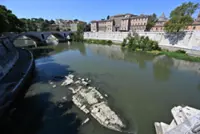
Nero's Bridge has come back. If you don’t know Nero’s bridge (I didn’t), it is an ancient Roman crossing near St Peter’s Basilica.
Good news! It has re-emerged from the water of the Tiber River this month. The bad news is it didn’t re-emerge out of the water because it decided on a comeback tour, it re-emerged because water levels have got so low in the Tiber we can see the bridge again.
And this isn’t the only place water levels are getting ridiculously low and revealing ancient sites.
In Spain, the Dolmen of Guadalperal, an arranged circle of roughly 150 granite stones dated, arguably, as far back as 5,000 BCE – which would make the circle older than Egypt’s pyramids and older than England’s famous stone circle, Stonehenge – has become visible four times in recent years because droughts have lowered the reservoir they are in.
In China in 2022, water levels in the Yangtze River fell far enough to expose the submerged island of Foyeliang, revealing three Buddha statues roughly 600 to 700 years old.
In Serbia, receding water in the Danube exposed the wrecks of German warships sunk in 1944 during WWII near the town of Prahovo. Several are still loaded with explosives.
So that is the current state of European and Asian archaeology. We are recovering neolithic temples, Ming dynasty Buddhas, sunken Nazi fleets and live ordnance, and none of it is because anyone went looking. The water simply left.
The reason all of this is happening at once, across regions with completely different geographies and climates, is not complicated, and I am not going to pretend it is.
A warmer atmosphere holds more moisture and pulls it out of soil and rivers faster. Higher temperatures increase evaporation from reservoirs. Rainfall patterns are shifting so that precipitation arrives in heavier, shorter bursts with longer dry stretches in between – which is significantly worse for river levels than steady rain, because rivers need consistency, not volume. And in mountain-fed systems like the Rhine and the Po rivers in Europe, reduced glacier melt and thinner snowpack mean there is simply less water arriving in summer.
What all this adds up to is that the historical baseline is gone. The climate models we built, the flood plains we mapped, the reservoir capacities we planned around, the assumptions about what a river does in August – all of that was constructed from a range of historical conditions that no longer describes the world.
We are not experiencing unusual weather within a known range. The range is unknown, what is happening to climate in our world is unprecedented. Nero’s Bridge is visible because the Tiber is doing something the Tiber was not previously understood to do.
We have always been good at leaving warnings. The Hunger Stones in Europe are a good example of that. They are rock markers in Central European riverbeds that are only visible in droughts. They were carved as far back as the 15th century and carry infamous inscriptions like “If you see me, weep”. Because it doesn’t take a lot of knowledge to know that low water levels are disastrous for most human societies.
The Hunger Stones are proof that a civilisation without instruments or data or climate science understood the situation clearly enough to carve it into rock for the benefit of strangers. We are good at warnings. We’re just bad at taking heed of them.
Climate scientists have been warning us for decades. But we did nothing, or if we did anything at all it was very little. And now every year the record breaks again – hottest summer, worst fire season, lowest river, fastest glacial melt – and every year we treat it as weather or odd news rather than what it is: unequivocal proof that the climate is changing. Fast.
But these warnings become like everything else in our society. Noise. Another news headline to read and shake your head at before moving onto the next new headline you shake your head at. Rinse, repeat, until you go to sleep and wake up to do the same.
Look, it’s great that all these old Buddhas and bridges are resurfacing for people to study and rediscover. It’s incredible the history was preserved in the water. I would just prefer we were finding them with equipment rather than with climate change-induced drought.
Avid writer Jason Godfrey – a model who once was told to give the camera a ‘big smile, no teeth’ – has worked internationally for two decades in fashion and continues to work in dramas, documentaries and lifestyle programming. Write to him at lifestyle@thestar.com.my and follow him on Instagram @bigsmilenoteeth and facebook.com/bigsmilenoteeth. The views expressed here are entirely the writer’s own.