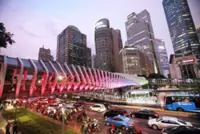
I recently went to Jakarta for a short holiday, but I have to admit that if I had done proper research beforehand, I might have been a bit concerned about the trip.
There had recently been quite a few stories in the newspapers about crime in Jakarta. In May, a Polish tourist’s bag was grabbed by a motorcyclist in the Kebon Sirih area. A week later, an Italian tourist had his mobile phone snatched, again by a motorcyclist, in Menteng. Both of these happened near some major tourist attractions, about 1km away from our hotel.
If I dug a little bit further, then I would also have found out that in 2015, Jakarta was ranked the ninth least friendly city in the world.
Of course, the reality was not like that at all.
Maybe it was because we were really distracted by eating – the food was very good. And there were nice malls and user-friendly public transport for most of the places we wanted to go, as expected of every modern metropolis.
The only time I perhaps felt unsafe was when our taxi navigated the “jalan tikus” at an impressive speed, apparently in an attempt to escape a sequence of ever-narrowing back roads.
We never saw anyone suspicious or dangerous in our path. My daughter, meanwhile, had her own theory about the motorbike thieves: Maybe they don’t do it nowadays because if they snatch your phone, they would just end up stuck in traffic.
Because traffic in Jakarta feels like a collective state of emergency. Everyone seems to be going somewhere, immediately. One article I read described it as people running while buses crawled. And it’s not a joke. During the Friday rush hour we saw a crowd literally sprint from the exit of one Transjakarta bus to line up at the entrance of another.
Despite this chaos, the public transport pretty much ran as it should. Some bus stops were built almost like train stations, properly sheltered with safety doors at entrances. My wife, who was watching all this with the eye of someone who lives in the Klang Valley, asked “Why can’t KL do this?”
Kuala Lumpur has tried bus lanes too, although not always with quite the same enthusiasm. Jakarta’s need for an efficient bus system might be more pressing, given that some roads even restrict traffic according to whether your license plate is odd or even on a given day.
Still, the overwhelming feeling I have about Jakarta is that of people hustling to survive, if that makes sense.
It’s an idea that is partly supported by the statistics. Jakarta attracts young adults looking for universities, first jobs, and opportunities. But while the young are moving in, those who have already found financial stability are moving out. Between 2017 and 2022, around 212,000 mig-rants moved into Jakarta. But almost 800,000 people moved out, producing a net deficit of roughly 585,000 people.
It’s true that Jakarta is crowded and polluted, and full of very heavy traffic, while housing and green spaces are limited. On top of that is the rather serious problem that the city has been sinking, and Indonesia is shifting its capital to Nusantara on the island of Borneo.
If you look only at the numbers, Jakarta starts to look like a place from which everyone should be preparing to escape. Why hasn’t the entire population hadn’t already packed its belongings and moved away, I began to wonder.
Then I saw Jakarta on the weekend. On Saturday, the area around Gelora Bung Karno Stadium was full of families enjoying themselves as they chilled out. The MRT and LRT also felt completely different from the picture I had formed from weekday traffic. They were much less congested and much more orderly.
Kota Tua was packed. Street vendors were lined up in rows, and people were eating, promenading, and generally enjoying the weekend.
There is a difference between a city being crowded because millions of people are desperately trying to get somewhere else, and a city being crowded because that’s where people want to be.
And then there was that Grab driver who I had to run after to catch because she had gone down the wrong side street to pick us up. She was very sympathetic to our sweaty and haggard family, and offered to stop by the road so we could grab a refreshing glass of es jeruk (iced orange juice).
Who stops to be that considerate if everyone is really just rushing around to keep their place in a rat race?
Suddenly that old ranking describing Jakarta as the ninth least friendly city in the world seemed tunnel-visioned and not taking account of the larger picture. A survey can measure something real without capturing everything correctly.
Perhaps many things can be true at the same time. A city can have criminals, and yet feel perfectly welcoming to a family visiting for a weekend.
These days, we increasingly experience the world through other people’s descriptions of it. We watch an influencer tell us where to eat, which countries to travel to, and whether a city is worth visiting or not.
We know what everybody else thinks about something, but that hasn’t necessarily made us better at understanding the thing itself.
The truth is, no matter what you read and see through the narrow scope of your phone, you still don’t really know what something is going to be like until you experience it yourself, first hand.
Logic is the antithesis of emotion but mathematician-turned-scriptwriter Dzof Azmi’s theory is that people need both to make sense of life’s vagaries and contradictions. Write to Dzof at lifestyle@thestar.com.my. The views expressed here are entirely the writer’s own.