Recently, I had the opportunity to visit the Lembah Bujang Archaeological Museum in Kedah. It is packed with some very interesting history dating back to around the third century CE, with exhibits showcasing artefacts unearthed from sites across the valley, alongside reconstructed remains of ancient candi (temples).
However, between the lingam and yoni, the iron ingots and glass beads, I found a glaring omission: Merong Mahawangsa. I should quickly interject, and say “the legendary Merong Mahawangsa”, not “the historically accurate and evidence-backed Merong Mahawangsa”.
For the unfamiliar, Merong Mahawangsa was a warrior descended from Iskandar Zulkarnain (identified in Malay tradition with Alexander the Great) who embarks on an adventure involving a Roman prince, a Chinese princess, a giant garuda, a magical arrow, and ultimately the founding of a kingdom in the region associated with Langkasuka, of which the Bujang Valley is a part.
It’s obviously a legend. But it’s also a great story. What if we could put it on film with a handsome lead actor and turn it into a billion dollar blockbuster?
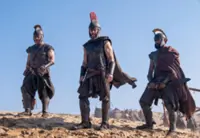
Well, we tried. Back in 2011, Hikayat Merong Mahawangsa (released internationally as The Malay Chronicles: Bloodlines) starred Stephen Rahman Hughes. It featured large-scale battle sequences, international actors, elaborate costumes, and visual effects. At the time, it was the second most expensive Malaysian film ever produced, and went on to win several honours at the 24th Festival Filem Malaysia, including Best Film.
And yet, I feel the movie has failed to become a classic. I rewatched it for this article: the fight scenes are still great, and Rahman Hughes is a worthy leading man. Yet the impression it makes doesn’t really last.
Why is it so difficult to turn an ancient legend into a modern classic?
I see some parallels with Christopher Nolan’s The Odyssey currently showing in cinemas. He too adapted an ancient epic that modern audiences should already be very familiar with. But he is making the effort to show us his version of this story. In doing so however, Nolan takes liberties with the story.
Prof Emily Wilson, whose English translation of The Odyssey appears to have informed Nolan’s adaptation, points out that Homer’s Odysseus is someone defined as much by his ingenuity as by his courage. This is the man who conceives the Trojan Horse, builds a seaworthy raft from the wreckage of his ship, and even constructs his own marriage bed around the trunk of a living olive tree. However Nolan’s version is wracked with guilt and tries to rely on brute force instead.
I put it to you that all this doesn’t matter. The fact that the movie version doesn’t hew closely to the original does not demean either version.
Historically, the legend of Odysseus was not some text laid down in concrete and stone, but instead a mishmash of oral tales finally written down hundreds of years later. So who’s to say what’s accurate and what’s not?
And that ability to adapt to suit new audiences has kept The Odyssey alive, from Euripides’ Helen, to James Joyce’s Ulysses, to Joel and Ethan Coen’s O’ Brother Where Art Thou.
So Nolan uses The Odyssey as a way to share his feelings and thoughts about war and how it represents a moral failure of civilisation. It’s a message that takes the triumph of sneaking soldiers in by the Trojan horse as an aberration of morals. Does winning the war excuse the unethical machinations behind it?
I mean, he could have written it as an essay, but instead chose to spend US$250mil (RM1.22bil) and three months to film it. I can respect that.
I feel that Hikayat Merong Mahawangsa couldn’t find the idea to resonate with its audience. What is the thing that is happening now (or at least in 2011) that we can understand better through the lens of this legend?
I think if you take the effort to make the audience chew a bit on the story, and if they can digest it, they will be rewarded by the effort, and more importantly, they will feel something substantial when they think about it.
Legends, by their very nature, are usually simple. They need to be memorable because they were designed to be retold. Their complexity often lies beneath the surface, either in the values and ideas they communicate, or in the context of how the stories were told to their audience.
The Hikayat Merong Mahawangsa, compiled in the 18th century as the Kedah Annals, presents Merong Mahawangsa as the legendary founder of the dynasty from which the Kedah sultans trace their lineage. According to the chronicle, Sultan Muzaffar Shah, the first Muslim ruler of Kedah, is a seventh-generation descendant of Merong Mahawangsa. The lineage of rulers from him remains unbroken to this day, with at least 29 Kedah sultans up to the present. And by legend, they are all descended from Alexander the Great. This is the context of the story then.
While archaeology can preserve the structures and museums house the artefacts for posterity, legends survive because we continue telling them. And they don’t have to be strictly the same as they have ever been. They just need to be relevant and entertaining enough for the next generation to want to retell it.