
A rare Hawaiian bird uses its distinctive curving beak in ways unlike any other living creature, according to a new study.
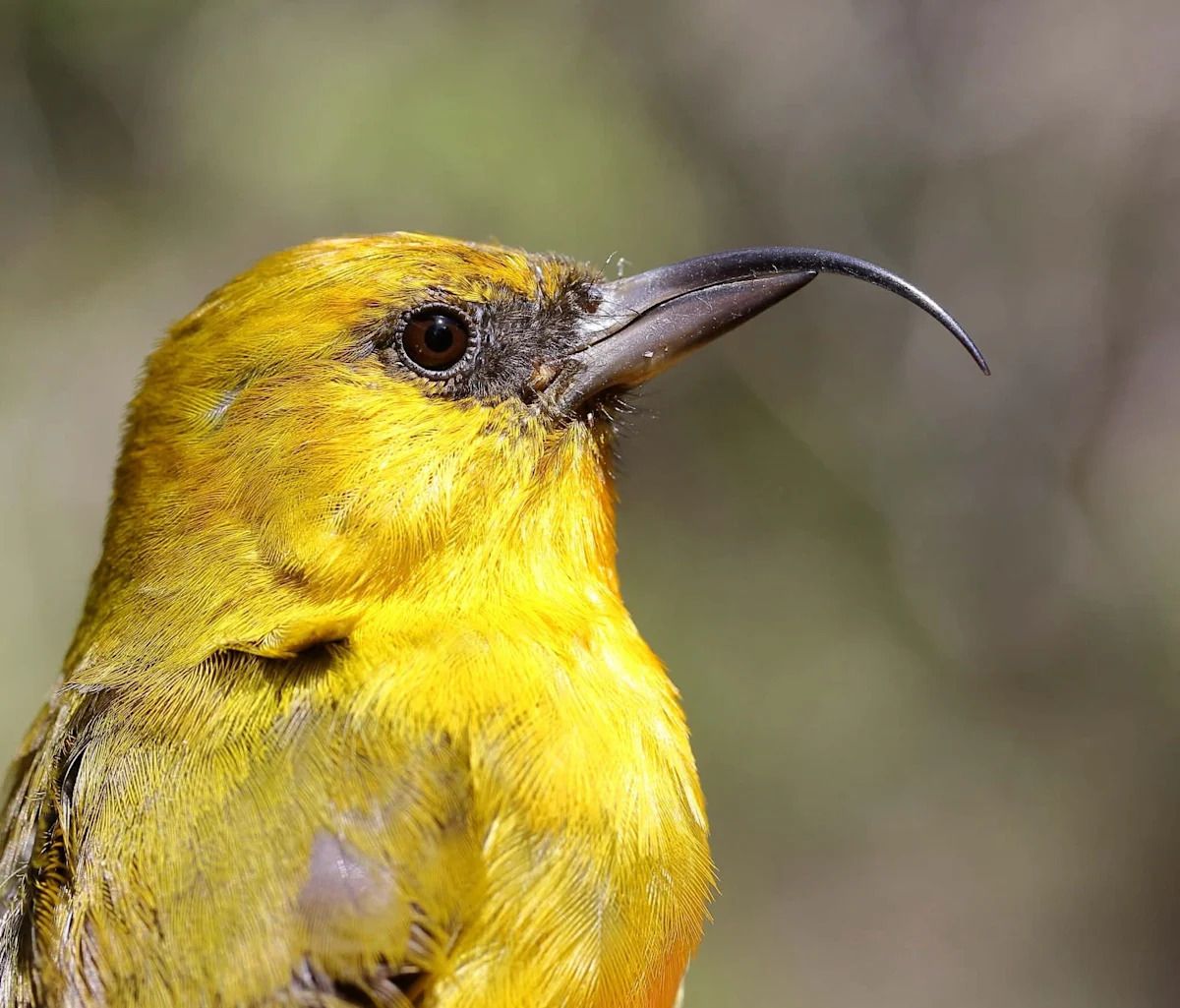
The beak of the bright yellow Akiapōlāʻau is narrow and long at the top, short and sturdy at the bottom, as though the beaks of two different birds had been joined together to form one.
The upper and lower beaks differ so markedly from one another that they function like two separate tools, says researchers writing in the journal Ornithology.
That has earned the Akiapōlāʻau the nickname the "Swiss Army knife of the Hawaiian Islands."
"The Aki is unique from every other bird that has ever evolved, and not just in Hawaii - it has features unseen in any birds," says lead author Alexander Clark of the Field Museum and the University of Chicago.
The small yellow bird's upper beak is long, slender and flexible, making it ideal for fishing larvae and caterpillars out of small crevices and holes in branches.
Its lower beak is short and sturdy, and the bird uses this part to chisel holes in wood.
'Swiss army beak' drills for food
By deploying both parts, the Aki manages to occupy a niche similar to that of woodpeckers - which never made it as far as the Hawaiian Islands.
"For a bird like the Akiapōlāʻau to have evolved, there must have been intense competition within the ecosystem,” says co-author Paul Banko, a former researcher at the USGS Pacific Island Ecosystems Research Centre in Hawaii.
As islands emerged from the water, there was a sharp increase in animal species and a great deal of competition - and it was in the course of this that the Akiapōlāʻau came into being.
When seeking insects, the birds first peck holes in the wood with their lower beak and then probe with their upper beak for prey, which they then pull out.
Using whole body, like forestry worker
The researchers discovered that the little bird uses not only its lower beak but its entire body when hammering.
Thanks to a relatively large tendon attached to a muscle that flexes the ankle, it is able to move its body downwards quickly and powerfully.
Woodpeckers primarily use their neck muscles when hammering - the Aki, on the other hand, utilises the full momentum of its body, starting from the feet.
"Basically, it’s like splitting a tree trunk with an axe: you use your whole body," says Clark. "You stand up straight, almost on your tiptoes, and then take a swing."
The Aki works exactly the same way. Among the bird’s distinctive features are wings and thigh bones that are proportionally shorter than those of its mainland relatives, a trait that reflects the evolutionary history of woodpecker species. The birds tend to hop through the treetops rather than fly.
Species under threat
The birds build open cup nests, often in ‘ōhi‘a trees. They usually lay one, rarely two, eggs and females perform all incubation and brooding. Males provide females and nestlings with most of their food.
Only one fledgling is produced per year, and the chicks have a long period of parental dependency, usually four to five months. Family groups consisting of newly born and 1-year-old chicks have been observed.
As unique as the Hemignathus wilsoni may be, it too is threatened with extinction. There are fewer than 2,000 individuals living in the wild, according to estimates, the Field Museum says.
"They all live on the north-eastern slope of a single mountain on the island of Hawaii.”
The island of Hawaii is the largest island in the archipelago and gave its name to the chain of islands in the Pacific.
Many of the species living on the Hawaiian Islands are found nowhere else in the world, Clark says.
The island chain offers astonishing examples of evolution and unique adaptations, yet its extreme isolation also leads to great vulnerability.
The native terrestrial species of the Hawaiian archipelago have been in decline for centuries, and extinction rates have risen in recent decades. – dpa