Contradictheory: The beautiful game is big business


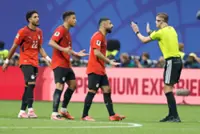
Egypt's Mohamed Salah (10) talks with referee Francois Letexier, of France, during the World Cup round of 16 soccer match between Argentina and Egypt in Atlanta, Tuesday, July 7, 2026. (AP Photo/Erik S. Lesser)

Malaysians were excited to see actor Mark Wahlberg in Penang in the middle of July 2026. In between filming scenes at City Stadium and Batu Kawan Stadium, the actor was also spotted seemingly casually lepak-ing at a mamak shop, which many locals seemed even more excited about.

Yet I wondered how many people realised he was in town filming The Big Fix, a movie based on the true story of Chris Eaton, the former FIFA security chief who helped expose a global football match-fixing network.

Already there have been many scandals generated by just over a month of World Cup 2026 football, culminating in the July 20 final (in the wee hours for Malaysia). It feels as though not a single day has gone by without somebody, somewhere, being outraged by a refereeing decision.

One of the biggest controversies came in Egypt’s match against Argentina on July 7. Egypt thought they had taken a 2-0 lead, only for the goal to be ruled out after officials decided an Argentine player had been fouled much earlier in the build-up. The Egyptians did eventually score another to establish a two-goal cushion, but Argentina somehow produced three goals in the final amazing 15 minutes to win 3-2.

And yes, there was an Argentinian goal when the Egyptians claimed their player was fouled in the buildup. After the match, head coach Hossam Hassan claimed he would "never watch the World Cup again, because there’s no justice in this competition”.

Of course, football supporters have been complaining about referees for almost as long as there have been referees. The World Cup has produced more than its fair share of angry curses.

In 1986, Diego Maradona famously punched the ball into the net against England, and the goal stood. In 1994, Italy’s Mauro Tassotti elbowed Spain’s Luis Enrique so hard he broke his nose but escaped punishment during the match. In 2010, a shot by England’s Frank Lampard against Germany clearly crossed the goal line before bouncing out, yet play continued.

These and countless other controversies eventually led FIFA to introduce the Video Assistant Referee (VAR), allowing officials to review incidents using video replay. Finally it isn’t only the fans shouting at TV screens watching slow-motion replays shouting, “How can you not see that, ref?!!”

Except, of course, football being football, VAR has hardly ended the arguments. The Egyptian goal was disallowed because VAR intervened. The disputed Argentine goal stood because VAR did not intervene. Instead of eliminating controversy, VAR has been proving what IT guys always say: It’s not the technology, it’s the people using it.

There is a large amount of subjectivity in assessing video evidence. A surprise perhaps to FIFA, though not if you’re in a group of rowdy friends watching football at the mamak shop. One can only imagine what a gritty action star like Wahlberg would be like in such a scenario.

It works (or barely works, for some) because ultimately we (barely) trust the referees. Or at least, believe they can improve and do better.

That’s really been the story of modern football governance. Alongside VAR, FIFA has introduced Semi-Automated Offside Technology, using cameras and computers to determine offside decisions, and new measures to discourage time-wasting.

It is interesting that the latter move (where the referee holds up his hand to indicate when they have to play the ball within five seconds) has garnered much less controversy than the measures using IT. But I think that’s almost always the case anytime technology is used.

And in the midst of all this stuff that’s happening on pitch, there are what I think are more serious allegations off it.

Host selection has long been one of football’s most controversial issues. The satirical film Mexico 86 reflects the uncertainty surrounding Mexico's surprise selection over the United States and Canada to host the 1986 tournament.

The 2015 FIFA corruption scandal revealed what US prosecutors described as a 24-year scheme involving bribery, kickbacks, and self-enrichment among senior football officials. A report submitted in 2014 about World Cup bidding included, among many other things, a US$2mil (RM8.16mil today) payment deposited into the account of a FIFA voter’s 10-year-old daughter. A report by the US magazine Tablet states that US$330mil (RM1.35bil) went to 22 people in the runup to the vote for the 2022 World Cup.

By comparison, the 2026 World Cup has been relatively free of allegations surrounding the bidding process itself. But not of other allegations. For a start, should sitting presidents be able to appeal to FIFA presidents to overturn red cards, even if everybody involved denies this happened earlier this month?

More worrying are the allegations of further encroachment of the beautiful game by corporate interests. FIFA’s new demand-based pricing model pushed the cheapest tickets for the 2026 semi-finals and final to around US$1,300 and US$6,700 respectively (RM5,300 and RM27,300). By comparison, official prices for equivalent matches in Qatar in 2022 started at US$137 and US$206 (RM559 and RM840).

Then there are the new hydration breaks, ostensibly to protect player welfare, but remarkably just long enough to insert a few money-generating advertisements.

And there’s the half-time show in the July 20 final, which could extend the traditional 15-minute interval by another 10 minutes. FIFA has emphasised that appearances by characters from Sesame Street and The Muppets are intended to promote the objective of the show: improving children’s access to quality education.

It seems pedantic to lambast FIFA for trying to simply get more money into the sport. However, the body already expects to make US$13bil (RM53bil) over the 2023-2026 World Cup cycle.

And whenever that much money is involved, football becomes about far more than just the world’s best players and the officials on the pitch. It also attracts lobbyists, political interests, con men, corruption investigations – and the odd action star making movies in Penang.

In his fortnightly column Contradictheory, mathematician-turned-scriptwriter Dzof Azmi explores the theory that logic is the antithesis of emotion but people need both to make sense of life’s vagaries and contradictions. Write to Dzof at lifestyle@thestar.com.my. The views expressed here are entirely the writer's own.
Follow us on our official WhatsApp channel for breaking news alerts and key updates!

Next In Living

Wildfire puts Fontainebleau, the 'French forest of kings', at risk
More shelters in the US are making room for four-legged friends
Legendary US steakhouse Smith & Wollensky lives up to its name at first KL outpost
Europe's forests under growing pressure from timber demand and climate change
Living with cats does not worsen asthma in children, study shows
Plantains could be your new best friend, whether baked, fried, or in a curry
How to transform your home into a vacation space with a holiday feeling
Heart And Soul: The romance of routine
Animal rescuer cares for pets and livestock stranded by war in Lebanon
What is 'house wine' and what are the pros and cons of ordering it?

Others Also Read