
Tatiana Ortiz-Rubio learned to question everything. Her mother had a doctorate in philosophy and taught at Mexico’s National Autonomous University of Mexico, and Ortiz-Rubio was around for the conversations that unfolded in the family’s living room, whether those were between family members or students from the university.
“It started there, with knowing how to ask questions, and questioning everything became some of that curiousity that is kind of never ending for philosophers. It became something that I enjoyed, and that’s kind of how they taught me to look at art, as well,” she says.
“To question, ‘Hey, what is this artist trying to look at or experiment with or analyse? What questions are they posing?’ That’s what truly sparked my interest in art, being in that realm of philosophy of analysing and questioning things.”
That curiousity flowed into her parenting, particularly when her daughter was diagnosed with Angelman syndrome, a neuro-genetic disorder that results in intellectual or developmental disability, seizures, issues with balance or fine motor skills, little to no speech and other symptoms.
As their family began navigating her disability, Ortiz-Rubio found that medical and educational professionals were impatient and unkind with her daughter and had begun labelling her child “non-compliant”.
They weren’t taking the time to learn or consider that, one, she’s a child, and two, she’s a child with developmental differences who is unable to speak verbally as a form of communication.
Inspired by Alina
For Ortiz-Rubio, she needed to find a way to challenge the term and the ways it was being weaponised.
Her response is Noncompliant, her solo exhibition which opened on March 14 in San Diego, California, the United States. It explores time as a social construction and the ways that this is incompatible with the realities of crip time. It is a concept credited to Alison Kafer that describes a non-linear, and perhaps slower, understanding of time in which disabled and neurodivergent people may need more time for daily activities that don’t follow a normative schedule.
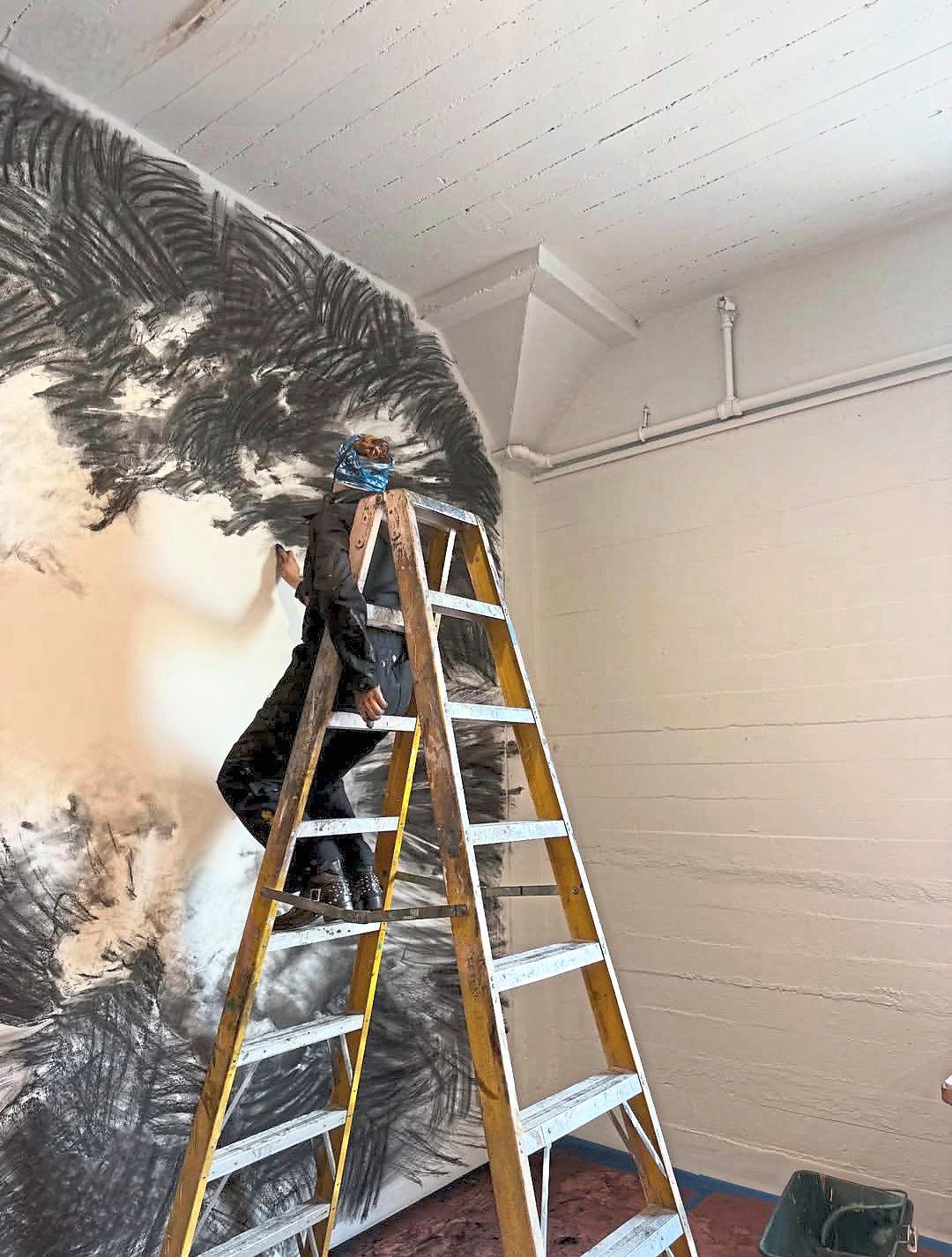
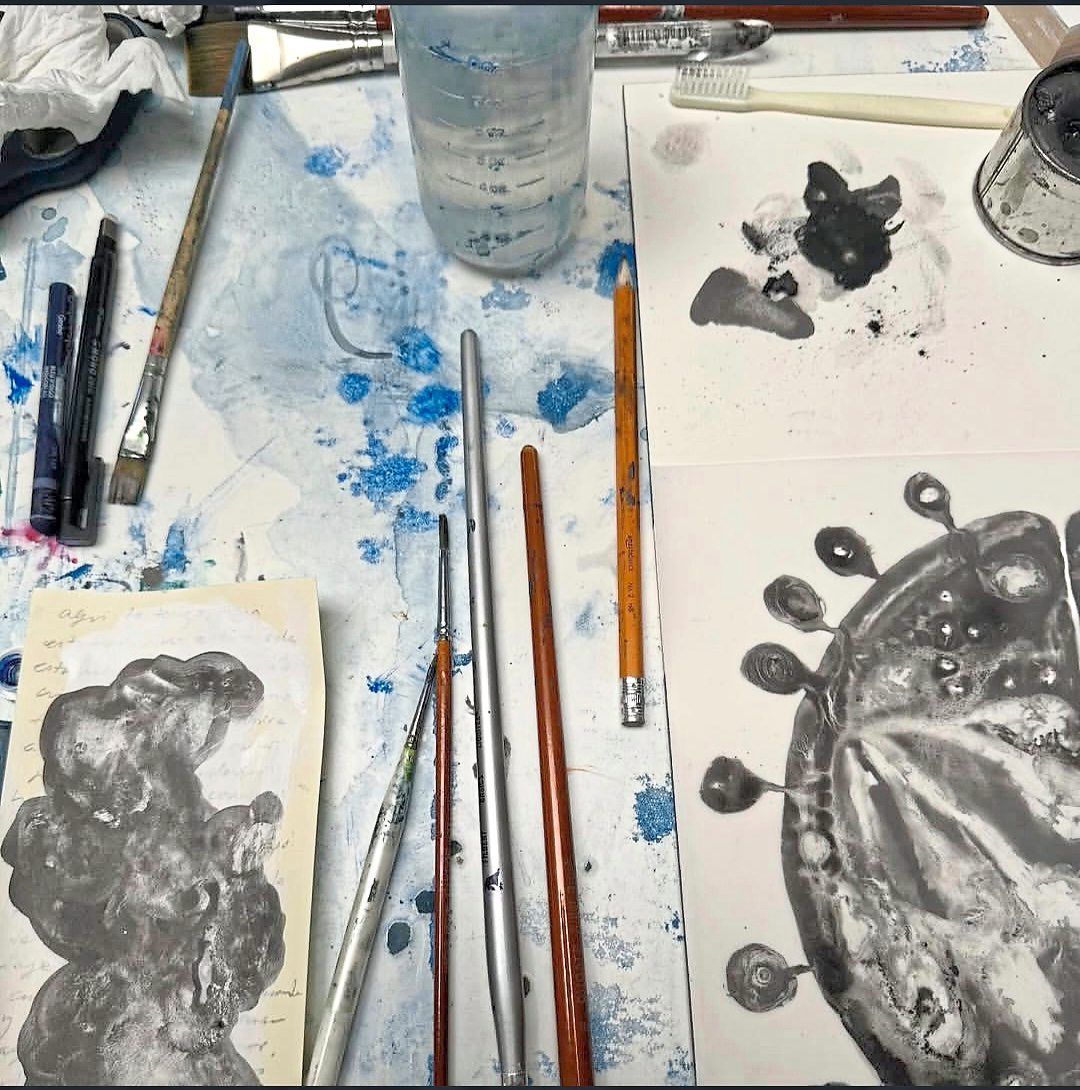
The work in the exhibition includes a large-scale mural done in charcoal, drawings on paper and canvas, and an installation.
Ortiz-Rubio, 40, is a visual artist and an adjunct professor at the University of San Diego who comes from a family of artists – her mother was a dancer with the National Ballet of Mexico, and singer before becoming a professor; her aunts and uncles were talented painters; and her grandmother was a professional pianist.
Today, she shares an art studio in San Diego with her husband, Jose Fernandez de Castro, and they live with their children, Alina and Lorenzo.
She talks about how Alina has helped their whole family look at and understand time differently, to slow down, and to practice empathy and compassion in ways that are more expansive, and she hopes others will interrogate themselves and their ideas around time and normativity, too.
Regarding what inspired her work in Noncompliant, she said: “It’s been gradually growing, but my daughter, who is 10 now, was diagnosed with Angelman syndrome. She’ll need care all her life and I’ve had to be an advocate because it’s quite complicated to get support; there are supports out there, it’s just not very easy.
“Sadly, it requires having the privilege of education and the time to research and do all the things you need to do. When you are like I was, being very biased when you grow up, ableism is so integrated into our education that we don’t even think about it – our jokes about intellectual disabilities, the ‘r-word’ is used so much and people don’t realise they’re being offensive. It’s just so ingrained.”
A platform for advocacy
She says having a child with this diagnosis forced her to analyse all these things and learn to have a new vision of what a life worth living is.
“Her life is worth living. Of course she has the right to take up space in society, as hard as it is. It’s heavy, being a parent of a child with this complex disability in our society means constant advocacy.
“So, this started to make me question time because, with her, we have had to modify our time. We can’t rush her. We’ve accepted, ‘Hey, if we don’t get somewhere, we didn’t get there.’
“We need to make peace with not getting to places, taking twice as long to leave a restaurant or take her to a restroom. She doesn’t sleep, so time at night stretches into infinity for us,” Ortiz-Rubio said.
With epilepsy, that has been a big, big part of her analysis of time, as well, because of her inability to understand what her daughter is going through when she’s having an epilepsy seizure.
“She can’t tell me because she’s not speaking. In my own experience as the caregiver, having to just sit there and all you can do is time it and have emergency meds at hand if it crosses a certain time. This experience of this very intimate relationship with time and how it changes so much with these experiences, is part of what this exhibition is about; it’s about questioning this concept of crip time,” she said.
Ortiz-Rubio shares how the word “non-compliant” is used in medicine and in education to describe someone not doing what someone is requesting.
“If we think about it with neurotypical people, if my son would go to the doctor and say, ‘I don’t want to get a shot’, the doctor would be kind and say, ‘Hey, I know it’s scary. How can we help you? Let’s distract you. Let’s give you a minute’.
“They don’t do that most of the time with people or children with disabilities. They’re like, ‘Hold them still, tie them to the bed, let’s put them under with anesthesia for a dentist appointment’, instead of ‘Hey, let’s figure out some creative ways of supporting’.”

The term “non-compliant”, is like this big term that makes so much noise for Ortiz-Rubio.
“I was reading How to Tell When We Will Die: On Pain, Disability, and Doom by Johanna Hedva, and she talks a lot about crip time and other things. With this book, it made me think that ‘non-compliant’ is actually a word we should take back ownership of because the disability community and neurodivergent have a right to their no, they have a right to say, ‘I don’t want that’.
“It’s agency over their body and their opinions. I’m trying to take back that word and say non-compliant is good, I want my daughter to say no, I don’t want her to follow rules blindly when I’m not around because there could be abuse, so noncompliance, I find, is creative,” she explained.
She added: “People that understand that inclusion is for everyone, they include women at the table, and people from all different races and nationalities, but is the table accessible? Can a wheelchair be there?
“I think of that non-compliance as saying, ‘I’m not going to sit at that table if it’s not accessible to me’, or, ‘I’m not going to go into that room if it’s not accessible, or the people are not understanding that I’m a human being with the same value’.” – The San Diego Union/Tribune News Service