



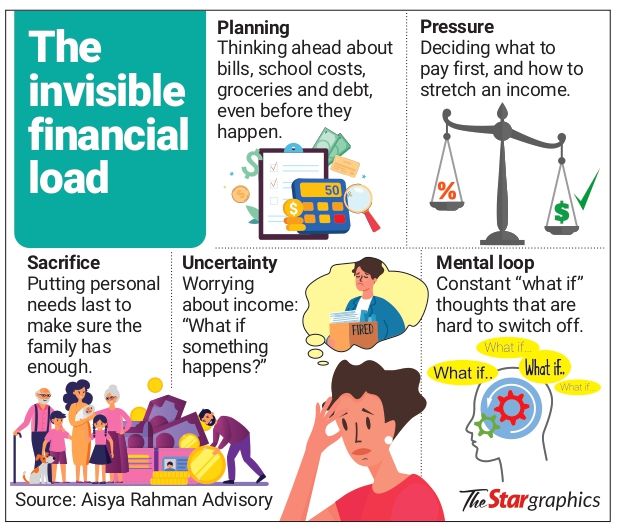
Behind every carefully managed household budget is something rarely discussed: the emotional and mental strain of making sure it all works.
While budgeting may sound straightforward, financial literacy advocate Aisya Rahman says the reality is far more complex.
Although many women are effectively the “chief financial officers of the home”, she notes that the title does not always come with equal support or decision-making power.
“Not every household is the same,” says the co-host of the Financial Saja podcast.
“Some women are sole breadwinners, some support extended families, and some rely fully on their spouses. When responsibilities differ, so does decision- making power.”
What makes it harder, she adds, is not the idea of budgeting – but the implementation.
“The hardest part is the execution, which requires you to sit with discomfort and face the truth as you tell yourself again and again that you don’t have enough,” she explains.
“Who can handle this kind of harsh truth? This is why many women struggle to stick to budgeting.”
Over time, this can turn simple money management into what she describes as “crisis management”, where every decision feels urgent and high-stakes.
Why knowledge matters
Aisya, who founded Aisya Rahman Advisory, says the lack of financial literacy – especially in crisis management – often pushes women away from engaging with money matters altogether.
“This is what mothers today need to learn and champion for themselves,” she says.
“Once they understand basic money management and can tell the difference between right and wrong financial choices, they will start to take financial education seriously.
“Financial education is a need – not a want,” she stresses. “Rich or poor, everyone must learn.”
More importantly, she says, financial knowledge gives women a sense of control – especially in uncertain times.
“Anxiety often comes from trying to predict the future,” she explains. “While we cannot control the future, having financial knowledge helps us feel more prepared for it.”
Among the basics women should understand, she says, are overnight policy rate (OPR), managing debt responsibly, maintaining a good credit score and navigating financial decisions during difficult periods.
But beyond knowledge, she believes financial literacy also shapes the future of the next generation.
“When women understand how money works, they gain a sense of control, and that changes how the next generation grows up,” she says.
Children, she adds, learn more from what they see than what they are told.
Aisya also points out that the environment you are in matters.
“The people around you shape how you think about money – which is why finding the right support system is so important.”
From coping to clarity
True financial empowerment, Aisya says, is not about doing more or earning more.
“It’s about clarity – knowing what you can and cannot do with your money, and making decisions based on that.”
While side hustles can help, they are not always the answer.
“You have to be realistic about your time and energy,” she says. “Sometimes, better money management is more powerful than earning extra income.”
To move from simply paying bills to building long-term security, she emphasises the need for a mindset shift.
“We often romanticise the ‘sacrificing mother’, but there is nothing romantic about being broke and having to depend on your children because you did not plan for your retirement,” she says.
“The kids never asked for posh schools, for example – that was our choice. We must stop sacrificing our retirement savings for a lifestyle we cannot afford.”
Her advice for those feeling overwhelmed is to start by changing perspectives.
“View your bills as an exchange for your goals – the home that shelters your family, the education that supports your children,” she says.
“When your perspective shifts, you move from simply surviving to building something secure.”
