From bejewelled fly whisks to elaborately worked silver and gold ewers, Singapore's Asian Civilisations Museum’s (ACM) latest show is packed with eye-popping objets d’art.
Crosscurrents: Masterpieces Of Mughal, Safavid, And Ottoman Art From The Musee Du Louvre, which runs through Jan 24, 2027, is a curatorial collaboration with the renowned French institution’s Department of Islamic Art.
With more than 100 objects from the Louvre, complemented by 30 items from the ACM’s collection, the exhibition foregrounds the diverse cultural links forged between three great Islamic empires and various other territories, including South-East Asia.
Here are five must-see highlights from the show.
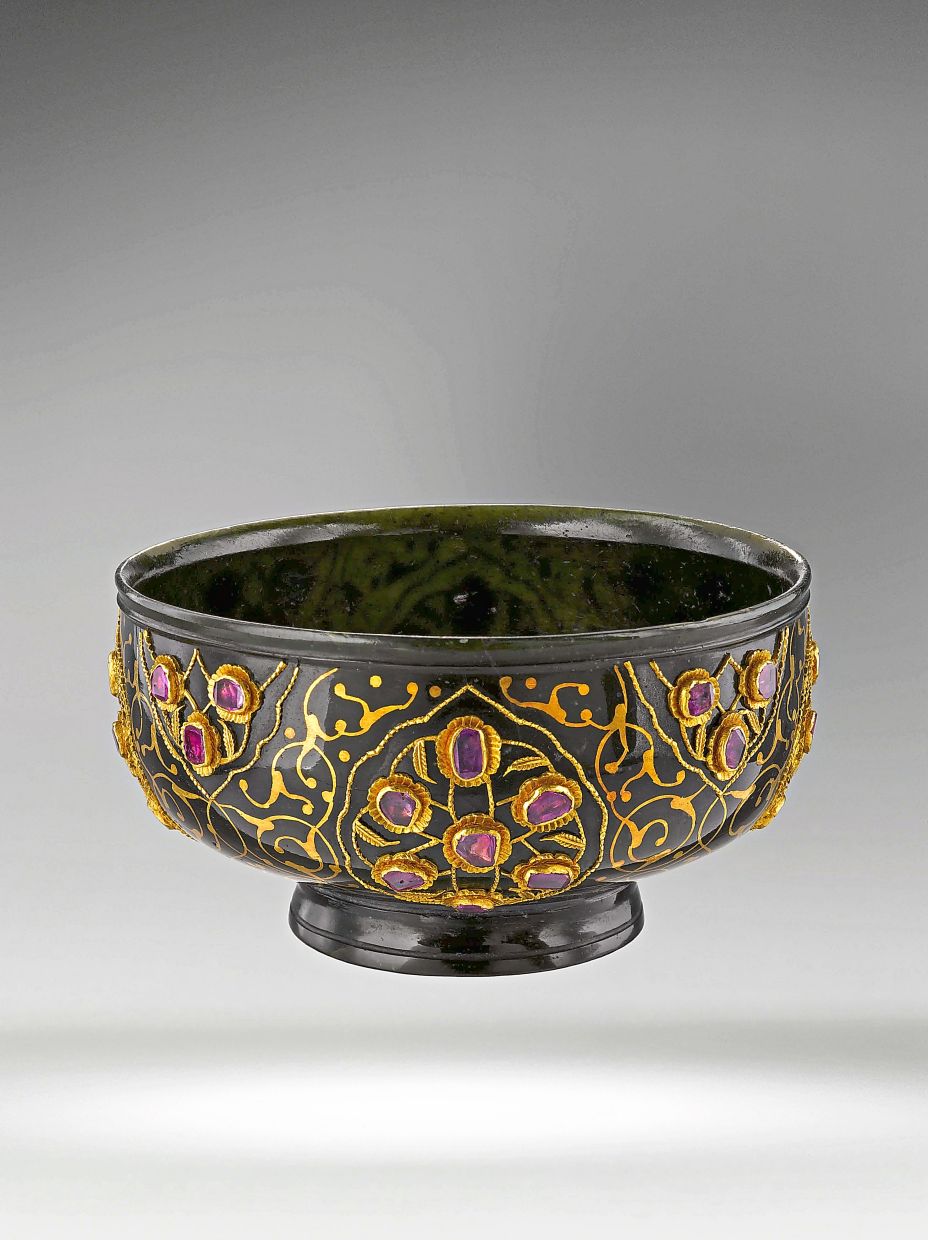
Cup (Jade, gold, rubies; Turkey, mid-16th century; Louvre Museum)
This exquisite cup, which opens the exhibition, embodies the globalisation of the late mediaeval and early modern eras.
It is made of nephrite jade from Khotan, China, an area renowned for its highly prized jade. The cup was probably shaped there before being shipped to the Ottoman Empire, where skilled craftsmen carved it and added the gold inlay. The rubies are from Myanmar, long a source of the precious stones.
It is evidence of the vast sprawl of trade networks that brought such different precious materials to the Ottoman workshops to be turned into this coveted luxury item.
The cup has travelled far since it was made in the mid-16th century. It was in the collection of King Louis XIV (1638 to 1715), the longest-reigning French monarch, before it entered the Louvre in 1796 as one of the first items in its Islamic collection.
Ewer and basin (gilded copper; Turkey, 19th century; Louvre Museum)
This set was presented to a daughter of Sultan Mahmud II, Mihrimah Sultan, when she was eight years old and living in the imperial harem. The Princess would have used this to wash her hands and for ritual ablutions.
While the set looks like gold, it was made using a sophisticated Ottoman gilding technique called tombak, in which gold is mixed with mercury, then brushed onto copper. Fired at a low temperature, objects treated this way have the lustre of gold but are cheaper to make.
The diamond pattern is inspired by European cut crystal.
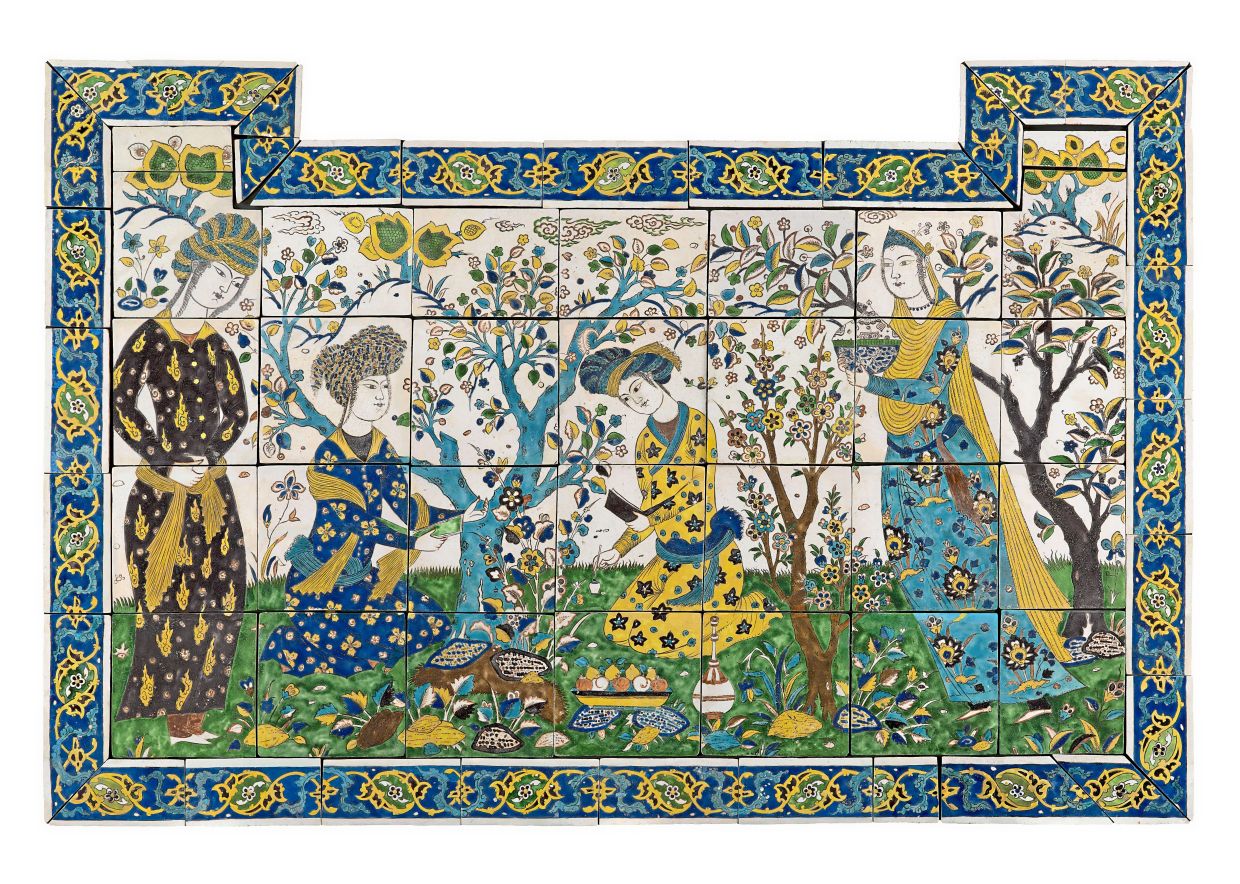
Tiled panel with poetry contest (Glazed ceramic; Iran, mid-17th century; Louvre Museum)
This panel came from a royal pavilion in Isfahan city. Shah Abbas (1587 to 1629), often considered the greatest Safavid ruler, made Isfahan his capital, commissioning buildings which turned the city into a shining example of Safavid architecture.
The decorative panel was made using a technique which looks like painting on ceramic, which was popular in the 17th century. It depicts what Judith Henon-Raynaud, deputy director and chief curator of the Louvre’s Islamic Arts Department, calls a scene of “princely entertainment”, a poetry contest. One figure is holding a book and dipping a pen in a pot. There are dishes laid out, suggesting it is daytime, and a woman is bringing another covered dish, presumably more food for the gentlemen at leisure.
The decorative borders show Chinese influences, especially in the scrolling forms that mimic classic Chinese depictions of clouds. Another set of border tiles in the gallery on Level 3 of the ACM features the same abstracted cloud pattern interspersed with the floral motif beloved of Ottoman courts.
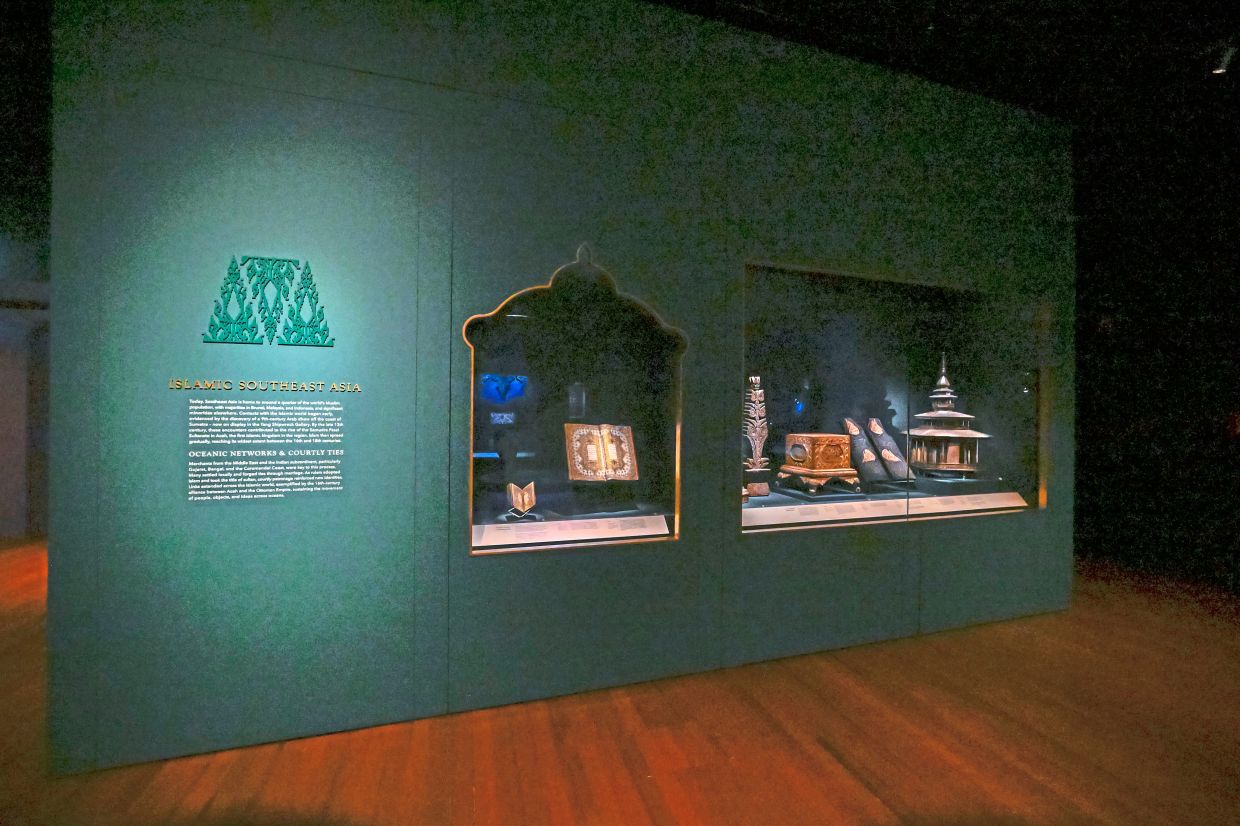
Quran (paper, ink, colour and gold pigments, leather binding; Terengganu, 18th or 19th century; ACM)
This stunning Quran is characteristic of illuminated manuscripts from Terengganu, Malaysia, which had a reputation as a South-east Asian centre for Quranic art.
It was given to the father of a man named Abdul Aziz Mohamad as a reward for the father’s long service at Istana Kolam, Kuala Terengganu, in the 20th century. It is displayed next to an Ottoman Quran, demonstrating the Ottoman influence on the layout where “Surah al-Fatihah al-Kitab” (The Opening Chapter Of The Book) is placed at the start.
However, the colours and the three double-page spreads (at the beginning, middle and end of the book) are unique to South-East Asia.
Noorashikin Zulkifli, ACM deputy director and principal curator of Islamic art, says: “The size of it and the kind of lavishness that has been afforded to the decoration – only royal workshops can command this kind of production. Because of the gold leaf, this is a really expensive object. You’re looking at at least two artists creating the illustration, then there is the bookbinding.”
Given tropical climes which take their toll on organic material, Noorashikin notes it is very rare to have surviving manuscripts such as this Quran, which shows much wear and tear: “To have such a fine example, we are very lucky.”
Dishes and a tankard (glazed ceramic; Turkey, 16th century; Louvre Museum)
This display of three dishes and a tankard spins a story about cross-cultural exchange and trading ties. The items come from Iznik, a town in Turkey famous for producing ceramics for the Ottoman Empire from the late 15th to 17th centuries.
They show an evolution of techniques and motifs. The top dish is blue and white, inspired by Chinese porcelain which was traded across Central Asia and valued by the Ottoman court.
The two dishes in the middle show how artisans developed new colours, from a vivid turquoise blue to a rich mauve. The tankard features the distinctive red that became a signature of Iznik fritware, and the floral motifs of tulips and carnations that were favoured by the Ottoman court. - The Straits Times/Asia News Network