Theatre practitioner Asyraf Syahir Mohd Najib’s latest production Socrates In D# Minor, explores some of life’s biggest questions, bringing the Greek philosopher Socrates’ famous dictum, “The unexamined life is not worth living”, to the KL stage this week.
The experimental work, presented by EJKLS Seni, is set to play at Pangkin@EJKLS Seni, a fringe arts space in Wangsa Maju from Sept 17-20.
Told in four episodes, Socrates In D# Minor takes popular scientific theories such as the Big Bang Theory and the Theory of Evolution as vehicles to explore existential philosophy and the subjective realities of human experience.
Jumping from different points in time and scale, from conception to death and from the microscopic to the cosmic, the 60-minute production asks some of humanity’s oldest questions (why are we here? what makes us human?).
Each episode approaches these questions from different starting points: the first episode, Kisah Fenomena Big Bang (The Big Bang Phenomenon), follows a race towards conception and the inception of the first existential thought, turning the beginning of human life into a microscopic battle for existence.
The second episode, Kisah Teori Evolusi (The Evolution Theory), traces the human evolutionary line, while the third episode, Kisah Paradoks Fermi (The Fermi Paradox) explores psychotic delusions surrounding extraterrestrial life and existential dilemmas.
In the final episode, Kisah Teori Kewujudan Zarah (The Particle Theory of Matter), the play confronts the soul of being and death.
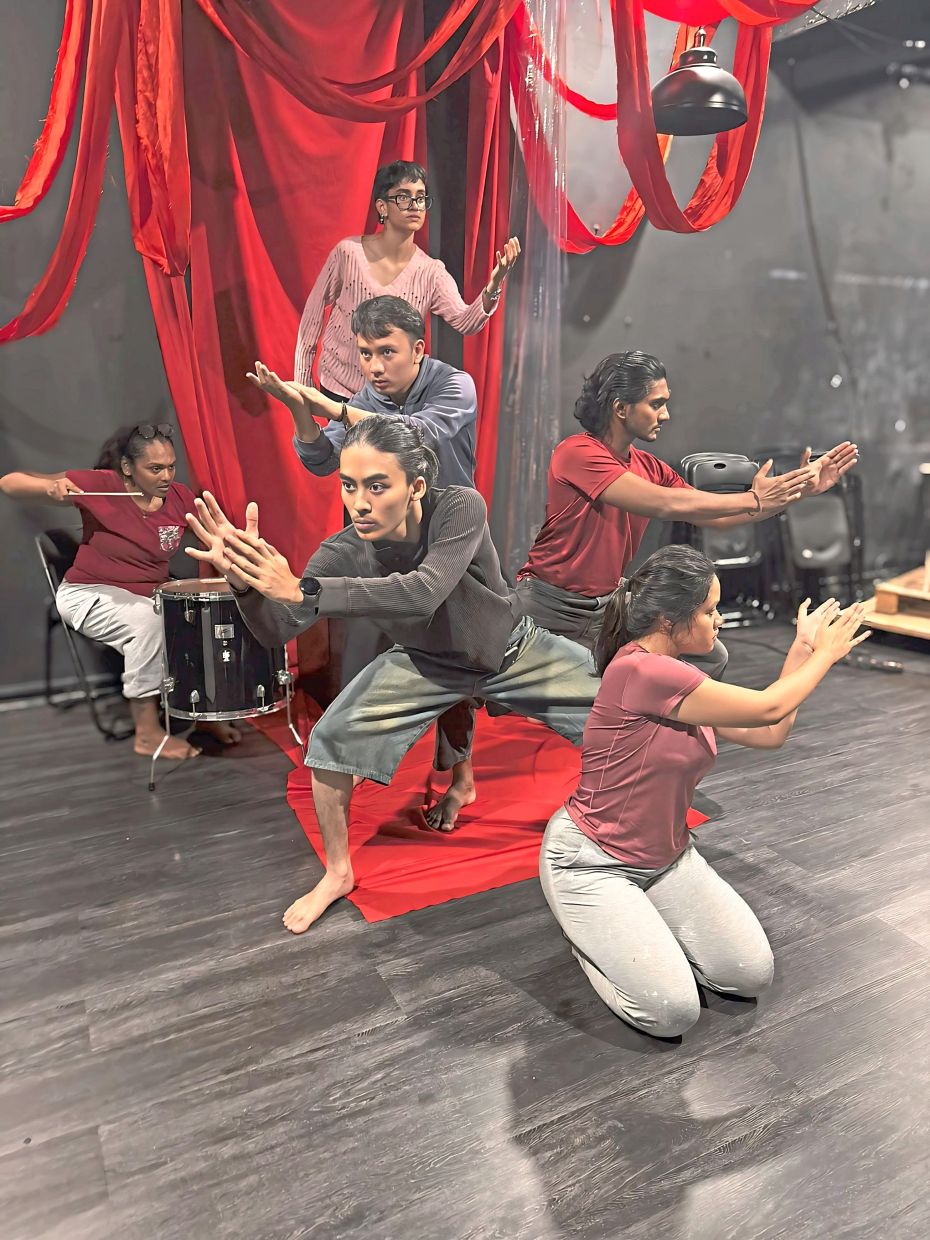
Performed mainly in Bahasa Malaysia, the production brings together a cast of six versatile actors from both the English and Malay indie theatre scenes, namely Nandagopall Mohan, Amaliyna, Ameenol Suhri, Harshini, Eunous Madeonus and Suba Magas.
Reading life differently
Written and directed by Asyraf, Socrates In D# Minor continues his long-standing exploration of faith, mortality, identity and self-discovery through experimental theatre.
The title for the show came to him in a roundabout way.
“I wanted to anchor the title to an existential theorist, but names like Kierkegaard and Sartre felt a bit too on the nose and they have very specific ideas on existentialism,” says Asyraf, 34.
“While my plays are tied to existentialist ideas, I wanted to have the creative liberty to explore my own philosophical standpoints on the ideas. So then Socrates came into the picture. While he’s not known as an existentialist philosopher, I’ve read papers linking his ideas to existentialism principles, so OK, Socrates lah,” he adds, in a candid tone.
As for the “D# Minor” (pronounced “D-sharp minor”), the title was chosen because, in music, it is an enharmonic equivalent of E-flat minor – two scales that use the same notes but are written differently.
“E-flat minor is generally preferred by musicians for being easier for notations and practical readability. So naming it Socrates In D# Minor is my way of saying that the play pushes us to read life in a more complicated manner,” says Asyraf.
One of the biggest challenges he faced in creating the play was turning philosophical theories into stories that could connect with an audience.
“I wanted to build them around human experiences in a way that the audience could understand and relate to,” says Asyraf.
“I think what sets a good story and a great story apart are the thoughts and values embedded within the play, whether it is bringing something novel or thoughtful to the audience. Trying to weave that into my plays will always be a challenge that I like to take up,” he adds.
‘One spatial experience’
Though inspired by age-old theories, Asyraf promises that Socrates In D# Minor won’t feel like a class lecture.
“Putting all the philosophical questions aside, I also want the audience to enjoy the whole theatrical experience we’re bringing to the production,” he says, emphasising that the play’s visual artistry is as important as its intellectual side.
The play will be highly physical, with choreography and synchronised movements playing a key role. Its episodic structure is also something Asyraf is trying for the first time, adding a new challenge for the playwright and director.
“As much as the episodes can stand alone as their own mini playlets, I don’t want the audience to feel as if they are watching four different plays. I want them to feel as if they are taking in one spatial experience with four thematically interconnected arcs.
“I guess this is one of the many ways we try to experiment with all the possibilities of theatre performances,” he concludes.
Socrates In D# Minor will be staged at Pangkin@EJKLS Seni, Wangsa Maju in Kuala Lumpur from Sept 17-20.