Spot checks at school can be memories that torment us every now and then – the panic of having to check or hide anything deemed “out of line”.
At times, the ridicule and punishment for something as simple as missing a barber’s appointment could feel disproportionate.
For Umar Sharif, the memory of being a 12-year-old student remains vivid. He recalls being singled out by a teacher in front of his classmates simply because his hair had grown over the nape of his neck.
Now a full-time artist, Umar revisits those school-day memories in his debut solo exhibition, Salon Hang, at The Back Room gallery in the Zhongshan building, Kuala Lumpur.
The exhibition, which runs through Sept 20, extends Umar’s body of work first presented in Asuhan Dan Dandanan at the Ilham Art Show (2025), and brings together new works made since.
“I see the exhibit as a continued expression of my current self. I have been growing out my hair for a year now and plan to continue doing so, ideally culminating in a mullet with the hair at the back extending below my shoulders. In a way, it is also an homage to my father, who was a 'mat rocker' in his youth and sported quite long, curly locks,” says Umar, 36, in a recent interview at The Back Room.
Umar’s material of choice for mimicking hair is the Malaysian school belt: a regulation strip of polypropylene webbing, in black or dark blue, buckled around the waist of students every morning since the national school uniform was introduced in the early 1970s.
Much like discovering and developing one’s personal style, transforming the material requires considerable time and effort.
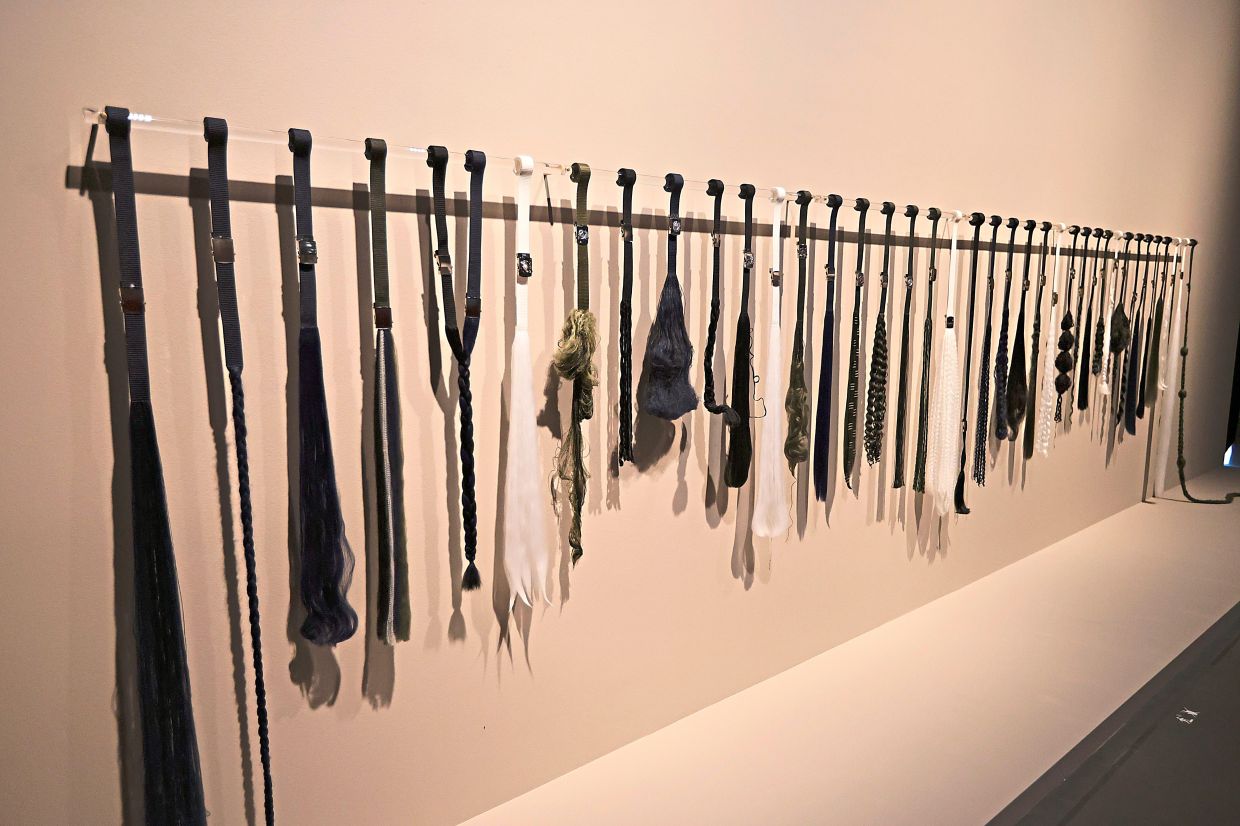
Umar's Asuhan Dan Dandanan series at Ilham Gallery last year showcased the lengths the KL-based artist went to in reimagining the commonplace school belt, grooming, combing and conditioning the material to mimic hair.
He also found time to curate Tong Fung Chuar’s Occurs painting series in Kuala Lumpur last June, further demonstrating his curatorial eye while working alongside peers to support artist-initiated exhibitions.
Shred, tease and transform
Right now, Umar’s focus is on his art-making. With greater attention on his methods through Salon Hang, more people may be drawn to understand his practice and the ideas behind it.
It all starts with purchasing standard-issue school belts and transforming them into something entirely unexpected.
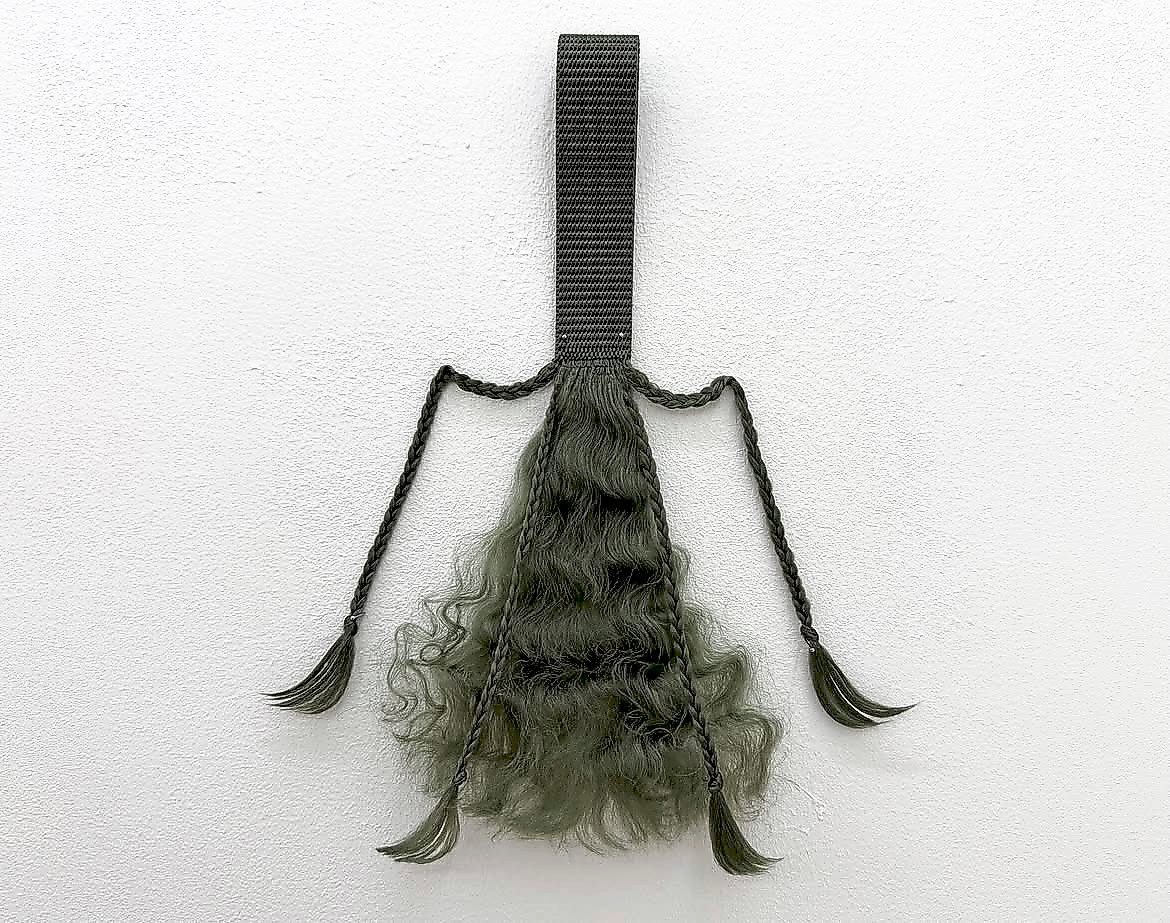
“The first step is always unravelling. I pick at the end of the weft and pull, loosening the warps (the vertical strands of thread/fibre) until they dance as I circle my arms around and around, pulling the material apart," says Umar, who holds a degree in architecture but chose to pursue a career in art.
"After that, there are a few options, depending on the desired outcome. If I want to create very straight, silky and smooth locks, I have to shampoo and condition them first, just like in a salon. I discovered that the conditioner coats the fibres and protects them when heat is applied,” he adds.
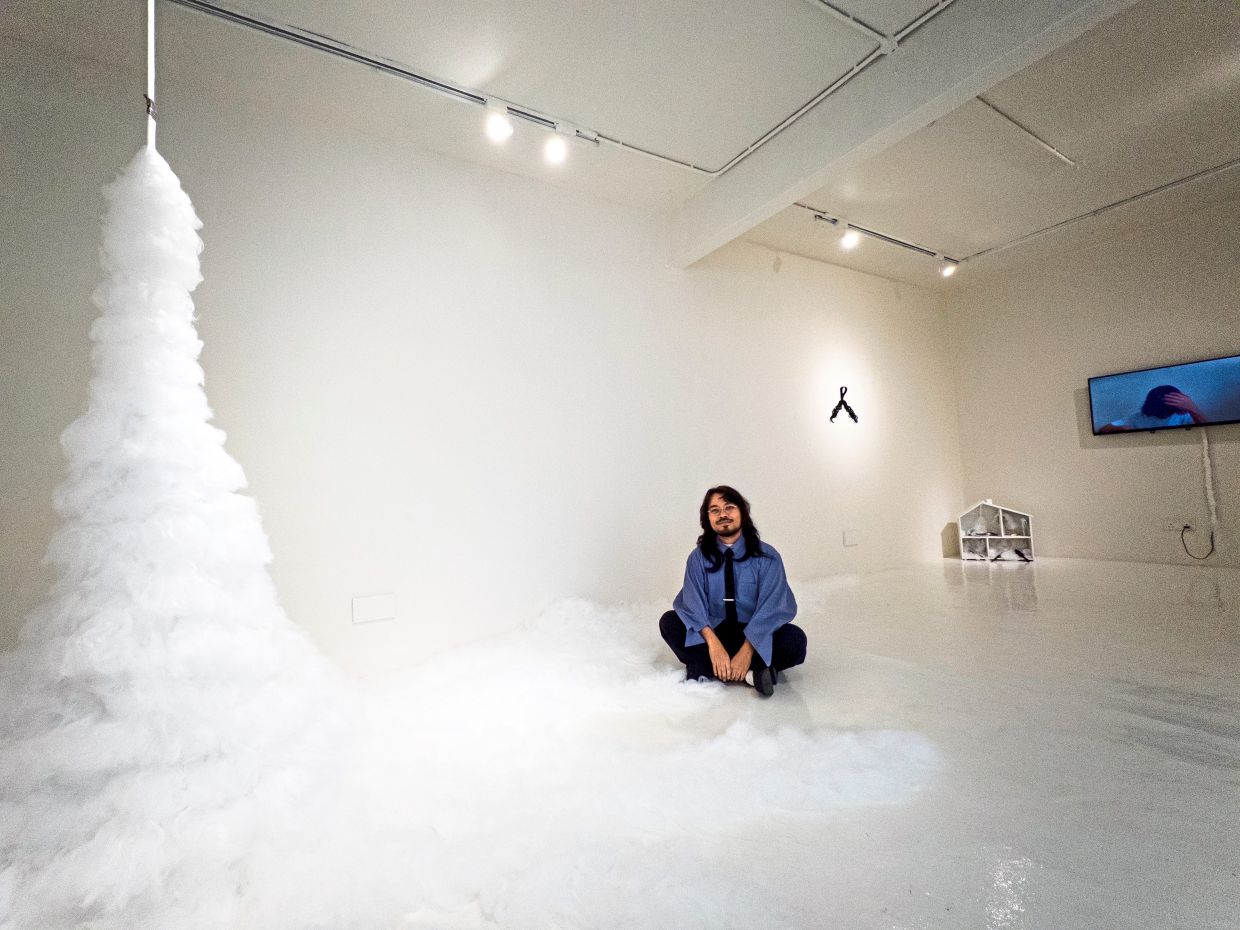
The Back Room may be a compact space, but Umar’s Dandanan I installation immediately draws the eye, anchoring Salon Hang.
In the hands of the imaginative artist, a standard-issue white school belt hangs from the ceiling, its fibres unravelled, conditioned and brushed into soft curls. The material spills onto the gallery floor.
From the Dandanan Study series, in which belts take on an altered appearance, visitors can only imagine the extent of experimentation required to achieve their remarkably realistic, hair-like quality.
“On and on, there are hundreds of ways to work with this material, much like hair styling, and I keep discovering new ways to do it. It’s very fun. Through all of this, I’ve realised the parallels it has with craft and art-making," says Umar, who has also added a process video to this new series.
"I am quite an objective person, and I’ve noticed that my approach is always a bit ‘scientific’ – each trial is an experiment, and I take note of the causes and effects. In art, that happens through the material considerations of the medium. I see myself doing the same thing with this fibrous ‘hair’ medium,” he adds.
It has been an eventful year for Umar, marked by his solo debut and selection for the 2026 Khazanah Associate Artist Residency (KAAR), organised by Khazanah Nasional Berhad.
He is currently in London undertaking a 12-week programme at ACME Studios, where he says there is little difference in how students obey or flout school policies.
“Honestly, they look the same as their Malaysian uniformed counterparts, but in both cases there are always those who don’t comply. The devil is in the details – the flare of your collar, ties worn loose or neatly tucked against your throat, bold socks, a few accessories. And, of course, the hairstyles,” says Umar, who recently arrived in London for his residency.
“I live in East London, in a diverse neighbourhood, so I have seen all manner of braids, whether protective styles or simply a loose one to tidy the hair, ponytails, hijabs too. What’s more interesting to me is how these kids, Londoners and Malaysians, negotiate these regulations to accommodate their own self-expression,” he concludes.
Salon Hang is showing at The Back Room gallery in the Zhongshan building, Kuala Lumpur until Sept 20. More info here.