It can take Ahmad Shukri Mohamed months, sometimes years, to complete an artwork. He allows ideas to develop gradually, waiting for inspiration to resolve into clarity rather than forcing the process.
There is little urgency until a deadline approaches. Yet once an idea has fully taken shape, the veteran artist needs relatively little time to realise it at Patisatu Studio, a creative space in Puncak Alam, Selangor he co-founded with his wife, sculptor and ceramic artist Umibaizurah Mahir.
For Shukri, the true value lies in the journey – the sustained process of observation, reflection and discovery that precedes the finished work.
Several of his latest works, comprising 10 mixed-media paintings and a wall installation, are currently on view at Sareng Gallery in Kuala Lumpur as part of IlmuAdab, an exhibition whose title brings together the ideas of knowledge and ethics. The exhibition runs through Sept 19.
Since emerging onto the art scene in the early 1990s, Shukri has cultivated a devoted following, making the enthusiastic response to his latest exhibition - his 10th solo show - all the more resonant. IlmuAdab marks his return to exhibiting after a seven-year hiatus, following Monuments, his last solo exhibition in KL in 2019.
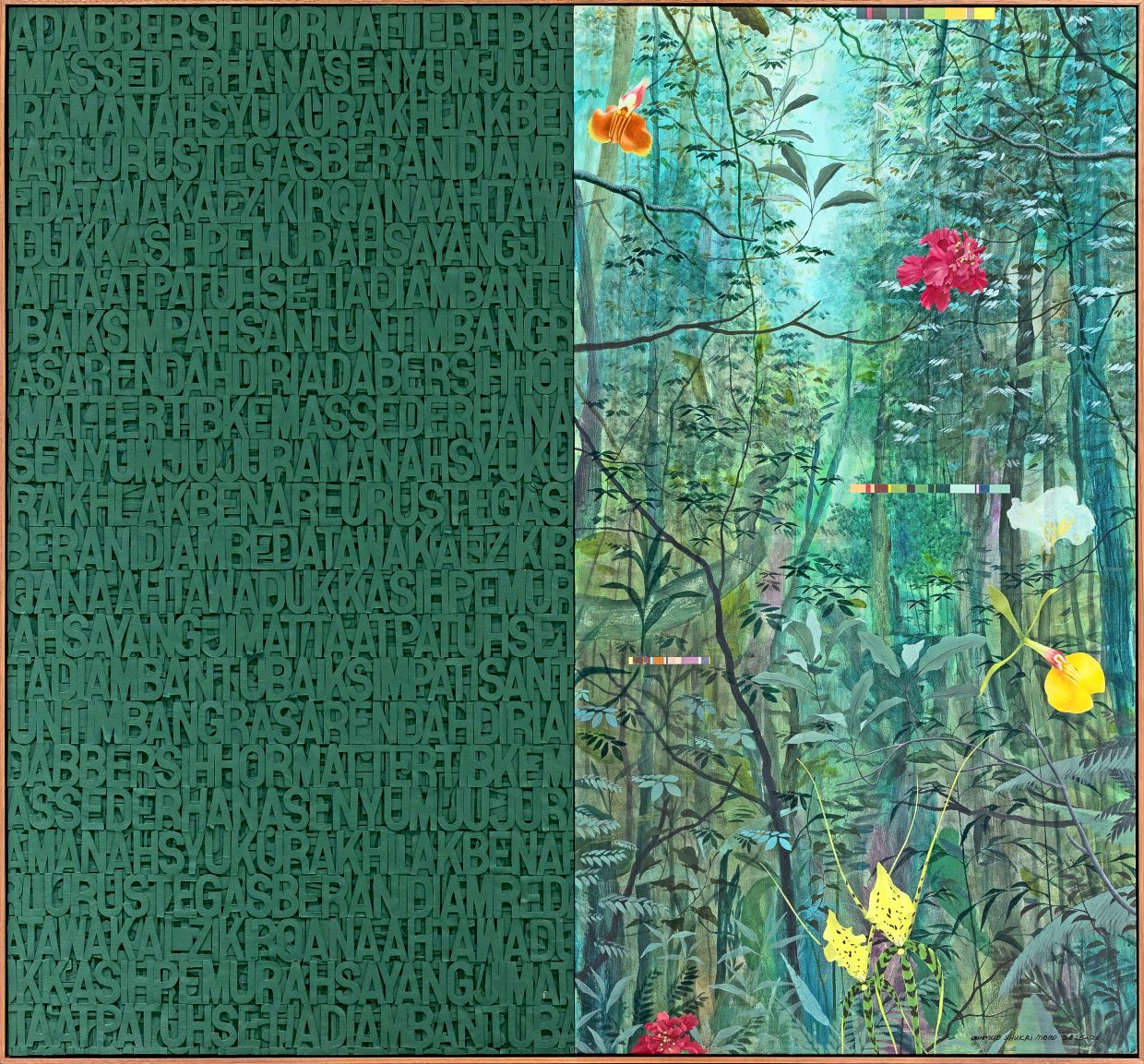
In the gallery, visitors can take in Shukri’s large-scale works, which reward close attention to detail. For him, knowledge gained through time and contemplation is not merely acquired, but valued, internalised and applied with purpose – an idea central to IlmuAdab.
“I think about ethics in three branches. The first is ethics with God. Regardless of the religion we practise, there is a respectful way to engage with one another. The second is ethics within society. In this country, we may hold different views across races, but we can still celebrate one another in a civilised manner," says Shukri, 57, in an interview at the gallery.
“The third is ethics with nature – how we treat and care for the environment entrusted to us,” he adds.
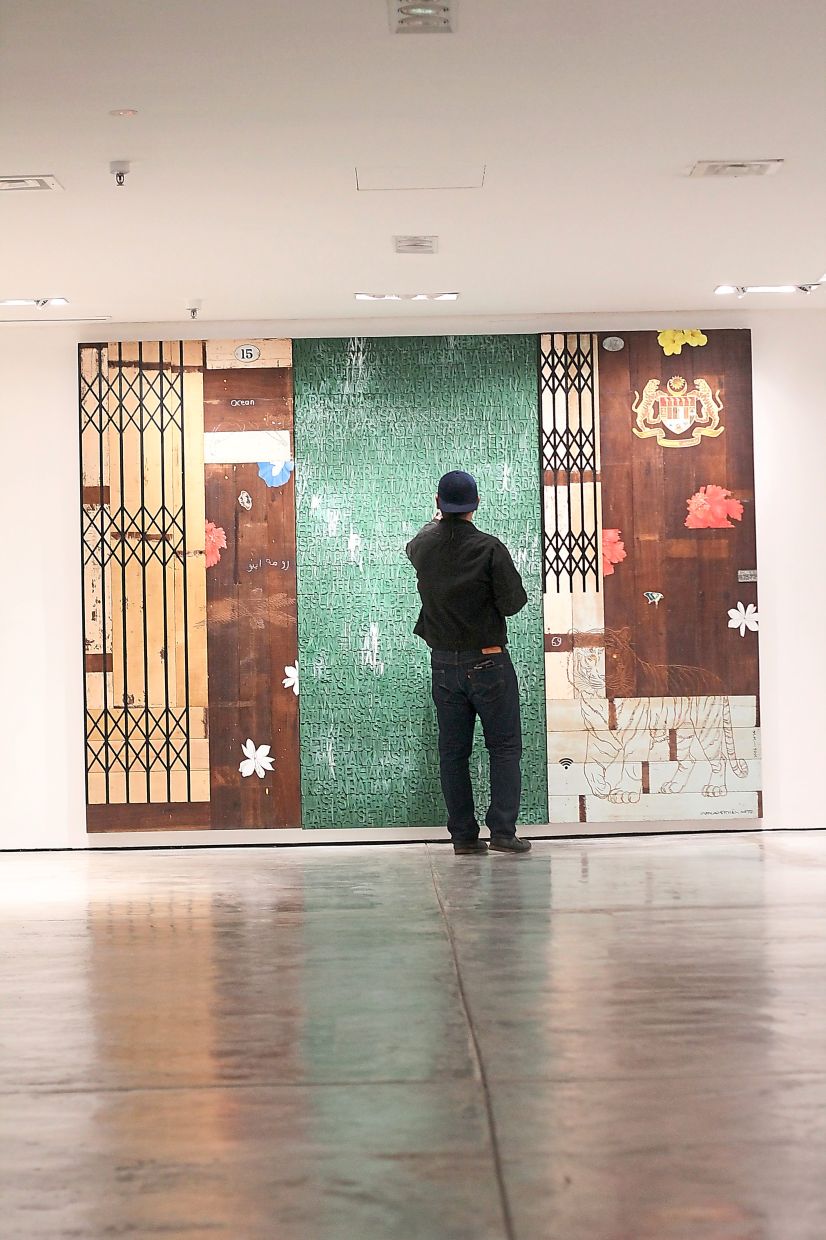
Several of the works are composed in distinct segments, pairing painted imagery with Jawi script or Bahasa Malaysia words that complement the visual elements. The largest, Rumah Ibu, occupies much of the gallery’s rear wall. The three-panel work features affirming words such as “Sayang”, “Bahagia” and “Ikhlas” across its central panel.
“The two outer wooden panels come from my old home in Klang. Rumah Ibu reflects the idea that education begins within the intimate space of the home. It is also a reminder to myself to preserve what I value. It is easy to build something, but the real challenge is keeping it from deteriorating over time,” says Shukri, known for his distinctive practice of collage and use of commonplace icons and motifs.
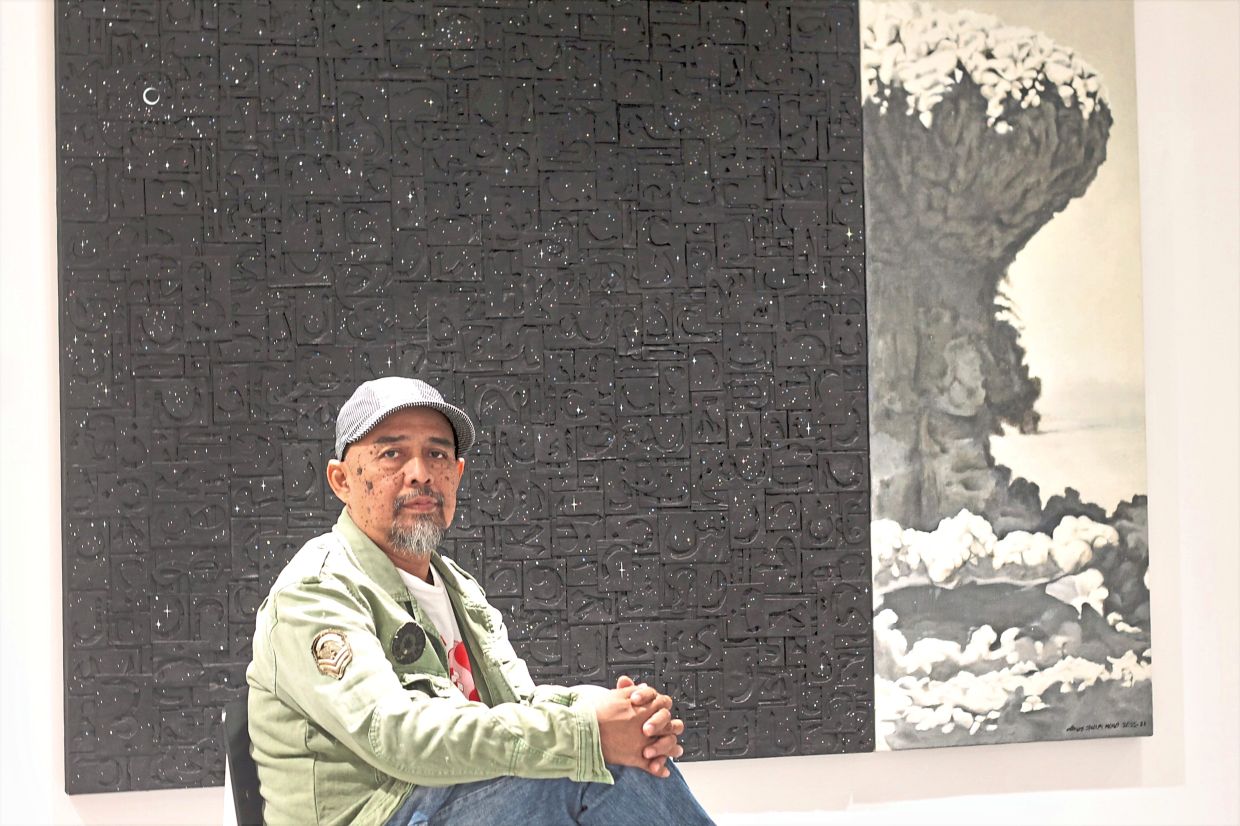
The idea of gratitude for learning runs subtly through the works. In IlmuAdab, Shukri pays tribute to the classroom board through a six-panel wall installation incorporating vintage class photographs, chalkboards and the colours of the national flag.
“In some of the panels, you’ll notice they are coloured green or black. This is my way of paying homage to the school environment. In my time, the chalkboard or blackboard was among the earliest spaces where knowledge was shared with me,” says Shukri, who hails from Kota Baru, Kelantan.
“It was also my first experience of community, among classmates and teachers. In our own Malaysian context, we discovered things we did not know and learned how to live peacefully alongside one another,” he adds.
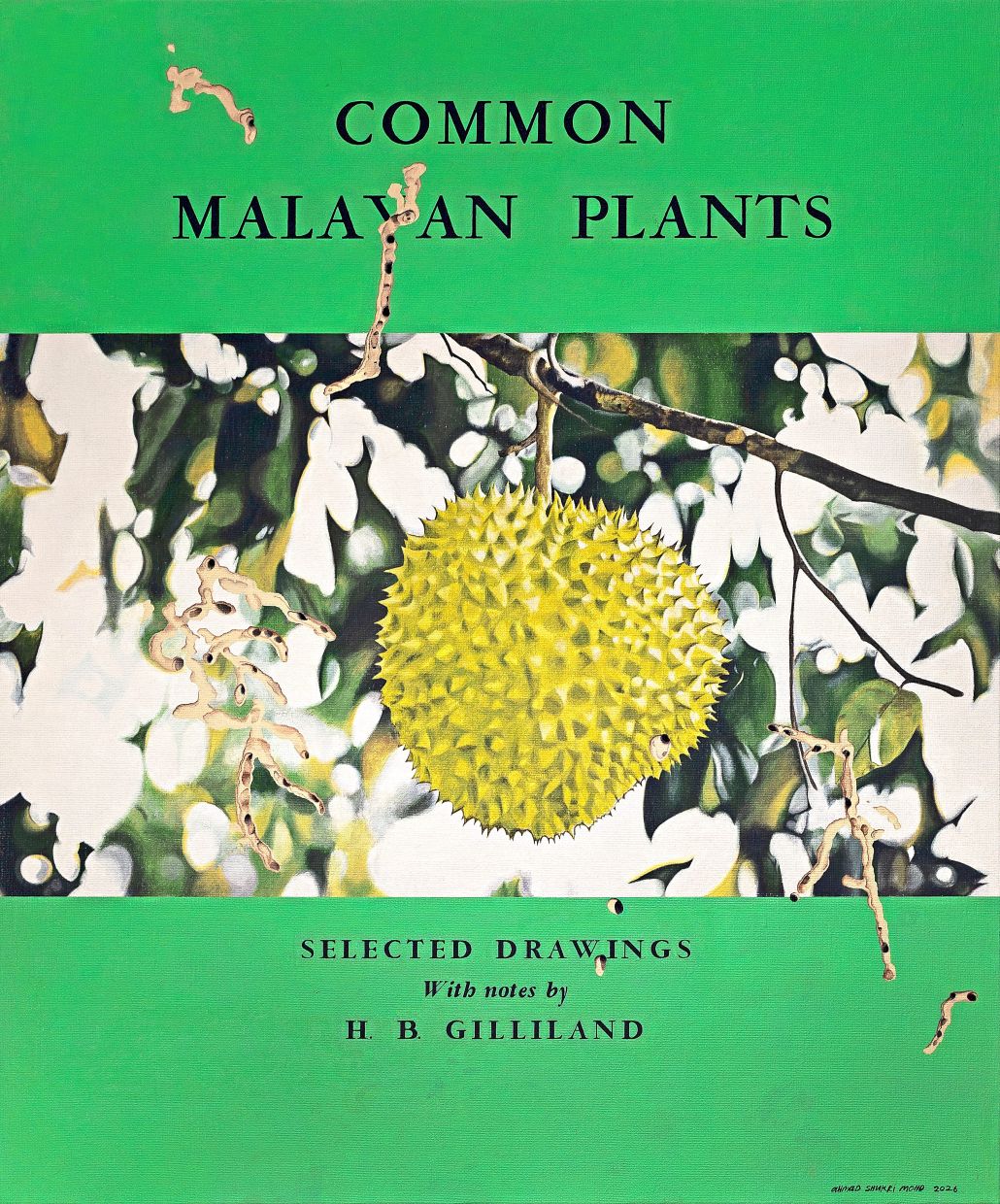
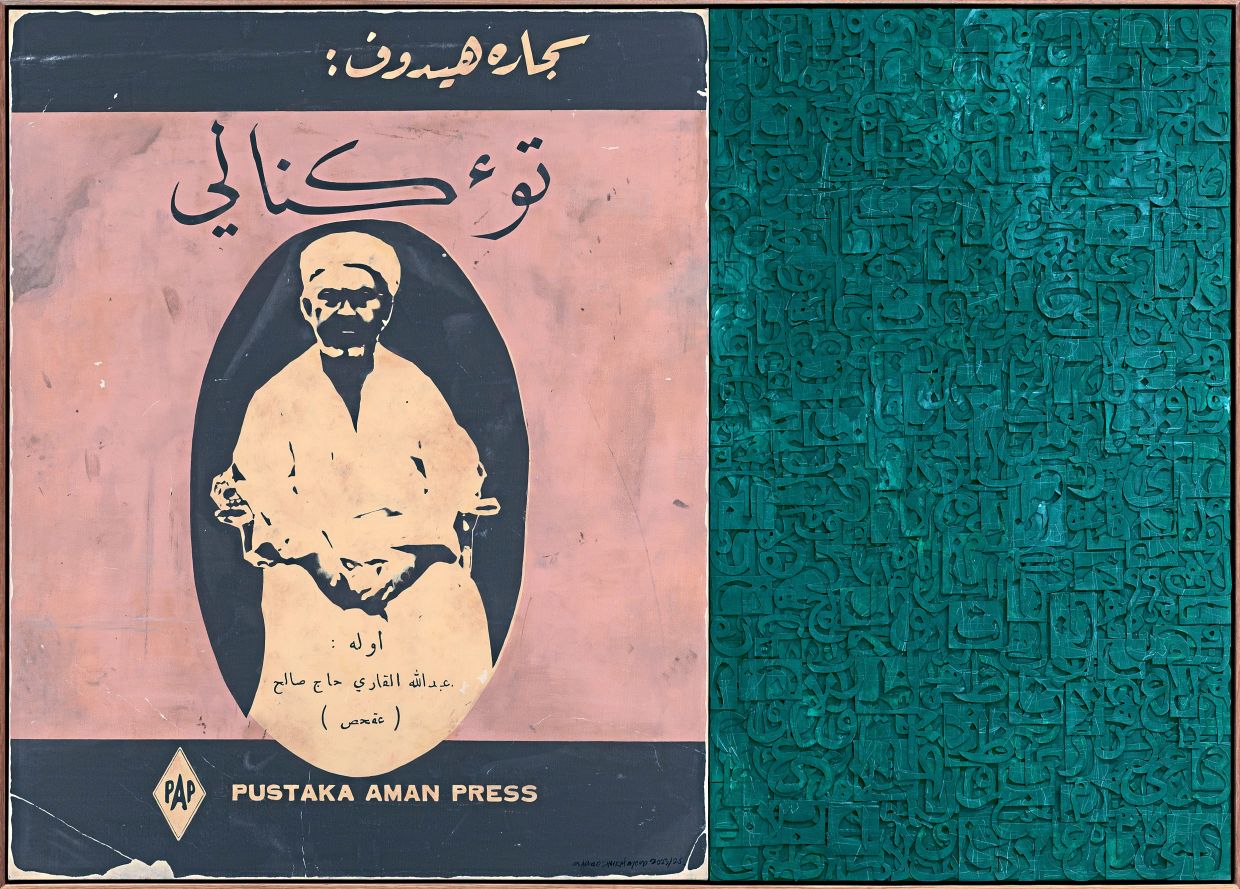
Shukri, a founding member of the 1990s arts collective Matahati, also references several books in his new exhibition, reproducing their covers in paint. These include Cara Pemerintahan Tanah Melayu (1957-1963) by Tan Sri Datuk Abdullah Ayub, the textbook Asas Kebudayaan Kebangsaan (1973), H.B. Gilliland’s Common Malayan Plants (1958), and a biography of Tok Kenali, the prominent Kelantanese religious scholar.
“I painted these book covers because they reflect an era when guidelines were needed to foster cohesion. We looked to government, education, spirituality and nature for answers. Unlike modern technology, which can provide answers and solutions almost instantaneously, this form of knowledge requires something technology cannot interpret,” says Shukri.
Some of the painted covers incorporate additional segments of Bahasa Malaysia words, while others are subtly altered to heighten the ideas Shukri seeks to convey.
“Take Gilliland’s Common Malayan Plants, for instance. It was written at a time when durian was not yet the export commodity it is today. The book speaks about the quality of our soil and the uniqueness of our ecosystem.
“When discoveries like these are guided by the right ethics, they can become a source of wealth for an entire nation,” he says.
Shukri’s version of the cover, however, bears signs of termite damage – a metaphor for knowledge that risks disappearing if it is not recognised and preserved in time. Without engagement, a book can become little more than an object on a shelf, gathering dust.
“With artificial intelligence becoming increasingly normalised and advancing so rapidly, I have learned to pause and take in information more cautiously,” says Shukri.
“When I want to share something, even in casual conversations with artists and friends, I try to slow down and remember how I came to know it and how it shaped my thinking. Knowledge that is used for the benefit of others can carry us far into the future,” he concludes.
More info here.