Come Deepavali, many Hindu homes mark their doorsteps with kolam, a pattern traditionally drawn by hand in rice flour,
its lines looping and meeting without a break, to welcome every guest.
A South Indian custom, kolam is now also seen in the form of stickers, a convenient alternative that keeps the look of the tradition.
With the Festival of Lights happening tomorrow, homes and temples will display these designs at their entrances.
Rangoli, its cousin among Indian floor arts, often adds coloured powders, rice and flowers.
The craft has spilled beyond the residential front door, to stretch across the floors of shopping malls and event venues.
StarMetro spoke to kolam artists commissioned to create such designs over the years, and asked what it took to carry a household tradition into the public eye.
Artistic journey
For Rupa S. Maniam, 37, her artistic journey began when she was just 21, after her mother passed away.
The first kolam she created was for her mother’s funeral prayers.
“I taught art to children from low-income neighbourhoods.
“I discovered my inclination towards art and saw how it helped others express their feelings. It also helped me,” said Rupa.
“My mother was my biggest inspiration. She gave me a lot of freedom to do what I wanted, and encouraged me to travel.
“After she passed away at 55, I travelled, ventured into the arts and visited 100 cities around the world.”
Rupa has been commissioned to create kolam designs for corporate clients over the years.
“My first corporate piece was created for a mall in 2016. I incorporated three-dimensional artwork into the kolam as a form of personal expression,” said Rupa, a self-taught artist.
“In the past, I have had my kolam designs changed numerous times at the approval-of-design stage.
“The board reviewing the designs may not even have included an Indian member who would understand the art form,” said Rupa, who also curates online exhibitions.
She opts to create contemporary versions that are more suitable for a wider range of occasions.
“Traditional kolam should be drawn first thing in the morning,” said Rupa.
“It is also a form of exercise because we have to bend while drawing and it requires mental effort to create the designs,” she elaborated.
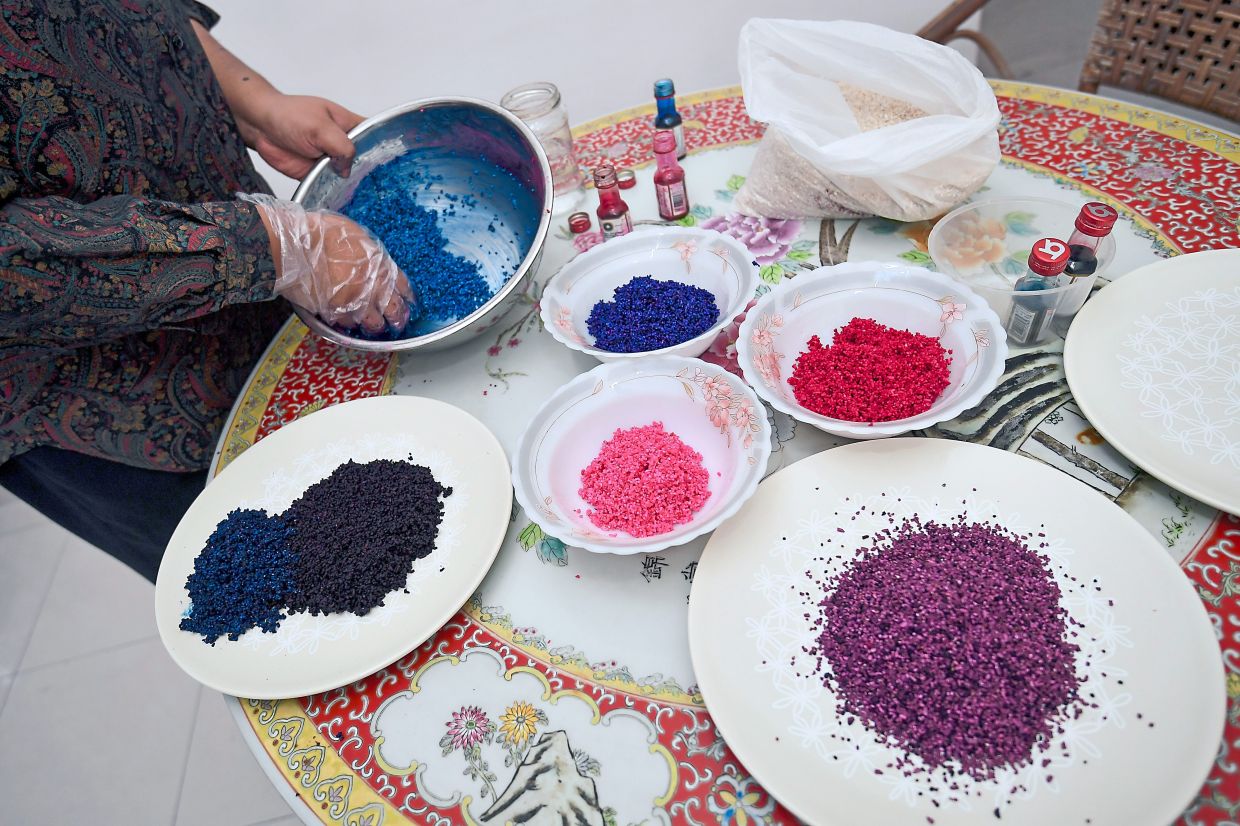
When commissioned to create a kolam, Rupa colours the rice using food colouring as it makes the rice safe for animals to consume and is environmentally friendly when disposed of.
Career-worthy
A couple turned the making of kolam and rangoli into a career, earning repeat business and referrals over the years.
Together, they have created more than 1,000 kolam designs.
Kobi Kanasan, 42, has been a kolam artist for more than 15 years.
“I learnt the art from my late teacher, Golukan Harikrishnan.
“I worked with my guru for seven years.
“I have created kolam designs in every state in Peninsular Malaysia,” he said.
Kobi is now assisted by his wife Shalaney Yealumalai, 37.
“Sometimes, we are commissioned to create between 20 and 30 kolam designs over a weekend. They can be for all kinds of occasions, from weddings to shop launches,” he said.
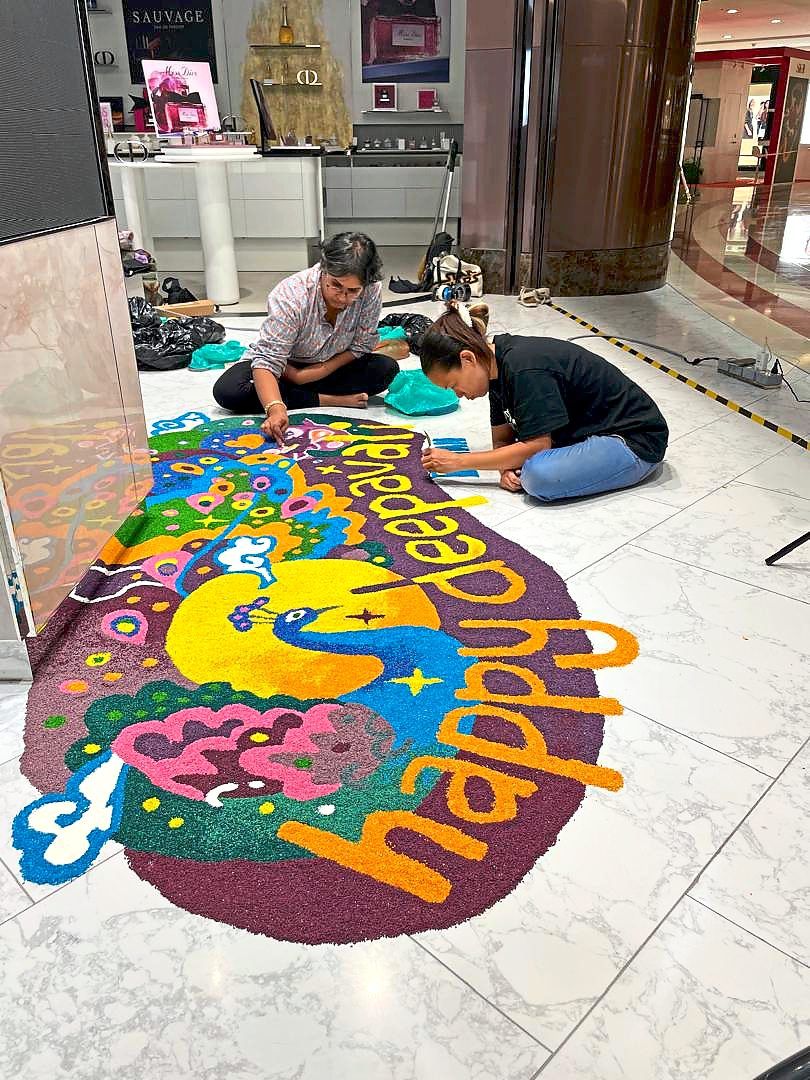
The largest kolam the couple created was based on the 1Malaysia concept and was displayed at 1 Utama shopping centre, Petaling Jaya, in 2013.
Measuring 4.5m by 4.5m, it took Kobi two days to complete and required 400kg of rice.
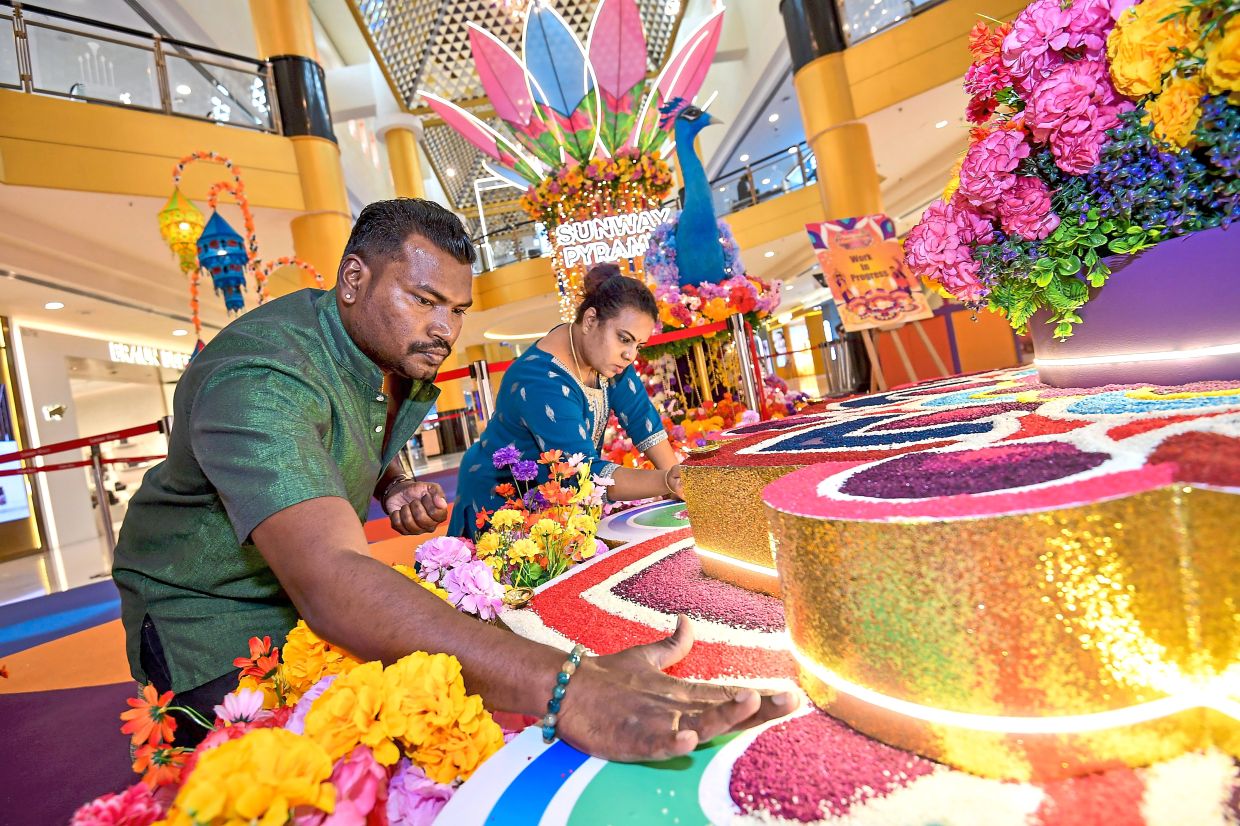
He has also been commissioned by Sunway Pyramid in Bandar Sunway, Selangor, to create kolam designs for the past 10 years.
“Sunway Pyramid has been very supportive of my work, and I am familiar with working at the mall,” said Kobi, who has worked alongside his wife since 2017.
He uses food colouring to produce about 12 colours for most of his designs.
“After the display period ends, the rice can be safely disposed of. I have seen cats eat the rice without any problems because it is coloured using food colouring,” he explained.
His kolam and rangoli works have included football team logos, animals and, more recently, designs based on artificial intelligence (AI).
“Nowadays, members of the public come to us with AI-generated designs and we recreate them.
“The most requested design is the peacock because of its colourful feathers. So far, I have not turned down any design request,” said Kobi.
He places great importance on punctuality in working on requests, especially when it involved weddings.
“People get married only once, so I have to arrive early at the venue to complete the kolam,” he said.
According to Kobi, a kolam brings positive energy to a space and offers several benefits.
“The kolam looks beautiful and comes in vibrant colours. It makes people stop and admire the designs.
“Kolam is an Indian tradition, and we cannot afford to lose this heritage,” he said.
Shalaney, who enjoys spending time together with her husband while creating kolam, said Kobi had created a custom kolam for their wedding, making it a particularly memorable part of their special day.
Offshoot interest
For schoolteacher Mohd Bakri Talib, 48, his interest in kolam began when he was an undergraduate at Universiti Putra Malaysia.
In 1998, while pursuing his bachelor’s degree, he was required to learn another language and chose Tamil.
“As I learnt Tamil, I noticed that its script was beautiful. Since I also love the arts, I became interested in kolam.
“In 2012, I started participating in kolam competitions. My first competition was held at a mall in Kuala Lumpur and I emerged the winner. Since then, I have participated in more competitions and often won.”
Mohd Bakri has developed a deeper appreciation for the art form rooted in Indian culture.
He believes art is a universal language that speaks to everyone and can serve as a voice for unity.
His designs do not incorporate religious elements. Instead, they focus on geometric patterns, human figures and words.
“Because of our diversity, I am proud to be a Malaysian and some of my kolam designs are my gifts to society.
“I am put in charge of the kolam competitions in my school,” said the Bahasa Melayu teacher at SMK Zon R1 Wangsa Maju in Setapak, Kuala Lumpur.
Mohd Bakri has also been commissioned to create kolam for shopping centres on numerous occasions.
He said that one of his favourites was a 4.8m by 1.8m design he created at a Terengganu mall.
“I drove from Kuala Lumpur to Terengganu and worked on the kolam from 11pm to 5am, when the mall was closed,” said Mohd Bakri.
“The next day, my entire body ached as though I had taken part in strenuous athletic activities.
“Creating kolam requires good stamina.
“I also need to wear loose clothing while working, and take short breaks in between,” he said.
Sometimes, he has help from his wife Afara Wahida Taib, their two children or his students in creating the kolam.
“Besides coloured rice made using food colouring, I also use sugee flour. It allows me to create finer details in white,” he added.
Over the years, Mohd Bakri has bought Indian lamps to complement his kolam designs. Previously, he borrowed them from Indian teachers at his school.
He said members of the public who saw him creating the kolam were often surprised to learn that he is Malay.
“They are even more impressed that I have embraced this art form and regularly participate in competitions,” he shared.