The Venice Biennale previewed its 61st and most chaotic edition ever on Tuesday, just days after the unprecedented resignation of its jury over the participation of Israel and Russia undermined the very structure of the world’s oldest contemporary art exhibition.
Tensions were evident as Ukrainian artists stood by a truck that had brought a statue of an origami deer from the war-ravaged eastern front to the Biennale's storied Giardini. Just metres away, a handful of participants in the Russian Pavilion danced to house music played by an Argentine deejay.
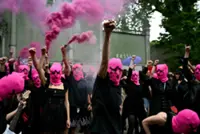
At the same time, a group of Palestinians marched through the Giardini wearing the names of artists who have been killed in Gaza. More protests were expected as the preview week continued.
Few inside the Biennale were surprised that global politics were spilling over into the international art exhibition, putting new pressure on its structure of national pavilions alongside a curated exhibition and raising old questions: Is the representation of nations outmoded in a globalised system where artists often operate internationally, and does it give states an undue platform for propaganda?
"I think what has been contested very much is the existence of the nation state within the space of the exhibition,” said Marie Helene Pereira, one of the five curators of the main exhibition In Minor Keys, who have taken up the mantle of the late curator Koyo Kouoh.
"We can see how much that can bring tension, especially in the midst of the political chaos (in which) we find ourselves,” Pereira said.
"It's important to be able to rethink structure, rethink institutions, in a way that allows for them to cater more to artists and artmaking," Pereira said, adding that didn’t mean that art should be devoid of politics.
Ahead of its resignation, the jury had said it would not award prizes to countries whose leaders were under investigation by the International Court of Justice. The move isolated Russia and Israel.
Israeli artist Belu-Simion Fainaru said he thought the jury's decision was "a fair one.”
"I should be treated as an equal artist, and I should not be discriminated because of my race, that I am a Jew, and not because of my nationality or passport. I have to be seen as I am. I am an artist that wants to show my art, and I have the right to be evaluated,” he said standing in front of his installation rooted in the Kabbalah.
The Biennale, he said, should be "a place where you can feel safe to create and do whatever you believe in.”
Ukrainian artist Zhanna Kadryova created The Origami Deer to take the place of a nuclear-capable Soviet fighter jet that had long stood in a park in Pokrovsk, in the Donbas region of Ukraine.
Curators of the Ukrainian Pavilion - its third since Russia's 2022 full-scale invasion - evacuated the statue from the park in 2024, with the front line just 5km away.
Co-curator Ksenia Malykh fiercely opposed the Biennale’s decision to allow Russia to open its pavilion, calling it "a false attempt to stay neutral.”
"You can’t stay neutral in these times. You can’t be neutral when people are dying every day because of Russians,’’ Malykh said. "They say that art is beyond politics, but they are using art as a weapon in a hybrid war in Europe.''
Instead of talking about Russian art, Malykh said, the focus is on the statement of their participation.
"I am absolutely sure this was their goal,'' she said.
The Russian Pavilion will only be open to visitors during previews that run through Friday and will not be open to the public after the Biennale opens for its six-and-a-half month run on Saturday. The pavilion has organised a series of performers for this week, and had an open bar upstairs near a flowering tree. Curators were not available for interviews.
Russia’s opening cost the Venice Biennale 2mil euros (RM9.3mil) in EU funding over three years. The Biennale has defended the decision, saying that any country with relations with Italy was free to open a pavilion, a position that has put it at odds with the government in Rome.
Still, the official catalog had a place-saving entry where the Russian text should have been, noting that Russia’s participation was "under review” at the time of publication.
Without a jury of peers, there will be no Golden Lion for best national pavilion or best participant in the main curated exhibition - a highly prestigious prize has led some to liken the Biennale to the Olympics of art.
Instead, visitors to both the Giardini and Arsenale sites will choose two winners, for best national participant and best main show participant, to be awarded Nov 22, the closing day of the Biennale.
The Ukrainian artist Malykh said that lack of professionally awarded prizes damaged the Biennale.
"It’s an important moment. If the prize is given by the public, it’s as if the Biennale came to Eurovision. It’s not a professional institution after that,” Malykh said. - AP