
What does a modern-day scholar share with an ancient soldier of the Trojan War?
In his latest novel Son Of Nobody, Canadian author Yann Martel draws narrative and visual parallels between the two, their stories unfolding in tandem across each page.
The upper half follows Psoas of Midea, a goatherd’s son who leaves his wife and family to fight at Troy. The lower half traces modern-day Canadian academic Harlow Donne, who uncovers the lost epic of Psoas’s tale and becomes consumed with reconstructing The Psoad, even as his personal life unravels.
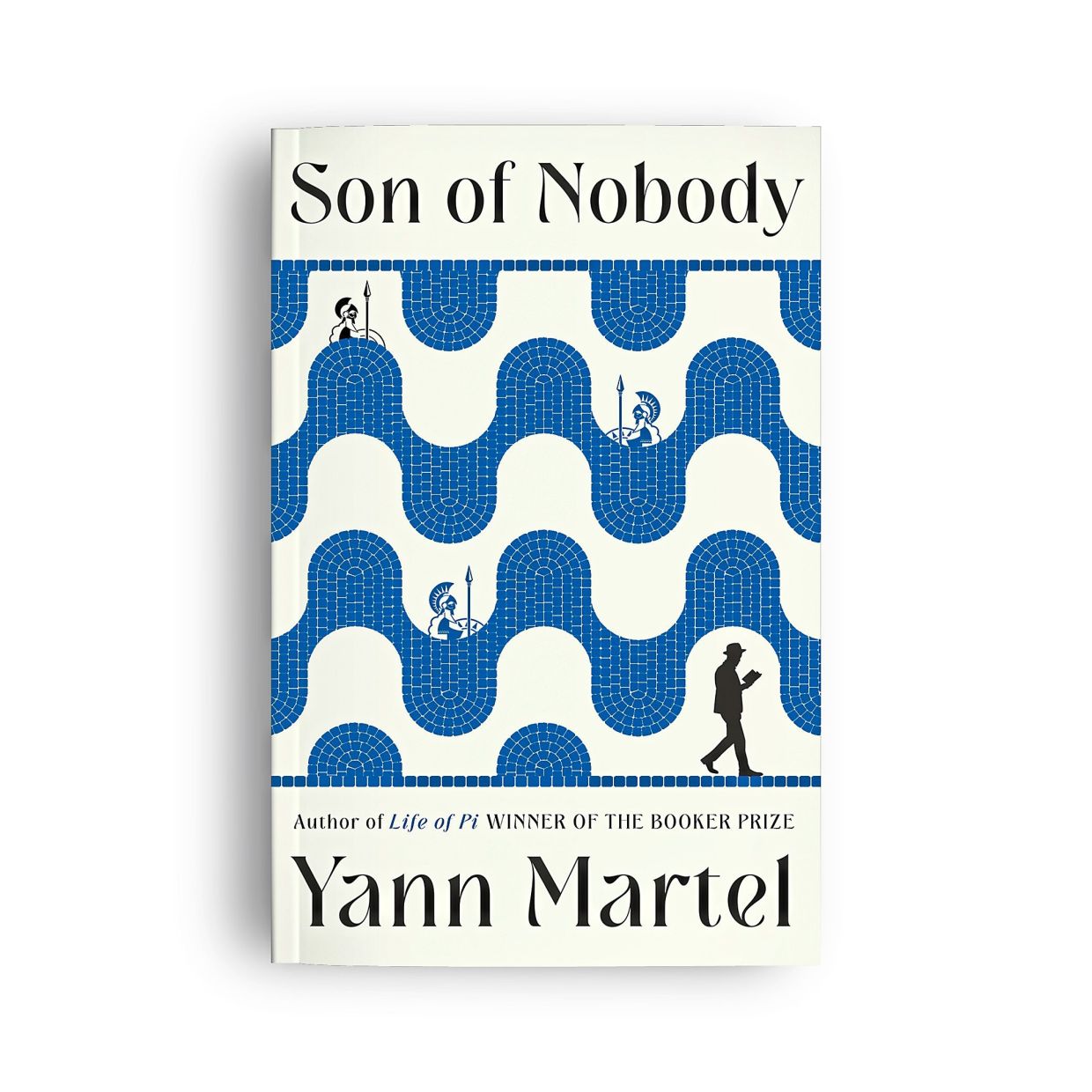
Moving between the ancient and modern worlds, the novel probes ambition, family and responsibility, while subverting the regal lens of traditional epics.
Instead, it suggests that “the past is never done with, that always there are parallels and returns and repetitions, always the song continues.”
In a recent interview, Martel discusses the book, published a decade after his previous novel The High Mountains Of Portugal.
The interview has been edited for clarity and brevity.
Could you elaborate on the ancient Greek themes you explore in the novel?
Son Of Nobody was inspired by Homer’s Iliad. I read it late in life, only a few years ago, which meant that I read it with a fresh mind. And a number of things struck me about it, particularly its emotional tone.
The first word of the epic is menim, or wrath, and sure enough, the story seethes with wrath. I was surprised that the Greeks would present themselves in the first book they wrote down, the first book of the West, in such a poor light.
Then there was the pervasive tragedy of the work. There is no redemption in The Iliad, at most the hope to have one’s name remembered, but otherwise life is short, hard and ends poorly, the gods are fickle or indifferent, and death is final.
Such despair! No wonder they gave themselves over to anger. Then, just a few centuries later, a short distance to the east, came a response, an equally mythical story – that is, with hardly any factual underpinnings – with a radically different central word and concept: love, in the story of Jesus of Nazareth.
In Son Of Nobody, I wanted to explore that strange duality, those two “feet of dreams” the Western mind walks on.
Unlike Homer’s version of The Iliad, which focuses on nobles and kings, The Psoad tells the story of Psoas, an “unsung hero” in the Trojan War. Why did you want to tell the story from his perspective?
Today, the point of reference in a society is the citizen. A society succeeds or fails depending on how it treats its citizens. Homer’s Iliad takes the perspective of the elite. Everyone who speaks (with one exception, a soldier named Thersites) is either divine or noble. Today that would be like telling a story strictly from the point of view of the Elon Musks and Jeff Bezoses of the world. Why would I do that?
In The Iliad, when Thersites speaks, he rails against Agamemnon, excoriating him for his conduct of the war and all the riches he has accumulated, while ordinary soldiers have gained nothing in 10 years of war. Thersites is then promptly beaten by Odysseus because he is questioning the social order.
Yet his protest makes total sense to the modern mind. Indeed, why would the many sacrifice so much and for so long to profit the greedy few? It was natural to me that I would speak from the perspective of Thersites and Psoas. I, too, am a commoner, an ordinary citizen.
The other half of the narrative unfolds through Harlow’s perspective, addressed to his daughter, Helen. Could you expand on this dimension of the story, their relationship, and the ways in which Harlow’s journey mirrors that of Psoas?
I wanted to establish a parallel between a vast war epic and something more familiar to a modern reader. Few of us today experience war first-hand, so to dwell on two wars, besides being vaguely pointless, would exclude the life experience of most readers. They would just read from the outside. Better to parallel something they might actually know, and a relationship falling apart, a couple at war with itself, that is something most people know, or can intuit.
Whether you’re in hell because you’ve been to war literally – against the Trojans – or metaphorically – against your wife or husband – you’re in hell. And where do you go from there, when all is lost, when all your dreams have collapsed?
Well, you hop on your other Western foot, as I mentioned in my first answer, you go from left to right, from Troy to Jesus, from wrath to love. If Psoas can’t do that, perhaps Harlow will stir himself and manage it.
An intriguing feature of the book is its split-page structure: the upper half presents the unfolding epic, while the lower half functions as “footnotes,” where Harlow interjects explanations and traces his parallel journey.
This dividing of the page into two halves, the epic in the top half, footnotes in the bottom half struck me as a good metaphor, both literary and visual. Like The Psoad over its footnotes, history looms over us, institutions loom over us, individuals can loom over us, all of them telling us that we are small and of little consequence – but does that diminish the emotional weight that each of us carries within ourselves? The big is made up of the small. To give a starring role to Psoas of Midea, the son of nobody, and to Harlow Donne, the ordinary citizen, is to reflect life in print.
In Son Of Nobody, the footnotes are granted fully half the page. I wanted this balance, this dialogue, between the past and the present, each giving its own space, its own narrative rights. Psoas and Harlow get their fair share. Then the reader has to make sense of it, to weave the split pages into a whole.
Did your research for this novel involve travel?
I read The Iliad, then researched the world of Homer. I also travelled to the Peloponnese and west coast of Anatolia, to visit the remains of Mycenaean Greece and of Troy. But there is not that much on the ground, especially at Troy, which is a very unimpressive archaeological site, no more than piles of worn red bricks and walls that are startling in their smallness.
But it was the air I wanted, the sunshine, the wind, the lapping waves of the Aegean. That carries much. You can feel it in the air, the ancient past, like spores blown in the wind. And then I closed my eyes and got to work.
Yann Martel’s Son Of Nobody is available in all good bookstores.