
German artist Georg Baselitz, whose expressive paintings and sculptures stirred controversy in West Germany before winning global acclaim, has died aged 88.
His death was confirmed to AFP by Ropac Gallery, which had a long-standing professional relationship with the artist.
A statement provided by the gallery on Thursday said Baselitz - who "defined German visual art for a generation" - had "died peacefully".
Baselitz, born Hans-Georg Kern, was among Germany's most prominent contemporary visual artists with a body of work over six decades across a range of techniques.
He adopted the name Baselitz in 1961 as a nod to Deutschbaselitz, the town near Dresden in eastern Germany where he was born in 1938.
Baselitz spent his early childhood in Nazi Germany and then grew up in communist East Germany.
He initially studied art in East Berlin but moved to West Berlin in 1957 after being subjected to "political pressure," according to the Ropac Gallery, and feared being sent to work as a miner.
'German Neurosis'
His first exhibition in West Berlin, in 1963, was labelled "pornographic" by the press. Two of his paintings were confiscated, accused of being too sexually explicit, and the exhibition was closed.
A high-profile legal battle ensued.
His success was recognised two years later in Florence, Italy, where he exhibited his Heroes group of works.
His works often echoed the traumas of German history and are now found in some of the most prestigious public collections around the world.
"All German painters harbor a neurosis about the German past. That is to say, the war, and especially the post-war period, the GDR," he told Der Spiegel in 2013, referring to the communist German Democratic Republic.
"All of this plunged me into a deep depression and put me under immense pressure. My paintings are, in a way, battles."
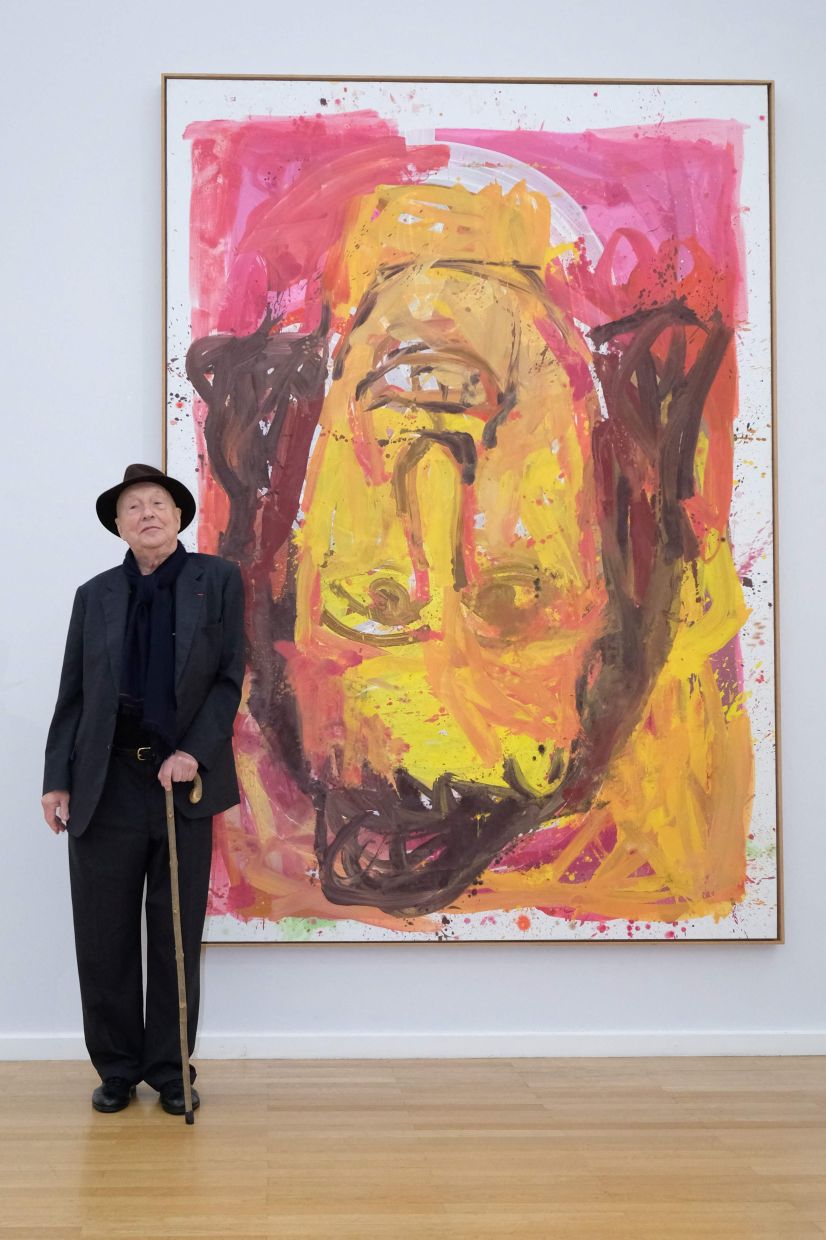
Baselitz's provocative persona included a penchant for controversial or even offensive phrases.
In the same Der Spiegel interview, he offered his opinion that women "don't paint as well" as men.
"That's a fact. Of course, there are exceptions," he said. "Agnes Martin, or, historically, Paula Modersohn-Becker. (...) But even she is neither Picasso, nor Modigliani, nor Gauguin."
"Shocking" the public
Baselitz not only painted but also worked in the graphic arts and was a noted sculptor.
In 1969, he began painting canvases upside-down and inverting motifs, a technique he said sought to find a way between abstraction and straightforward figurative art.
His work drew on the traditions of German Expressionism, postwar American abstract painters like Jackson Pollock and Willem de Kooning as well as the Pop Art movement.
But his work also clearly stood out, breaking for example in the 1960s with the more dominant artistic trend towards heavy abstraction.
"Like any artist, I want to create something unknown to the viewer. They will be shocked by what they see. And once the shock has passed, they may perceive something... or perhaps not. That is the goal of every artist," he told the Sueddeutsche Zeitung newspaper in an interview last January.
His wife, Elke Kretzschmar, whom he met shortly after moving to West Berlin and married in 1962, also became a major subject in his art from the 1970s onward.
Baselitz achieved an international breakthrough in the early 1980s after representing West Germany at the 1980 Venice Biennale along with painter Anselm Kiefer.
His works - alongside those of other German artists such as Kiefer and Gerhard Richter - became highly sought-after among collectors.
In Paris, his career had reached a double milestone in recent years with his election to the Academie des Beaux-Arts in 2019, followed by a major retrospective exhibition in 2021 at the Centre Pompidou, one of Europe's leading museums of modern and contemporary art.
The Ropac Gallery said a final set of works by Baselitz are due to be shown in an exhibition in Venice at the Fondazione Giorgio Cini starting next week. - AFP