Scotland's Nnena Kalu took home the Turner Prize on Tuesday, with the autistic artist beating four competitors including an Iraqi painter to the prestigious contemporary art award.
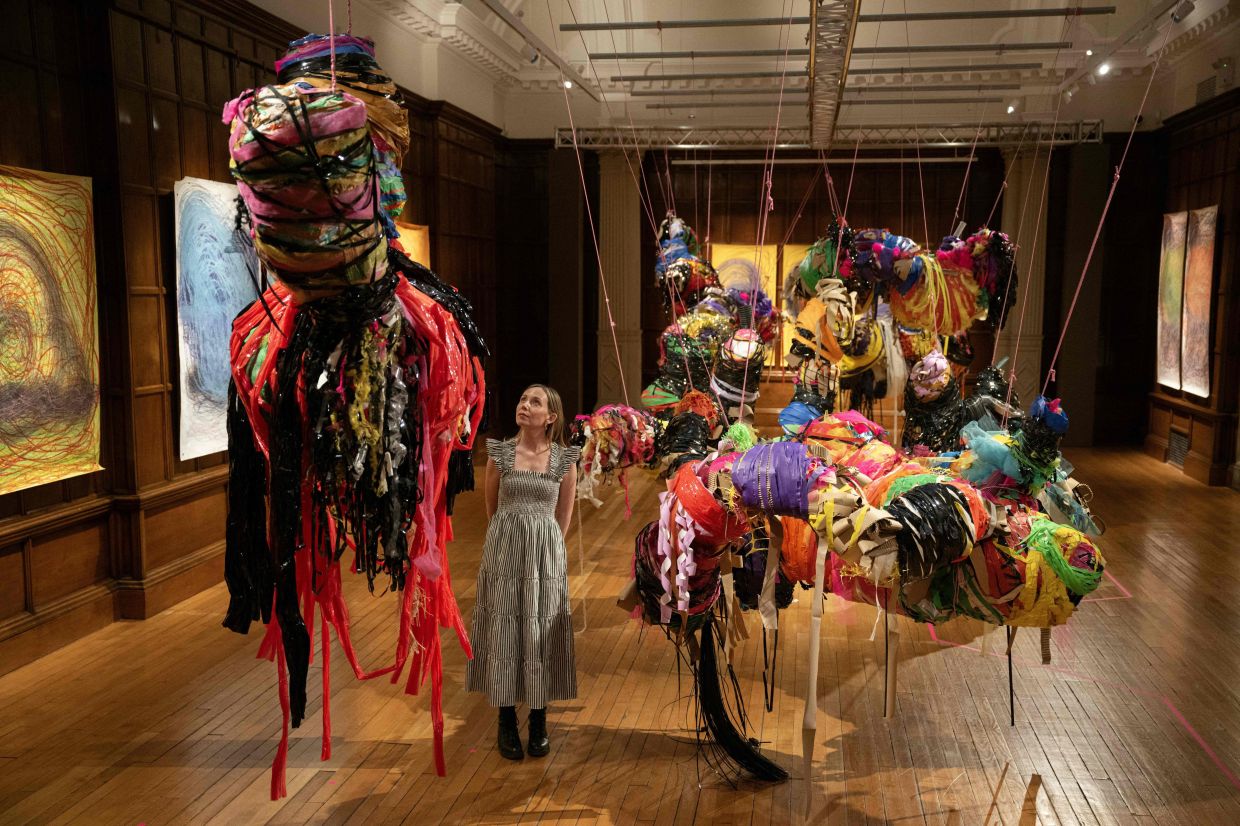
Glasgow-born Kalu, 59, was nominated for her hanging sculptures using wrapped material, including fabric, rope and tape, with the British disability charity Sense hailing her shortlisting as "incredibly significant".
The jury of the prize, established in 1984 to celebrate contemporary British art, hailed Kalu's art as "bold and compelling" as well as "the powerful presence these works have".
"This amazing lady has worked so hard for such a long time," said Charlotte Hollinshead, Kalu's helper, hailing the artist's perseverance in the face of stigma.
"Nnena has faced an incredible amount of discrimination, which continues to this day, so hopefully this award smashes that prejudice away," Hollinshead added.
"It's seismic. It's broken a very stubborn glass ceiling."
The Turner Prize is awarded each year to an artist born or based in Britain for an outstanding exhibition or other presentation of their work.
Named after English painter J.M.W. Turner and his legacy of artistic experimentation, the prize, organised by the Tate institution, is one of the world's leading visual arts awards.
The four shortlisted artists were announced on April 23, 250 years to the day since Turner's birth.
British-born Kalu and Rene Matic were joined by Iraqi painter Mohammed Sami and Canadian-Korean artist Zadie Xa. All four now live and work in London, according to the prize organisers.
Their work has been on display since September at the Cartwright Hall Art Gallery in Bradford, in northern England.
Seashells, war, race
Alex Farquharson, director of Tate Britain and chair of the Turner Prize 2025 jury, denied that Kalu's neurodivergence was a factor in the choice to award her the prize.
"It was interest in, and a real belief in, the quality and uniqueness of her practice, which is inseparable from who she is ... whatever the artist's identity is," Farquharson added.
Sami, 40, who had been seen by some commentators as the favourite, explores memory and conflict in his war-torn home country in his paintings.
Matic, 27, an artist from central England, presents work that blends intimate photography with sound and objects, addressing themes of race, care and vulnerability.
Xa, 41, is a finalist for her installation of bells, seashell soundscapes and painted walls drawing on Korean shamanism and ocean folklore.
Every other year, the Turner Prize exhibition ventures out of the Tate Britain gallery in London.
The prize-winner receives £25,000 (RM137,000), while the remaining shortlisted artists will be awarded £10,000 (RM55,000) each.
'Launching pad'
Christopher Turner, head of the architecture and design department at London's V&A museum, said the prize has "struggled to connect with the public ... as it used to".
"That said, it is an important launching pad for emerging and mid-career artists," he told AFP.
Previous winners include now-household names such as duo Gilbert & George, Anish Kapoor, Rachel Whiteread, Antony Gormley, Tracey Emin, Steve McQueen and Damien Hirst.
The annual award seeks to encourage debate around new advances in contemporary art, which has often spilled over into controversy.
Chris Ofili, for example, won in 1998 for incorporating elephant dung into his paintings.
Hirst in 1995 exhibited pieces including a rotting cow's head, while Emin's 1999 entry My Bed - an unmade double bed with stained sheets surrounded by soiled underwear, condoms, slippers and empty drink bottles - attracted huge attention.
Scottish artist Jasleen Kaur won last year's prize with a solo exhibition, which included an installation of a Ford Escort car with a giant doily on it, as the award celebrated its 40th anniversary. - AFP