A wooden house structure stands prominently in a main section of Ilham Gallery in Kuala Lumpur, carrying the humble, welcoming presence of a Chinese New Village home in Jenjarom, Selangor.
Inside, nine lacquer carvings – recalling the delicate traditions of Chinese wooden plaques – reveal a striking interplay of Western art references, featuring images inspired by Goya, Dalí, and Courbet.
A commanding Hokusai wave anchors the main wall’s central etching.
The installation, presented by artist Gan Chin Lee at the Ilham Art Show 2025, marks a turn from his usual painting practice toward a deeply personal – and ambitious – exploration of his roots.
The work, titled Invasion And Resistance, feels both personal and wide-reaching. It connects the artist’s own history with bigger art traditions, opening up layers of memory, culture, and imagination for curious viewers to explore.
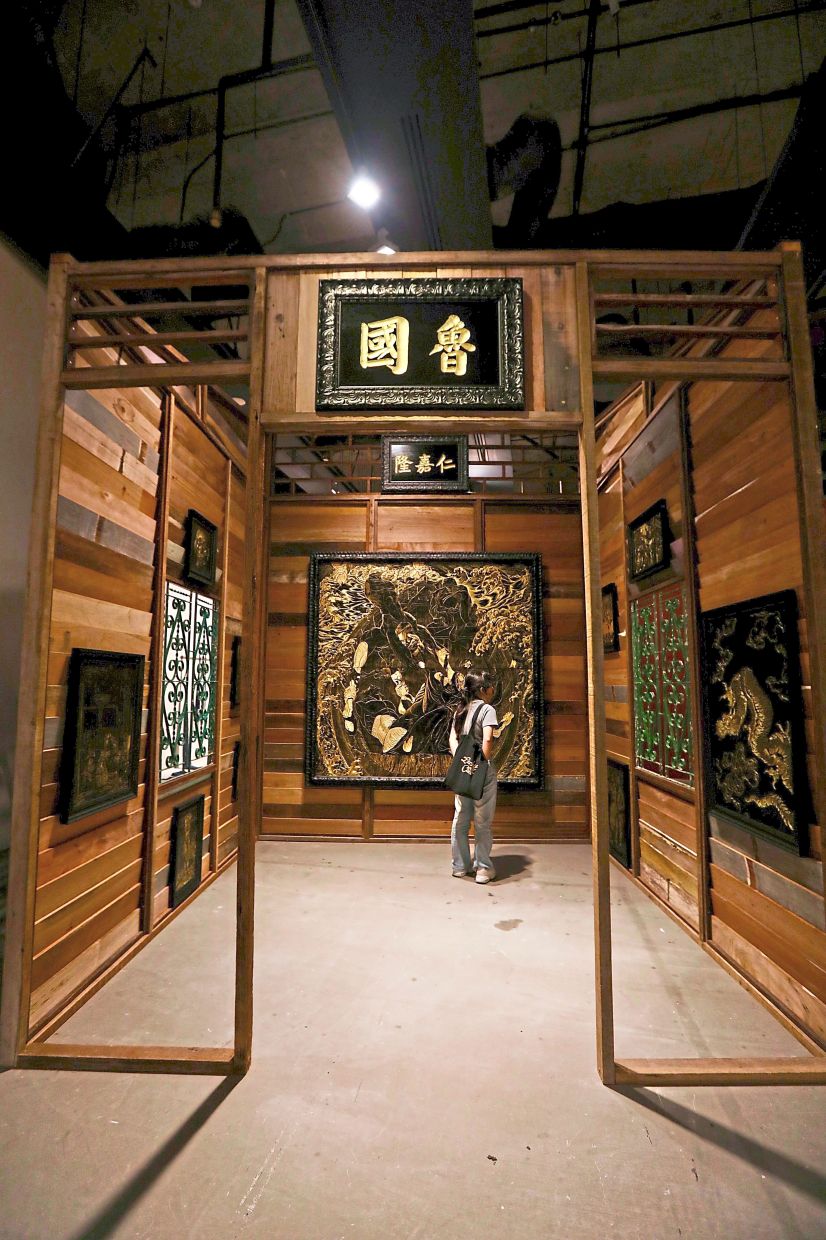
“The wooden house in this installation does not specifically reference the anti-communist New Villages of the Cold War, but rather the place where I grew up,” says Gan in a recent interview, reflecting on his contribution to the Ilham Art Show 2025, an open-call series highlighting homegrown contemporary art.
“My Chinese elders often reminded us that our surname originated from Shandong (as noted on the ‘Ancestral Surname Plaque’ at the house entrance) to emphasise our lineage. Yet, I deliberately placed another plaque in the centre of the main hall, bearing the word ‘Jenjarom’, to anchor myself in the place I have actually lived – one of the many New Villages once enclosed by barbed wire under British colonial rule,” he adds.
For Gan, the work may start from a personal angle, reflecting the hybrid experiences that shape his artistic language, yet it also channels his perspective to engage with broader questions about Malaysian art history and evolving artistic identity.
“Through this work, I hope to express the importance of acknowledging the ground beneath our feet – our historical and geographical roots – and of speaking, creating, and debating from that grounded perspective.”
Contemporary art is also a field the 48-year old has approached with careful reflection.
“In the past, I did not label myself as a contemporary artist – I considered myself a realist painter committed to expressing lived conditions,” says Gan.
“Yet, as I understand it, contemporary art requires a reflexive engagement with the history of visual art, a critical distance from Western modernism, postmodernism, and post-structuralism.
"It is not simply about producing colourful, spectacular works, nor is it aligned with the speculative market-driven tendencies of art fairs,” he adds.
Gan’s Invasion And Resistance, a work of critical reflection, is among the highlights of the Ilham Art Show 2025, running until April 5, 2026. Established in 2022, the triennial series returns this year with a strong line-up, featuring 20 artists and collectives selected in March to present new and thought-provoking works.
A table, a cabinet and loads more
“In terms of the scope and criteria of the Ilham Art Show, there was no difference between 2022 and 2025. What we did find however, was that there were a lot more applications from younger, emerging artists this time round,” says Rahel Joseph, Ilham Gallery director, revealing that over 270 submissions were received for the open call.
“We were thrilled to see so many new names applying. While the 2022 line-up featured mostly established artists, this year’s selection is a mix of both established and emerging talent. The exhibition is also intergenerational, with our oldest artist born in 1965 and the youngest in 2000,” she adds.
Joining Joseph in the selection process was a regional panel that included Gridthiya Gaweewong (Jim Thompson Art Centre in Bangkok, Thailand), Sharmini Pereira (Museum of Modern & Contemporary Art, Sri Lanka) and Wong Hoy Cheong.
“We had two to three rounds of curatorial meetings. It was a really meaningful process for us as well and we are grateful that the artists were so open to our feedback, as well,” says Joseph.
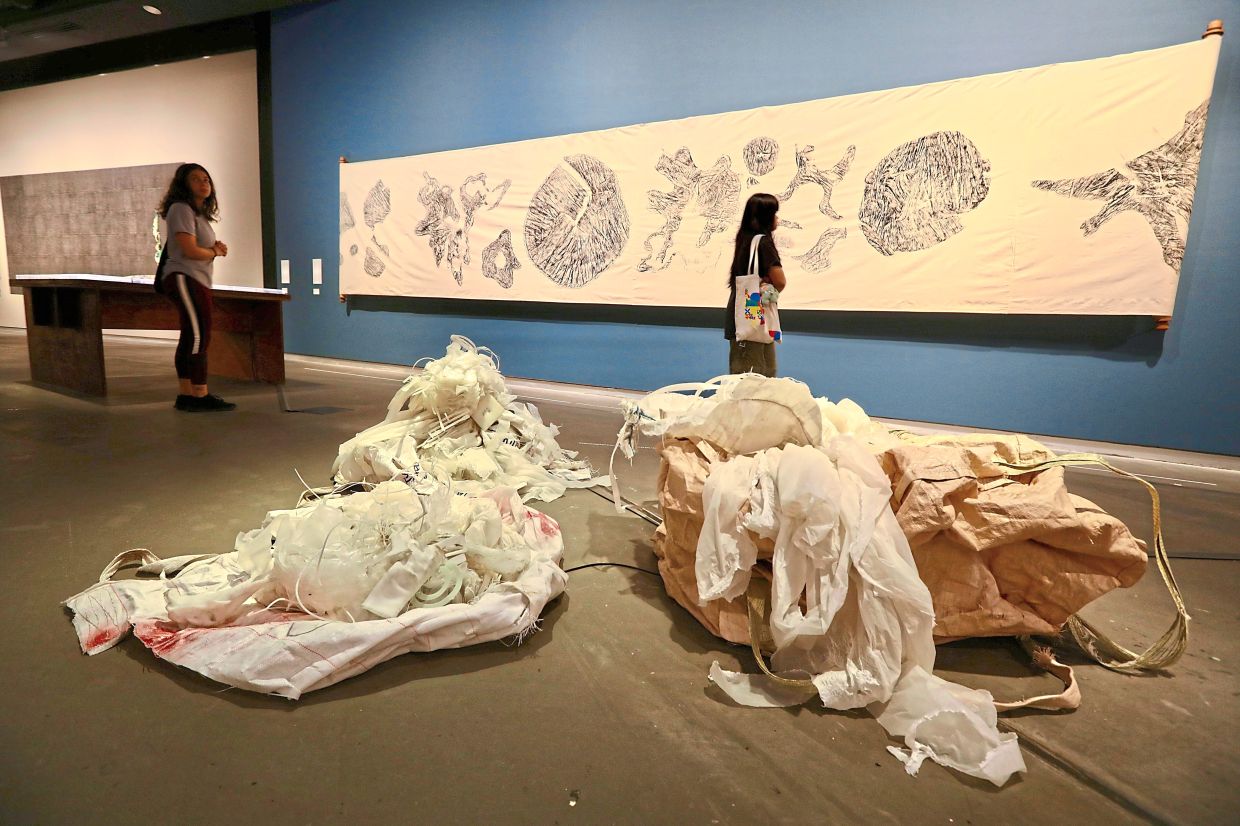
Across the floor of Ilham Gallery, the exhibition presents a diverse collection of contemporary art, spanning painting, drawing, printmaking, photography, installation, textile, film, and video.
Artists such as Wong Perng Fey, Roopesh Sitharan, Tiga Tawai, Eiffel Chong, Marcos Kueh, Hieng, Dr Kendy Mitot, Joshua Kane Gomes, Arikwibowo Amril, Syarifah Nadhirah, Yvonne Tan, Eddie Choo Wen Yi, Umar Sharif, and Ang Xia Yi bring a remarkable range of voices and approaches.
Their works explore a wide range of themes, including identity, culture, the environment, migrant experiences, the spiritual realm and more.
At the start of the exhibition, a dinner table installation greets visitors. Titled and here we sit, in the weight of silence, the piece by Kimberley Boudville is a handmade ceramic feast that confronts loss and grief – a courageous exploration of a rarely addressed subject in contemporary art.
“It was an emotionally difficult process. Making the work brought many feelings to the surface; grief, longing, tenderness, and even moments of discomfort I didn’t expect. In some ways, it drew me deeper into those memories; in others, it gave me a gentle release,” says Boudville, 26, who uses the family table to reconnect with memories, noting that festive seasons and family dinners have felt different since the loss of her father and grandmother.
“Sitting with the materials, shaping each object, allowed me to hold those emotions without turning away. The installation became a space where I could confront what I usually keep tucked away, and in doing so, it slowly transformed into something softer and more bearable,” she adds.
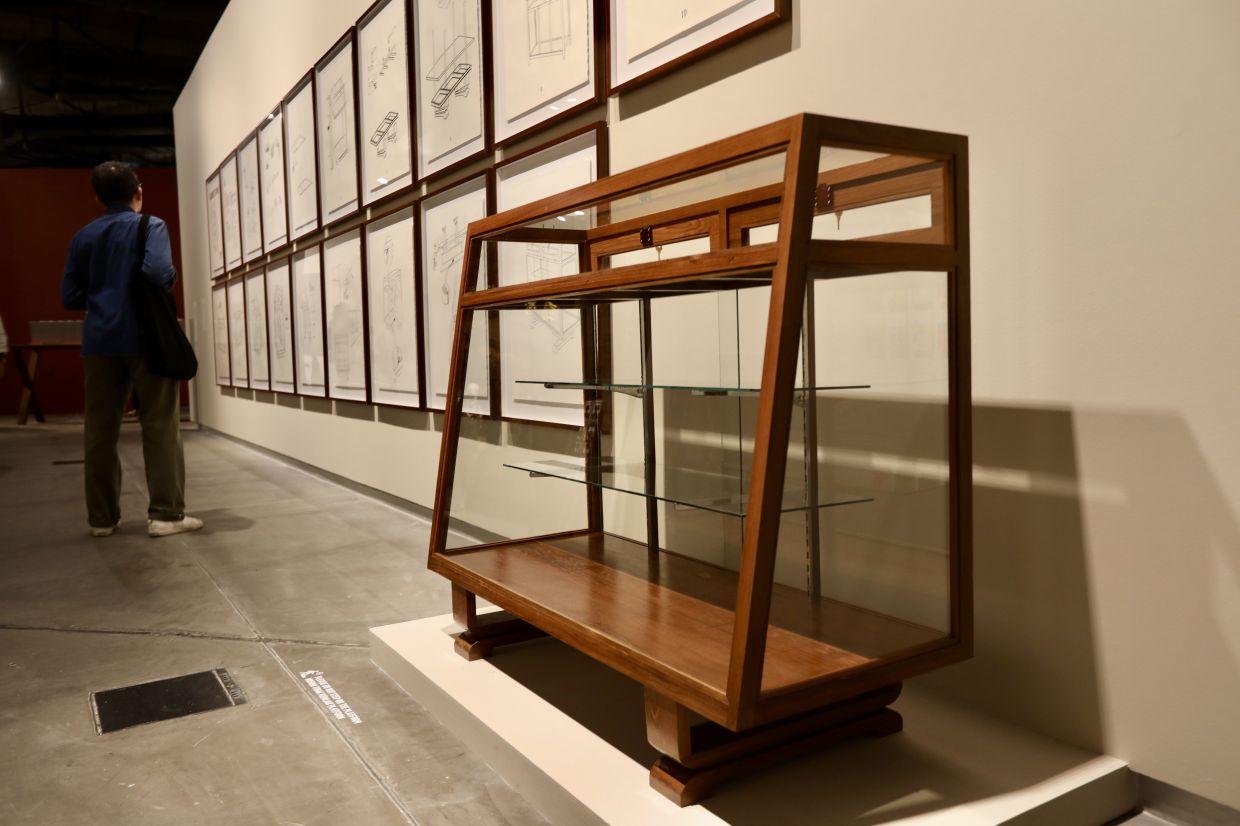
In his series of charcoal paintings paired with a vintage 1960s furniture installation, Arikwibowo “reverse engineers” the wooden cabinet, producing a hand-drawn manual that maps out its construction.
The work Operation Cabinet is affectionately referred to as "Kabinet Opah" in his manual - a tribute to his late mother-in-law, who had been a constant supporter of his practice and was always curious about how his works came to life.
When he proposed a series of “manual” drawings, 37-year-old artist had to find a wooden cabinet quickly to meet the exhibition deadline. Fortunately, he came across one at a second-hand furniture warehouse in small town Rengit, Johor.
“I felt fortunate that the project came together, drawing curiosity from making sense of the cabinet’s creation and the craft behind it. Its unique design and workmanship also offered a rich source of inspiration," says Arikwibowo.
“With help from the furniture restorer, my manual drawings map out the cabinet being taken apart and put back together - the careful sequence of each piece moving and settling into place. Through this process, I wanted to show what often goes unnoticed: the mix of function and creativity, the patience of craftsmanship, and the quiet, hands-on labour that brought this handmade cabinet to life,” he adds.
Conceptual to cultural
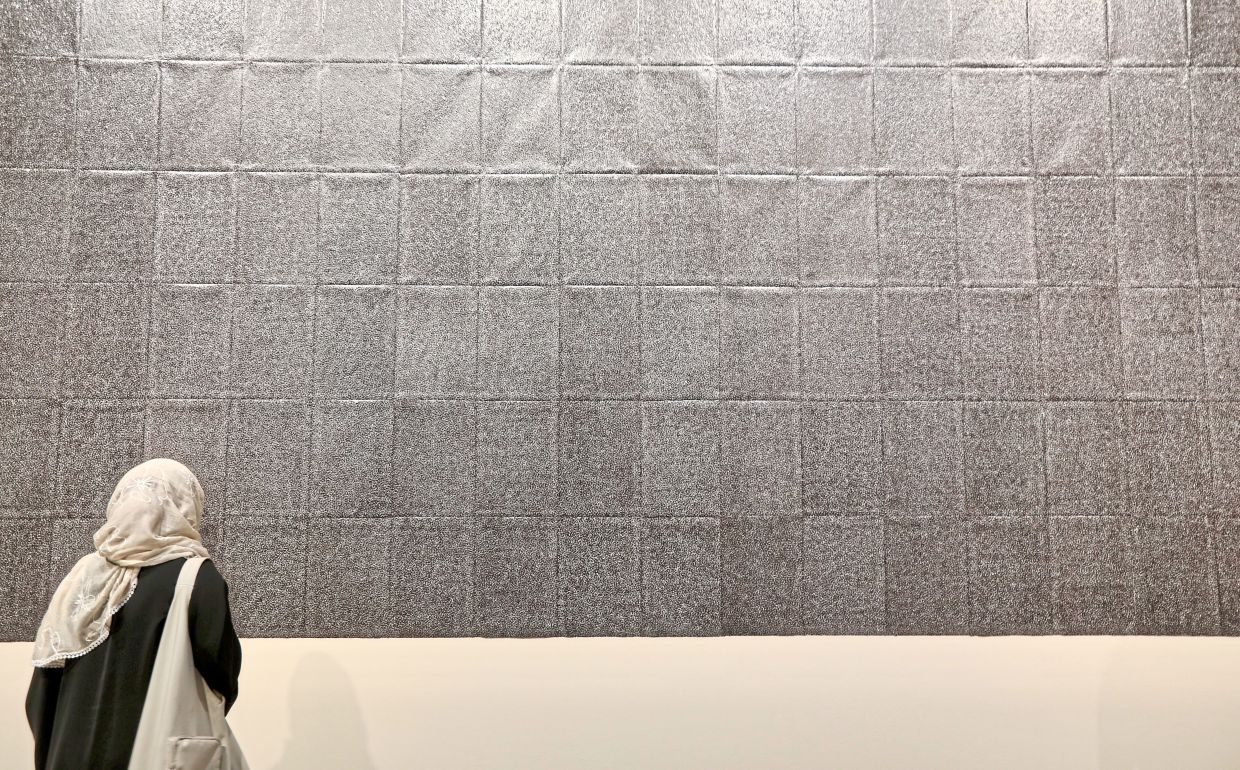
Kim Ng, a printmaker and art lecturer, presents perhaps the exhibition’s most minimalist work with his wall installation A State Of Resilience. Consisting of 120 unique pieces of photocopied paper, each carefully punctured with needles, the installation meditates on human behaviour, materiality, and endurance – inviting viewers to confront the fragility and persistence inherent in both body and spirit.
For nearly two months, Ng, 65, set aside two hours each day before class to work on this project, giving printmaking a conceptual twist.
He admitted that he initially punctured each sheet of paper with needles, but later found a meat tenderiser worked better, speeding up the daily process of piercing the 120 sheets.
“There is no set sequence to the arrangement of the paper. At first glance, the installation appears calm, yet a subtle force pulses beneath the surface – some sheets frayed more than others, bearing the marks of their making.
"Like my art practice, which is steeped in contradictions, this work quietly embodies the interplay between fragility and resilience, order and disruption,” says Ng during a recent exhibition walkthrough.
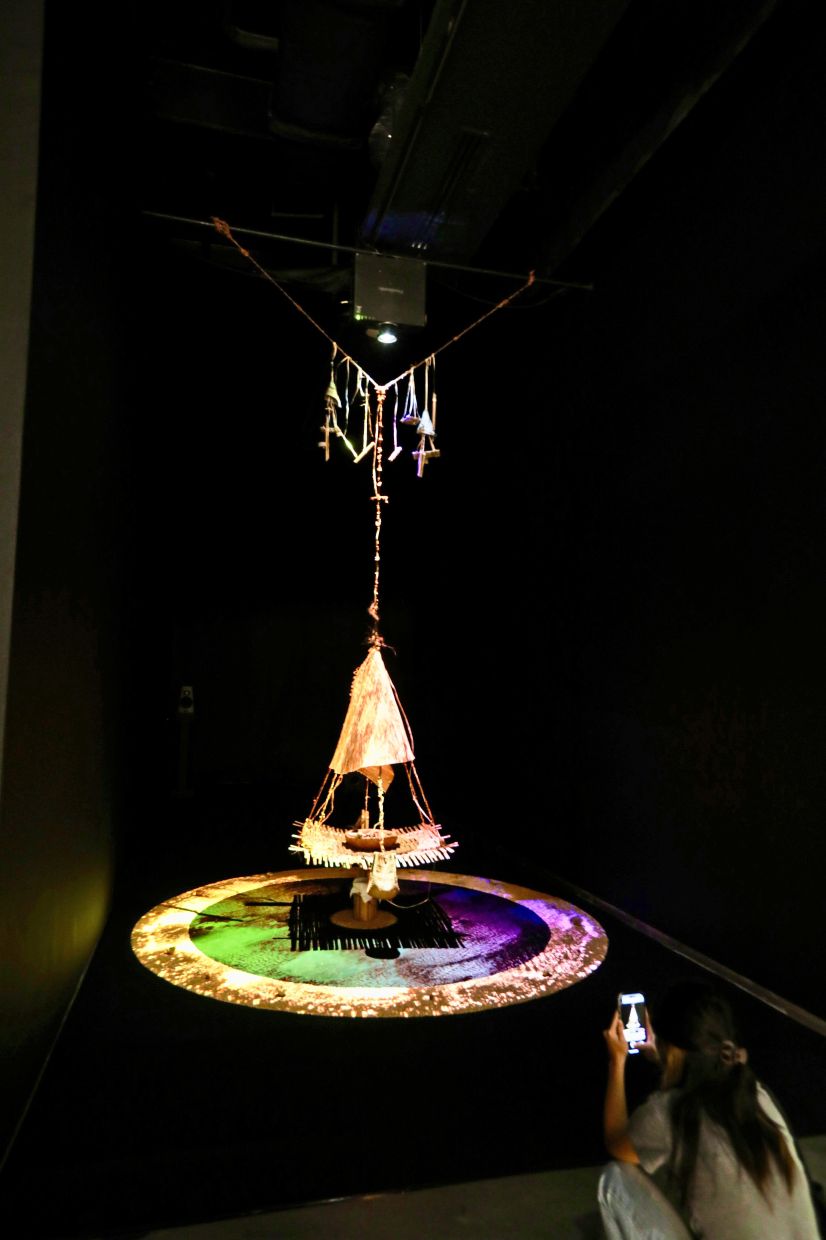
At the far end of the gallery, Kendy’s mixed media installation and video projection, Circle Between Realms, created in collaboration with Studio 1914 and Joey Lee, offers a space to explore Bidayuh culture. Set during a Gawai festival in Kendy’s hometown of Bau, Sarawak, the work brings Bidayuh cosmology into sharp focus through the ritual summoning of simanggi i’eng padi – the spirit of paddy – traditionally performed by the Dayung Borih, a shamanic priestess, during the harvest festival.
“This work is very personal to me. I spent a year back home during the pandemic, exploring traditional rituals, speaking with the elders, and documenting them through field recordings – all of which I have incorporated into this exhibition,” says Kendy, who was also present during a gallery tour, sharing insights with visitors.
Video mapping has added a new dynamic to this installation, while Kendy’s presentation of the shamanic ritual grounds it in tradition.
“Many of these rituals are disappearing, and through this work, I wanted to share a piece of Bidayuh culture on its own terms, preserving its essence for others to experience,” he concludes.
The Ilham Art Show 2025 will also feature a series of public programmes, including exhibition tours and talks throughout the duration of the show.
Ilham Art Show 2025 is showing at Ilham Gallery in KL until April 5, 2026.