The New Museum has always had its finger on the pulse. Since its founding in 1977 in New York, the museum has chased the bleeding edge in contemporary art, looking to showcase what’s happening before it happens. It’s the gallery where hot artists surface first, before they find the limelight in Basel or Miami or Venice, or at establishment museums uptown. Even its location today on the Lower East Side signals something important about the New Museum’s mission as an upstart space that delivers downtown cool.
Future visitors may never know it. For over 20 years, under visionary founder Marcia Tucker, the New Museum operated from various lofts and storefronts across SoHo and other Lower Manhattan neighbourhoods, giving such celebrated artists as Felix Gonzalez-Torres, Ana Mendieta and Carolee Schneemann their first New York exhibitions. After a major expansion, however, the double-wide New Museum resembles the old-guard institutions that it strives to beat to the punch.
On March 21 the New Museum opened the doors to a new 5,761sq m addition that doubles the institution’s size. This is the New Museum’s second project on the Lower East Side in just under 20 years, an achievement all its own, and doubly so for a museum with no art collection.
Yet for a place that’s always challenged institutional dogma, the New Museum has embraced some awfully familiar ideas about cultural space. This US$82mil (approximately RM323mil) expansion finds New York’s first purpose-built museum devoted exclusively to postwar contemporary art embracing its status as a mainstream art space, no longer the underdog as it enters middle age.
The new building adds three new floors of galleries that connect to the original building, significantly opening up the museum’s exhibition areas. The architects at OMA passed the technical test of stitching together the new space with the original building designed by SANAA, creating seamless, flexible horizontal expanses.
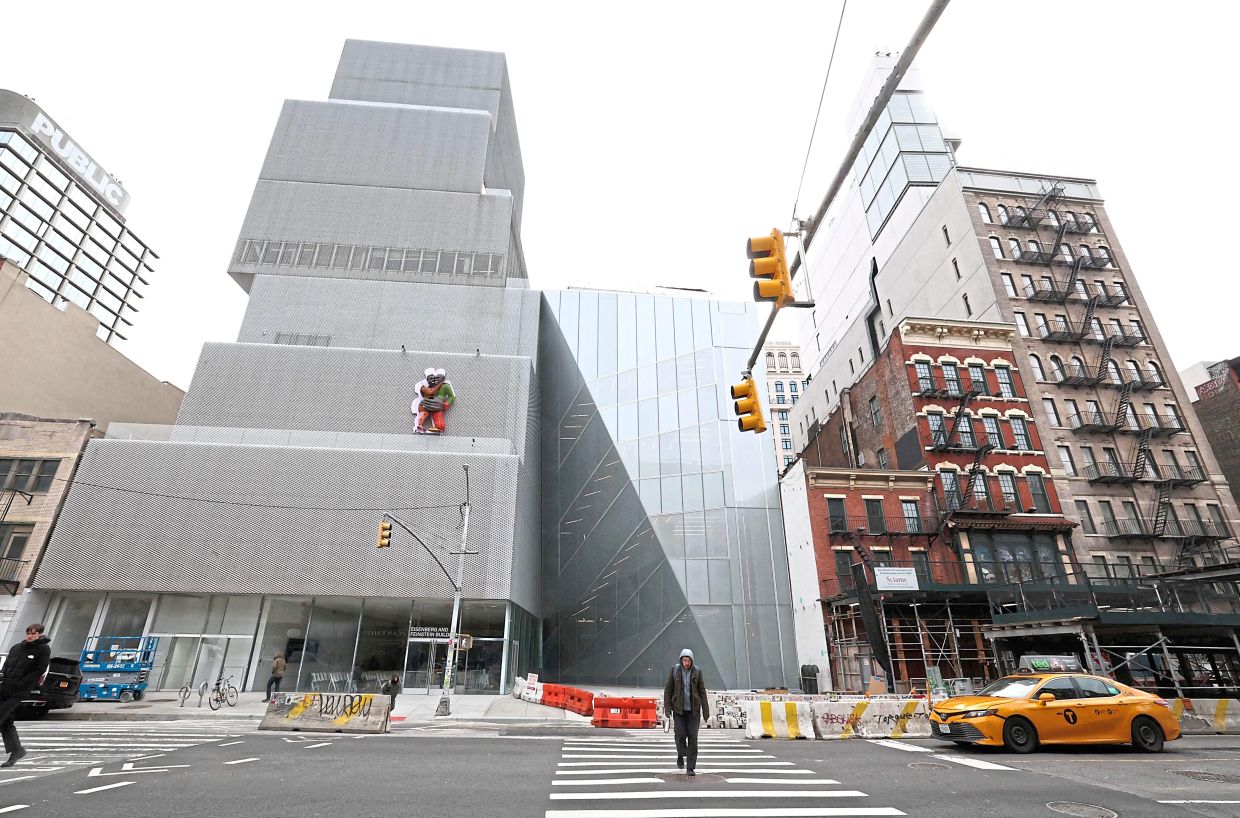
But the addition includes several jarring elements - above all the monumental atrium staircase that hugs the building’s transparent facade - with little rooted in the New Museum’s mission. An inaugural exhibition spanning both buildings, New Humans: Memories Of The Future, is surprisingly historical and even educational in scope - and out of step with the urgent now of Nu Mu at its best.
"Their new building is not a new wing, it’s not an extension, it’s not an annex. It’s a second building in an expanded campus,” said outgoing museum director Lisa Phillips, protesting perhaps a bit too much during a press preview.
Led by OMA’s Rem Koolhaas and Shohei Shigematsu, the design team needed first and foremost to link up with the existing building, a local landmark on the Bowery. They had their work cut out for them.
The forward-looking 2007 design by SANAA’s Kazuyo Sejima and Ryue Nishizawa - a jumble of rectangular galleries, stacked like a bundle of shirt boxes and wrapped with an aluminum mesh that makes the whole thing shimmer - still feels new. Shigematsu described the addition as a balancing act: "We thought less about designing a single object and more about designing a pair.”
On the whole, OMA zigs where SANAA zagged: The new building takes the form of a multifaceted prism, with deep diagonal setbacks to balance the horizontal volumes of the first building. Triangular apertures open up terrace views on the upper floors.
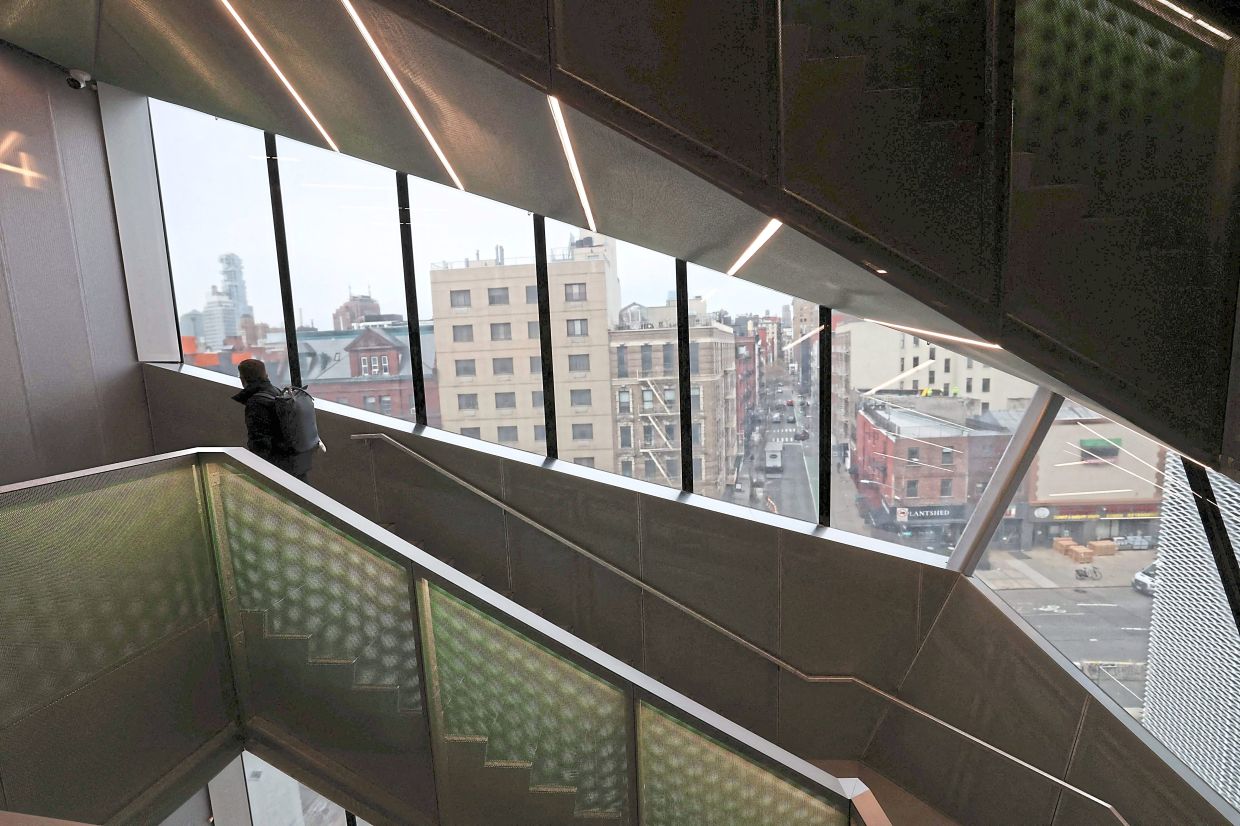
A setback at ground level marks where Prince Street intersects the Bowery, carving out a not-quite plaza to break up the frontage. Looming over this void is the building’s atrium stair, a great vertical column that connects the exhibition floors while providing views of the street.
Such a grand processional space seems more in keeping with a Gilded Age gallery like the Frick Collection than a renegade curatorial practice that operated out of a SoHo loft for more than two decades. Metal-mesh balustrades that crisscross the atrium roughen the edges; back-lit and painted green, the balusters glow with the moiré effect, turning the atrium into a kind of glitchy emerald.
The vision is high tech, but the execution falls short, with paint slapped on structural beams and a few floor panels that buckle when you step on them. It’s nevertheless ideally suited for events, giving the institution space for collectors, donors and influencers to mingle.
It’s here in OMA’s atrium that the harmony of the new New Museum breaks down. Despite its playful form and ethereal facade, SANAA’s 2007 building is ruthless in its maximisation of gallery space. One of the original building’s signatures is a claustrophobic linear staircase with no turns or landings other than a couple of bays where curators can squeeze in just a few more installations.
That staircase is still there, its confines all the more conspicuous given the spacious new atrium and dedicated gallery elevators. I took the old stair anyway and was rewarded with When the Lambs Rise Up Against The Bird Of Prey (2024), an animatronic sculpture by Precious Okoyomon, tucked away in an opening shaped like a trash chute or street shrine.
That’s the New Museum I remember. The old building was strictly made for showing and seeing contemporary art, parties be damned.
New Museum, New Humans
New Humans is a hell of a way to introduce OMA’s new building, given how the show breaks with what longtime viewers have come to expect from the museum.
Curated by Massimiliano Gioni, Gary Carrion-Murayari, Vivian Crockett and Madeline Weisburg and spanning the entire campus, New Humans is an encyclopedic survey of the last century or so of ideas about the human body and how its depiction has evolved in response to new technologies. The show balances historical artefacts with contemporary artworks, looking back to look forward.
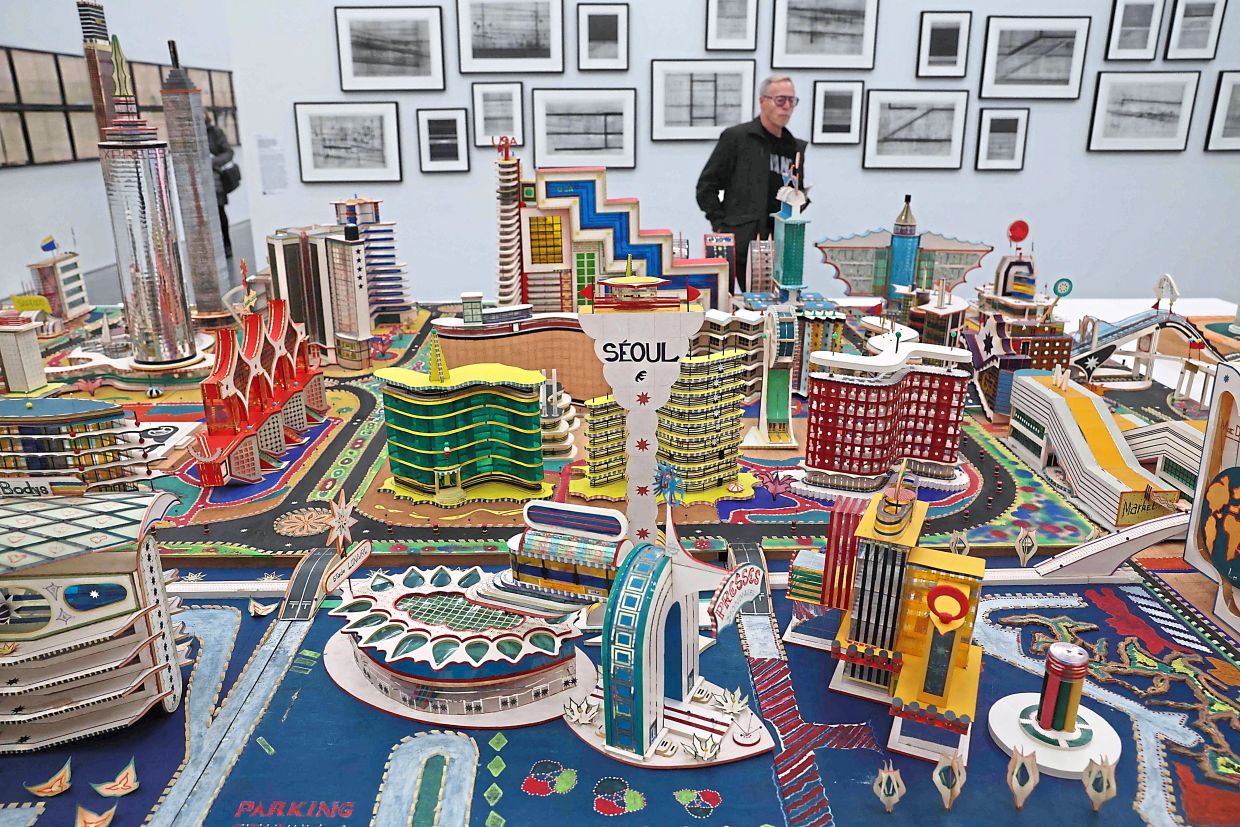
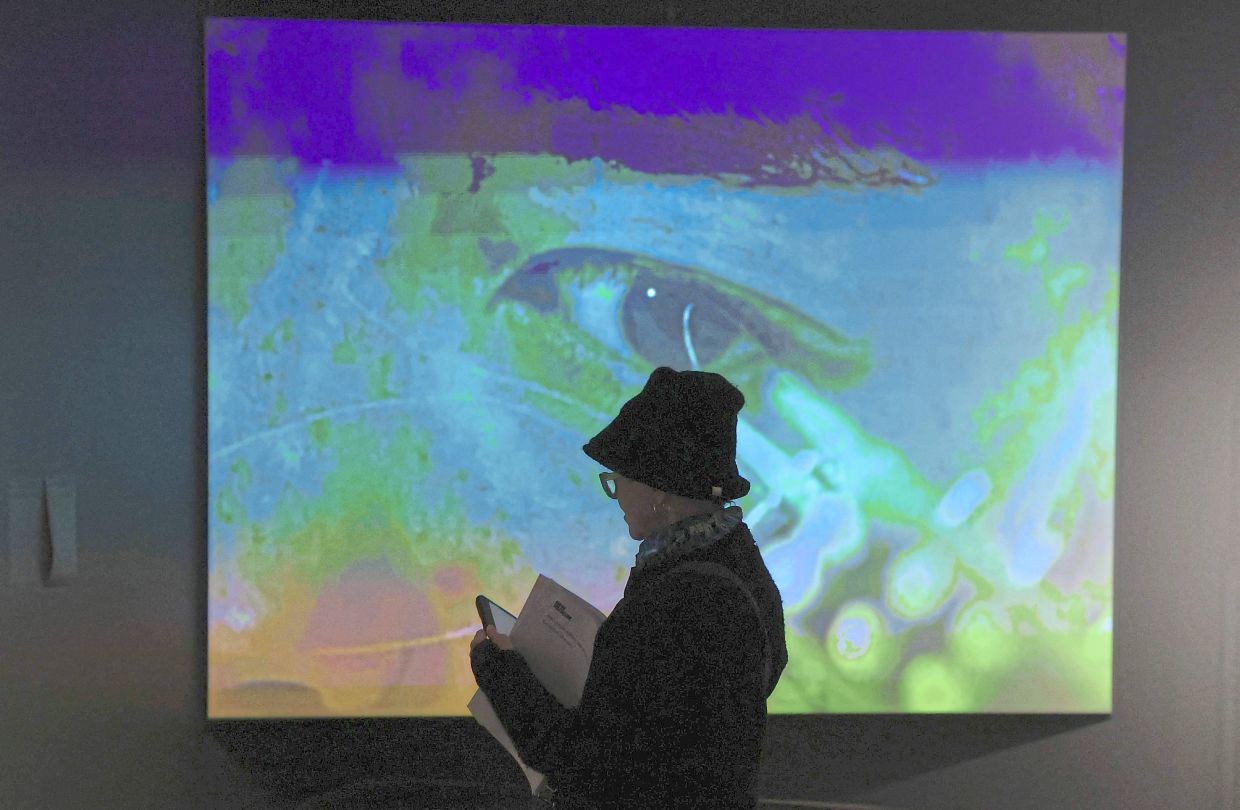
Pictures by Swedish photographer Lennart Nilsson, who developed the first endoscopic photographs of the fetus in utero in the 1960s, hang near a 2022 video installation by Chinese artist Cao Fei of a multiversal avatar with cybernetic implants and tentacle limbs. Susie Bobby Ryan (2022) by the Lower East Side’s own Jamian Juliano-Villani, depicts the interior of the shuttle from Stanley Kubrick’s 2001: A Space Odyssey, a scene over which she’s painted the floating words "Anna Nicole Smith” in watermelon candy-coloured letters.
The hyperreal is familiar territory for Gioni and Carrion-Murayari, hewing close to the theme the curators explored in another New Museum show, 2012’s Ghosts In The Machine. This exhibit goes so much further, with whole galleries devoted to body horror, transhuman interfaces and utopian cityscapes.
It’s a big swing that pairs next-generation stars such as Hito Steyerl and Wangechi Mutu with textbook staples like Marcel Duchamp and Salvador Dali. Some of the present-day artists given prominent placement will be familiar to fans who follow the contemporary art circuit. Juliano-Villani was highlighted by the Venice Biennale a few years back. Others are presented almost like rare finds, such as an immaculately polished aluminum sculpture by Kristin Walsh placed on a vitrine in a (delightfully cramped) hallway chock-a-block with objects. With a legible theme yet countless rabbit holes for viewers, New Humans clears the low bar set by the 2026 edition of the Whitney Biennial across town.
That’s just the thing: New Humans reads more like a sprawling catalog survey by the Met or MoMA than the kind of agile, insistent, fugitive thinking for which the New Museum is known. Unmonumental, the sculpture survey that opened the original building in 2007, was a show for haters: It said no to craft, no to ornament and no to permanence. New Humans, with its winks at pop culture, rigorous scientific history and overflowing wall text, would be a get for the Smithsonian.
Playing to the gallery
If the New Museum felt any pressure to level up, it likely came not from other museums but from commercial megadealers. Over the last two decades, the biggest galleries built enormous storefronts from the ground up and started programming them like museums, launching podcasts, publishing monographs and hosting retrospectives.
New York’s megadealers built infrastructure with museums in their sights. Annabelle Selldorf designed a 929sq m gallery for Barbara Gladstone in 2008, a larger 2,787sq m building for David Zwirner in 2013 and still another 3,345sq m space for Hauser & Wirth in 2020 - all built for showing contemporary art in Chelsea.
In 2019, Pace opened a 6,968sq m gallery designed by Bonetti/Kozerski, a building larger than the New Museum.
None of those white-cube spaces has the same renegade charm as the New Museum, traces of which can be found in OMA’s expansion. Every conceivable corner of both buildings is named after a sponsor, from the Richard Mumby Coat Check up the John S. Wotowicz Stair to the Laura Skoler Atrium Landing - a testament to Phillips’ iron will as leader. The New Museum’s floors look perpetually dirty, but it reads as gritty.
And the new building’s floors already look perma-scuffed. That’s no knock: After a 20-year arms race, the art market has cooled substantially, and contemporary art spaces are due for a reset.
The New Museum was meant to be a space for New Yorkers, not just buyers. Even at its shiniest, the New Museum still feels close to the ground. - Bloomberg