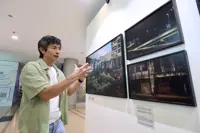
The Borneo Cultures Museum showcases a wide range of artefacts and extraordinary exhibits that represent Sarawak’s rich culture and history through the ages.
Here are some of the museum’s star attractions.
Niah ‘Deep Skull’
This skull was among several bone fragments discovered from excavation works within a deep trench in the Niah Caves in 1958. Early studies suggested that the skull belonged to a young man, but it was later found to be that of a young woman. Charcoal samples date her burial to about 35,000 years ago while 2016 research suggests that the fragments came from an early indigenous South-East Asian population. Stone tools found in the trench are evidence of early human settlement in Borneo around 50,000 years before present.

‘Kelirieng’
This is a replica of a kelirieng, or burial pole, which belonged to the family of Kebieng Tuluy from Long Segaham in Sarawak’s Belaga district. It is carved with dragons, miniature creatures and hudo’ figures with huge fangs and jaws, which took craftsmen two years to complete. In its original location, it was surmounted by a large flat stone. The actual kelirieng now stands in the grounds of the Borneo Cultures Museum.

Sleeveless bark jacket
Before cotton came to Borneo, most garments were made from processed tree bark. This sleeveless jacket is made from cotton and tree bark, then painted with natural dye in a pattern called border dragon (aso) by the Kenyah ethnic community. The jacket is part of 412 artefacts from the Nusantara Museum in the Netherlands which were returned to Sarawak recently.

Hornbill casque earring
This is a rare earring made from the casque of a helmeted hornbill, worn only by men as a personal adornment. Helmeted hornbill casque earrings are delicate and beautiful, standing out by their colour and shape. Only a few individuals could carve this type of earring, showcasing their skill in carving fine designs on the ivory.

Beaded bridal attire
This “baju ujan” or “ngepan marik” is a traditional Iban bridal attire made from beads. It is usually worn with a matching “dujung marik” beaded headdress and a short bead train known as “tali ujan”. The “ngepan marik” originates from the Batang Rajang area in Kapit and the beads used in constructing it are very valuable.
‘Fahua’ vase
This is an original globular “fahua” vase with a tall neck and garlic-head mouth. “Fahua” refers to Chinese wares decorated using the cloisonne technique, where the design motifs are outlined in relief and filled in with brightly-coloured glazes. This “fahua” vase is decorated with the Eight Immortals standing on clouds. The Eight Immortals are well-known figures in Chinese mythology. Only a few vases decorated with the Eight Immortals exist, dating from the 15th to 16th centuries of the Ming dynasty.
Already a subscriber? Log in
Get 20% OFF The Star Digital Access
Cancel anytime. Ad-free. Unlimited access with perks.