Debut cookbook Penang Makan offers a fresh new halal take on the street food of the state


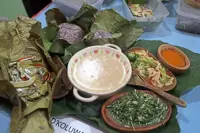
Nasi kandar dishes are some of the over 50 recipes highlighted in Wong's debut cookbook. — Photos: PENANG MAKAN

As a child growing up in Penang, Dayana Wong was constantly enthralled by the food of the island-state, mostly because she was lucky enough to be surrounded by it day and night.

In her halcyon formative years, she remembers steaming plates of char kuey teow helping to fortify her stomach (and her brain) before a particularly gruelling exam or how just the promise of oh chien (oyster omelette) could help speed up the progress of her dreaded Maths homework.

Wong also loved cookbooks – a fondness that began as a child when she would peer at the pages of her edition of Rohani Jelani’s Good Food for Kids and imagine the feasts that could be prepared using those recipes.

“I’ve been collecting cookbooks since I was a kid. I didn’t know how to read then, but I just liked flipping through the book and looking at the pictures and words. And I would tell my mum, ‘Mum, can you cook this for me?’ So that’s how I started,” she says.

As an adult, Wong spent a considerable amount of time in Toronto, Canada and London, UK, where homesickness and an inability to find the Penang food of her childhood had the serendipitous effect of turning her into an accomplished home cook.

Growing up, Wong remembers how the appeal of alluring street food like oh chien (oyster omelette) would propel her to finish her homework faster!

“I was in Toronto to do my degree and the first thing I missed was not my family, but the food! So I called up my mum and asked her how to make dishes like curry mee, because at the time, there were not many cookbooks on Penang street food.

“So that’s how I learnt to cook. I am not a professional chef, I just started cooking for the sake of wanting to eat the food that I love,” she says.

When Wong returned to Penang, she worked as an investment banker, but her love of food and cookbooks loomed large in the background.

So over a two-year period, she began testing and writing street food recipes that encompassed the essence of Penang’s veritable culinary playground, with the aim of crafting a full-fledged cookbook of her own.

To put together her inaugural cookbook, Wong pored over family recipes and cooked them under the watchful supervision of her 69-year-old mum Hayati Ismail. She also trawled the Internet for recipe ideas for dishes that she had no clue how to make.

Wong's love of cookbooks started when she was a child and has now culminated in the publication of her very first cookbook, which pays homage to the street food she grew up with.

“Usually, I would cook on the weekends and holidays with my mum. We often did it together so I learnt a lot of tips and tricks in the kitchen by cooking with my mum.

“Like sometimes I would write a recipe and when we made it together, she would say, ‘Oh, that’s not how I make it!’ and so I would tweak it according to what she said,” says Wong.

In November 2021, all of Wong’s hard work finally came to fruition when she published her cookbook Penang Makan: Heritage Street Food Recipes.

Challenges aplenty

The road to publishing her own cookbook hasn’t been an easy one. Wong lives and swears by the agak-agak (guesstimation) method of cooking invoked by many Malaysian home cooks, which is why converting sprinkles, dashes and handfuls into accurate measurements proved more of an uphill task than she could ever have imagined.

“I’m not very methodical, so I just use my instincts to cook. And when I was writing down the recipes, the person who was helping me was my boyfriend Kévin Poncelet, who is from Europe. And he was always like ‘Use the measuring cups’ or ‘Use a spoon when you cook’ but I was like ‘Aargh’!

“I feel so restricted when I cook that way, but in the end, I had to do it,” she says.

The cookbook took Wong over two years to put together and she eventually published it herself.

Dayana and Poncelet (who helped her throughout the project) then used their friends as guinea pigs and assigned five recipes for each friend to try to ensure that each recipe worked.

“I gave it to my friends and asked them to try it out exactly as it was written, so all the recipes have been tested by other people,” she says.

But what ended up being Wong’s biggest hurdle wasn’t the trial-and-error involved in perfecting each dish; it was the far more serious obstacle of finding a publisher willing to publish her cookbook.

“It was hard to get a publisher to publish the book because I’m a newbie author and the book industry these days is not doing well, so most publishers don’t have the budget for this as a cookbook is quite an expensive project,” she says.

Battle-weary but unwilling to give up, the intrepid Wong decided to set up her own publishing imprint instead and published the book herself – a move which she says ended up being for the better in the end.

“I decided to create Bulan Press, which is the publisher of this book, so in a way, it was a blessing because I got to control how the book ended up looking and what went into it,” she says.

The book

Penang Makan: Heritage Street Food Recipes is clearly a labour of love. The time and effort that has gone into the over 50 dishes and 150 pages of the cookbook is fairly obvious from the get-go, from the beautiful imagery to the carefully selected recipes – essentially a compilation of all the street foods that make up Wong’s personal favourites.

The famed Ramly burger is a meal that Wong felt needed to be included in her cookbook, because of its strong appeal among Malaysians and tourists.

Also, unlike many modern cookbooks which weave in copious amounts of food anthropology, memories and lengthy narratives, Wong’s book harks back to those simple, fuss-free nostalgic cookbooks of yore which were sparing but gave you all the information you really needed to get started in the kitchen.

“I didn’t really know where the cookbook was headed, so I wanted to keep it simple,” admits Wong.

Recipes in the book range from char kuay kak to oh chien, Penang rojak, Penang assam laksa, nasi kandar dishes, Penang Hokkien mee, duck kuay chap and so much more.

Wong says some of these dishes have been losing favour over time, and are consequently difficult to find even in Penang.

“Some of the recipes that I don’t see anymore in Penang are things like duck kuay chap (duck cooked for hours in a soy-infused sauce) and kerabu bihun (a Nyonya noodle dish). So those are the things that I wanted to bring back through the cookbook.

“Also I put in a few new things, like the Ramly burger – that was a request from my boyfriend, because he really likes it. When he came here, he said the Ramly burger really stood out for him, so these are some of the new iconic foods that I’ve added to the book,” she says.

One of the major highlights of Wong’s book is that while it showcases some of Penang’s best street foods, it is also Muslim-friendly, so dishes like lor bak (pictured here) have been adapted with pork substitutes like chicken.

Perhaps the book’s biggest point of differentiation is that all the recipes are Muslim-friendly, making it one of the most inclusive cookbooks to highlight the cuisine of the state. Wong says this was particularly important to her as she is Muslim (her mum is Malay and her dad is Chinese) and as many Penang dishes are non-halal, she wanted more Malaysians as well as tourists to be able to experience the food of the state.

“The book is a halal take on Penang street food, because I wanted to make the book more inclusive for everyone, so that everybody can experience the same thing.

“Many Penang dishes have pork elements, like Penang curry mee often has a serving of coagulated pig’s blood and lor bak is a pork-based dish. So wherever there is pork, I use chicken or beef as a substitute. And for things like pork lard, I find that a good alternative is chicken skin. So I tried to make it more halal-friendly,” she says.

In the book you will discover inclusive versions of Penang staples like lor bak (traditionally a five-spice pork roll) made using chicken fillets; Penang Hokkien mee broth made using chicken bones instead of the usual pork bones; wantan mee with barbecued chicken slices; and kuay chap (a rice noodle dish) that uses duck as a broth base instead of pork.

Wong says even though these halal versions of Penang street food are not true to the roots of these dishes and don’t fully mimic their structural DNA, she feels that these iterations are reflective of the changing ways that food has adapted to suit times and needs.

“I think food – like culture – evolves with people and people are looking for ways for food to be more approachable. I feel like making it halal-friendly is the natural progression that it was going to go to, rather than keeping it super authentic.

“Yes, I want to keep the essence of these foods but I want more people to know about it, so it’s about making it accessible to others who have not experienced it before. This will make these recipes live longer,” says Wong.

Moving forward, Wong is hard at work getting her book into more bookstores in the Klang Valley as well as readying it for delivery to Europe and beyond, as she feels that many tourists who have been to Penang will be drawn to the book.

“Ultimately, this is a book for people who want to cook and eat Penang food at home and share it with their family and friends,” she says.

For Wong though, perhaps the ultimate triumph in creating this cookbook is seeing how proud her parents – once sceptics of her fledgling endeavour – now are.

“Initially, my parents were not really keen on the idea, because being typical Asian parents, they would rather have me work on something that makes money. But when they saw the book, they were really proud of me.

“So now they will go into a bookstore that stocks my cookbook and they will say very loudly (so everyone in the shop can hear them) – ‘This cookbook is going to be a best-seller!’” says Wong, laughing.

Penang Makan: Heritage Street Food Recipes is priced at RM120 and available on www.bulanpress.com as well as Lit Books in the Klang Valley.

Get 20% OFF The Star Digital Access

Monthly Plan

RM 13.90/month

RM 11.12/month

Billed as RM 11.12 for the 1st month, RM 13.90 thereafter.

Best Value

Annual Plan

RM 12.33/month

RM 9.87/month

Billed as RM 118.40 for the 1st year, RM 148 thereafter.

Follow us on our official WhatsApp channel for breaking news alerts and key updates!

Next In Food News

KL hotel offers trio of culinary experience until September
Classic British teatime� treat with a bit of bite
Eat up your veggies for your lungs�
Kampachi Restaurants' new campaign maps the food of Japan's 47 prefectures
A mochi twist and bake
Spicy Thai classic stir-fry
Twin culinary traditions meet at Sunday brunch
Classic churros reimagined with playful twists
Crisp, tangy irresistible acar hu
French classics reimagined with local flavour

Others Also Read