




Ahead of next month’s expected summit between US President Donald Trump and Chinese leader Xi Jinping in Washington, a low profile US regulatory agency has opened a new front in the technology battle between the world’s two superpowers, even as it attempts to avoid sabotaging the vital high-stakes meeting.
The latest action by the Federal Communications Commission (FCC) in July saw it advance stringent bans on new Chinese robots and power inverters.
The move came after months of FCC measures that did not prompt a direct retaliatory response from Beijing, even as the agency continued to expand its restrictions.
Although China held its fire ahead of the last Trump-Xi summit in May, that restraint appears to have ended following the FCC’s latest steps.
Beijing’s retaliation last week – imposing drone export controls and sanctioning US testing firms – signalled the expansion of an already crowded field of tit-for-tat actions involving tariffs, export controls and the blacklisting of each other’s companies.
Former senior FCC officials defended the agency’s national security mandate to protect US technology sectors and communication networks from Chinese influence.
But analysts said these aggressive regulatory moves highlighted a delicate balancing act for the Trump administration, which is seeking to curb Chinese presence without shattering the fragile trade truce brokered last October.
Experts argued the FCC offers the administration a relatively low profile tool to advance its technology agenda, targeting specific sectors, equipment categories and approval processes rather than relying on broad tariffs or export controls. Its existing regulatory authority also allows it to act through national-security and communications rules.
However, they cautioned that the approach could increase the chances of missteps.
“Securing the nation’s networks has always been a priority,” Tom Wheeler, the FCC chairman from 2013-2017, said in an email to the South China Morning Post.
“The Trump administration may be trying to restrict Chinese tech products without upsetting the Busan trade truce,” said Kyle Chan, a fellow at the John L. Thornton China Centre at the Brookings Institution.
“There is certainly a risk of miscalculation here,” he added.
FCC spearheads China crackdown
The FCC has quietly emerged as one of the Trump administration’s most aggressive agencies targeting Chinese technology companies on national security grounds, even as other departments, including Commerce and Treasury, have taken a back seat.
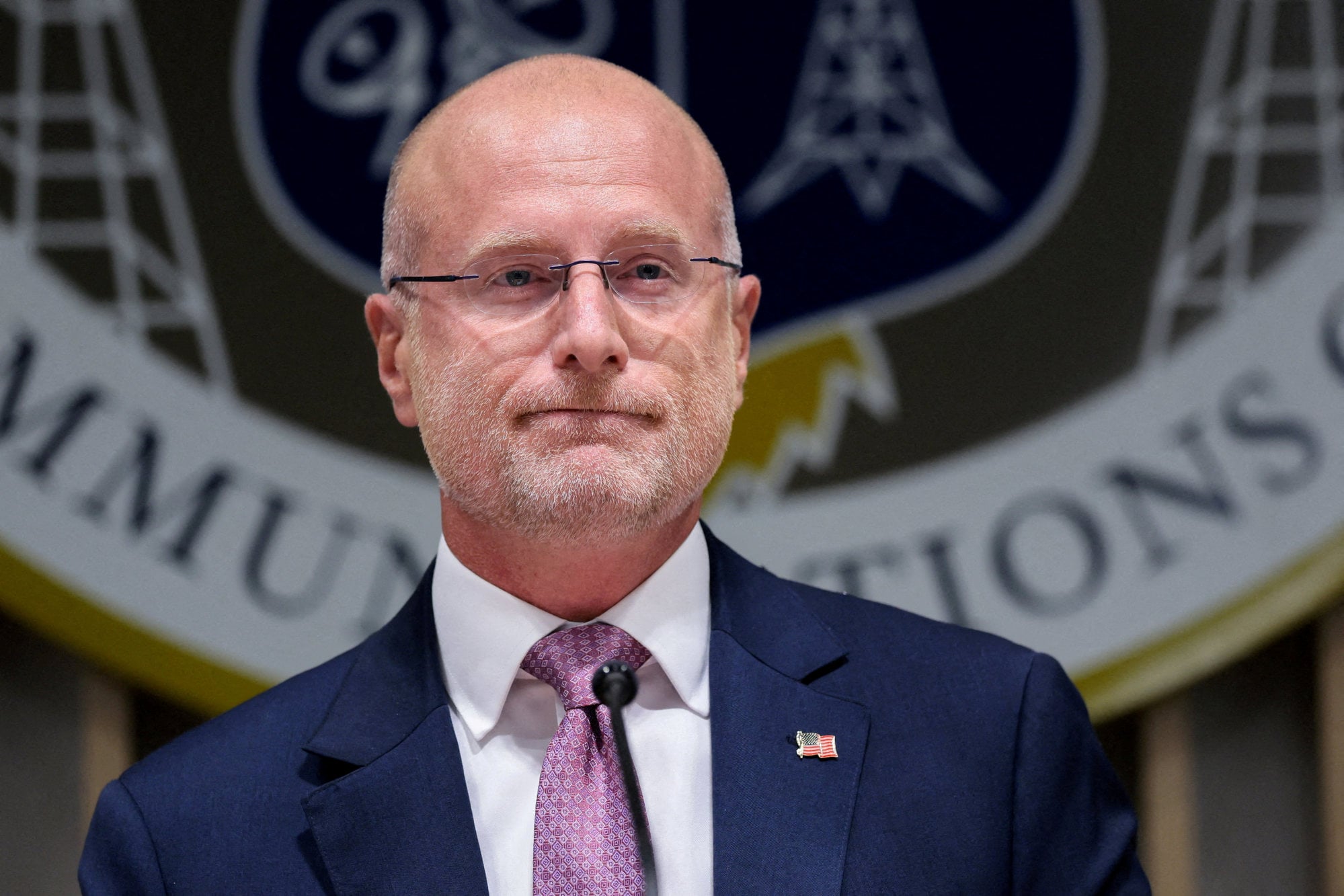
Under Chairman Brendan Carr, the agency has pursued a two-pronged strategy: combining targeted measures against individual Chinese companies with sweeping, category-wide bans and supply-chain restrictions.
In April, it advanced a proposal to ban Chinese telecoms operators – China Mobile, China Telecom and China Unicom – from operating data centres in the US.
It also moved to bar Hong Kong telecoms carrier HKT International from operating in America, with Carr asserting that “CCP-controlled entities that pose national security risks to our country cannot connect to our telecom networks.”
That salvo followed a move in December last year, when the agency implemented a series of sector-wide crackdowns, including a stringent ban on imports of new Chinese drones, followed by restrictions on new models of consumer routers in May and robotics and power inverters in July.
The products were among those targeted by the FCC’s Covered List, which identifies communications equipment and services deemed to pose an unacceptable risk to US national security.
“Advanced robotic devices collect data that could be leveraged by malign actors to surveil Americans, enhance the capabilities of foreign intelligence services, or to remotely commandeer the robots,” the FCC said after announcing the robotics ban in July.
Additionally, it advanced a proposal to ban what it calls Chinese “bad labs” from testing electronic devices headed to the US. According to the agency, around 75 per cent of all US electronics are tested in China.
“Some of those labs themselves were linked or controlled by or tied to the PLA [People’s Liberation Army], so not necessarily the most trustworthy,” Carr told TBPN, a technology-focused online network, earlier this month.
“We’re now inserting national security checks in that lab process.”
The agency has increasingly invoked national security to justify measures targeting Chinese companies and technology across the US communications and technology ecosystem.
In March last year, Carr launched the FCC’s Council on National Security to “promote America’s national security and counter foreign adversaries.”
“Today, the country faces a persistent and constant threat from foreign adversaries, particularly the CCP,” Carr said at the time.
In response to a query from the SCMP, an FCC spokesperson said that “Covered List actions are country-neutral and apply to all foreign-produced devices that meet the criteria.”
“The FCC will continue to be in lockstep with the entire administration to protect Americans from foreign threats and make sure that the United States is in the best position to deliver on President Trump’s vision to lead the world on the next generation of technologies,” the spokesperson added.
The Chinese embassy in Washington did not respond to a request for comment.
Trump has repeatedly used the national security rationale to justify policies ranging from border fencing and mass deportations to tariffs, domestic energy policy and timber harvesting on federal land.
Analysts and legal scholars argue that “crying wolf” – using “national security” as a pretext for political expediency – risks undermining faith in institutions and eroding trust if a genuine catastrophe strikes.
However, Wheeler asserted that protecting national security is a core mandate of the FCC, noting: “National security is a Section One responsibility of the FCC, meaning the first section of the Communications Act.”
The FCC was established in 1934 under the Communications Act, which states that the commission was created “for the purpose of the national defence” and “for the purpose of promoting safety of life and property through the use of wire and radio communications”.
Rachelle Chong, a former FCC commissioner, argued that the agency’s council on national security “centralises the effort across multiple bureaus” and “expressly treats strategic competition with China as an organising agency priority”.
“The FCC’s national-security role is both older and broader than many people realise,” she said.
She described the first Trump administration as an “important turning point”, pointing to the FCC’s denial of China Mobile’s application, restrictions on the use of federal universal-service funds for Chinese tech companies Huawei and ZTE equipment, and the establishment of the Covered List and removal-and-replacement programme.
“Over the last decade, the FCC’s role has evolved from reviewing individual foreign entrants to protecting the communications supply chain as a whole,” Chong said.
Chan, of the Brookings Institution, noted that the FCC has emerged “as an increasingly popular tool for restricting Chinese tech products”.
“It can act relatively swiftly compared with other government restrictions,” he said, adding that the administration “appears to be making moves designed to operate below the threshold of upsetting the Busan truce”.
“The FCC is further away from trade negotiations with China compared with Commerce and Treasury.”
After months of escalation marked by high tariffs and China’s restrictions on rare earths, the two sides reached a one-year arrangement in Busan, South Korea, last year under which Washington agreed to suspend additional export controls in exchange for continued flows of critical minerals from Beijing.
Under the arrangement, the Commerce Department’s Bureau of Industry and Security (BIS) suspended its Affiliates Rule, which had expanded export restrictions to companies owned 50 per cent or more by entities on the Entity List, and has not added new Chinese entities to the list since last October.
While the Busan understanding was reaffirmed during the Trump-Xi summit in May, both sides have kept the pot simmering with tit-for-tat actions without allowing tensions to spiral, particularly ahead of Xi’s expected visit to the US next month.
After more than a year of refraining from directly retaliating against FCC actions, China’s response last week went beyond the tighter drone export controls to include sanctions against seven US companies and Beijing’s first foreign trade-related national security investigation.
“I assess it as a shot across the bow, especially as the FCC actions began to add up,” said Sourabh Gupta, the head of the Trade and Technology programme at the Institute for China-America Studies.
“You could call it a case of the ‘new normal’ in ties taking shape, one uncoupling at a time.”
Chan argued that there is a “risk of miscalculation” where a “relatively minor action by Washington may be interpreted as a major escalation by Beijing”.
However, according to Gupta, the FCC’s “nicks and cuts” are just “a small sting each time”.
“The very fact that the administration took recourse to the FCC in the first place rather than have Commerce’s BIS issue the order – say, by dumping the Chinese vendor on the Entity List – itself suggests that the administration is attentive to avoiding miscalculation.” -- SOUTH CHINA MORNING POST



