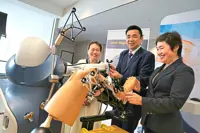
A German startup has developed a humanoid robot equipped with several senses. In fact, it can see, hear and touch, thanks to impressive on-board technology.
Cognitive robotics specialist, Neura Robotics, has raised some €120mil (RM556.39mil) for the development of its future models. Today, its most advanced robot, capable of learning and adapting to different environments, is the 4NE-1.
It stands out for its advanced technical features and multiple functionalities, making it suitable for assisting humans in various aspects of daily life. It measures 180cm, weighs 80kg, can walk at 3km/h and handle loads of up to 15kg.
At present, this robot can recognise objects, understand its environment and interpret the gestures of people close by. The idea is for it to be able to interact with humans, whether in the home or in the workplace.
Whether for domestic or industrial applications, this robot aims to improve quality of life. It can be described as a cognitive robot, thanks to its advanced capabilities that enable it to perceive, interpret and interact with its environment intelligently.
In the home, it could very well take out and iron the laundry, set the table and wash the dishes. At work, it could select, carry and move materials and even... make sandwiches.
Integrated intelligence and autonomy are the two challenges currently being taken up by humanoid robot manufacturers. The American company Boston Dynamics, for example, recently demonstrated that its Atlas robot can now operate autonomously, adapting to its environment whatever happens. The automotive industry should be the first to benefit from this technology.
For its part, Physical Intelligence is working on robots capable of carrying out increasingly complex household tasks by imitating human gestures, in collaboration with OpenAI. Norwegian company 1X Technologies has already demonstrated that it is now possible for humanoid robots to perform several tasks in succession by responding to instructions given orally by humans.
The same applies to Figure, one of whose robots can describe objects placed in front of it, or stack dishes on a draining rack. – AFP Relaxnews