




SCOLIOSIS is characterised by an abnormal curvature of the spine and has an incidence rate of about two to three per cent in Malaysia.
ALTY Orthopaedic Hospital consultant orthopaedic and spine surgeon Dr Wong Chung Chek says that the most common form is adolescent idiopathic scoliosis (idiopathic means the cause is unknown), which typically develops in the teen years.
Family clustering is frequently observed in adolescent idiopathic scoliosis, with well-documented cases of mothers, grandmothers, and cousins sharing the condition. Epigenetic factors also play a significant role in disease development. Notably, girls are substantially more likely than boys to develop symptomatic scoliosis.
Recognising the signs early
The condition is usually painless in its early stages and it is very difficult to detect during this time as the signs can be very subtle, says Dr Wong.
Dr Wong recommends a simple screening manoeuvre: positioning the patient with feet together and asking them to bend forward at the waist until the torso is parallel to the ground, allowing the arms to hang freely. The examiner should observe the back carefully from behind and from the side, noting any asymmetry.
Because scoliosis can progress rapidly during growth spurts, early assessment is crucial as delayed diagnosis may allow the curve to worsen. If left untreated, this can lead to a range of complications over time.
“In severe cases, large thoracic spinal curves can reduce the space available for the lungs and the heart, potentially affecting breathing and overall cardiopulmonary function.
“In the lumbar spine, large curves can cause nerve impingement and its resulting sequelae. Therefore early detection and appropriate treatment are important to help prevent curve progression and minimise these long-term complications,” observes Dr Wong.
Understanding options
Treatment selection depends on the patient’s age, curve severity, remaining growth potential, and likelihood of progression. The traditional approach involves observation for mild curves, bracing for selected moderate curves in growing children, and surgical intervention for severe or progressive deformities.
For decades, spinal fusion has remained the gold-standard surgical treatment for significant scoliosis. In this procedure, vertebrae are permanently joined together to correct the curve and prevent further progression.
As the vertebrae are permanently fused, it eliminates motion in that segment of the spine, resulting in loss of flexibility and range of movement.
In younger patients with substantial remaining growth potential, spinal fusion is generally less desirable in younger patients as the fused segment cannot grow longitudinally.
In the long term, the increased mechanical stress placed on the adjacent unfused segments may contribute to accelerated wear and degeneration of those vertebrae.
Vertebral body tethering
Advances in surgical technique have created alternatives for carefully selected patients.
Vertebral body tethering (VBT) is a procedure that has recently been introduced in Malaysia, offering selected patients a growth-modulating approach that preserves spinal motion and continued longitudinal growth. He notes that early outcomes from the procedure have been encouraging in appropriately selected patients.
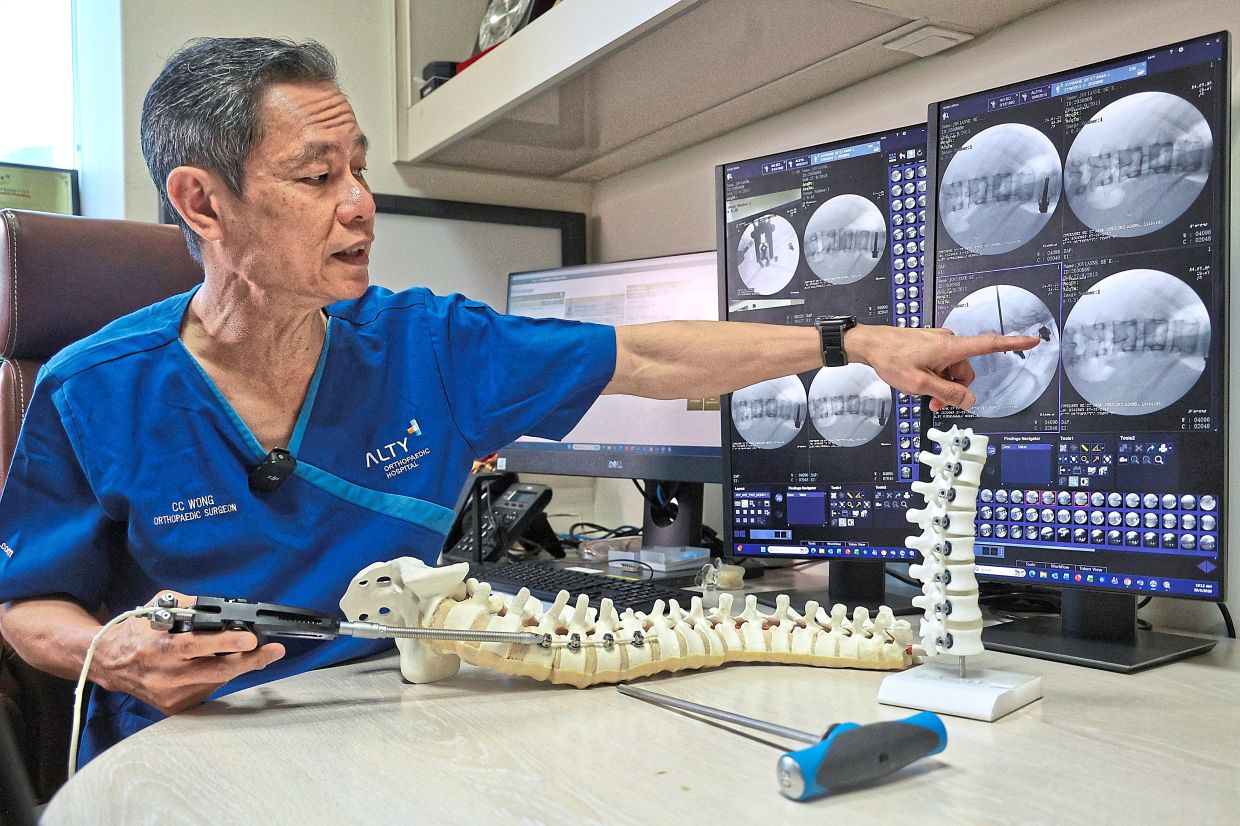
“Instead of permanently fusing the spine, surgeons place screws into the vertebrae on the outer side of the curve and connect them with a flexible cord (a tether). The tether is tightened to partially straighten the spine.
“As the child grows, the tether slows growth on one side of the spine while allowing the opposite side to continue growing normally. Over time, this can help further correct the spinal curvature,” says Dr Wong.
Potential benefits include greater spinal flexibility, continued spinal growth and improved spinal motion (compared with fusion, especially in the lumbar spine).
Because VBT surgery is approached from the front and uses minimally invasive (keyhole) techniques, this reduces postoperative pain, shortens hospital stay duration, and facilitates an earlier return to physical activity.
Not all patients with scoliosis are candidates for VBT. Current approval focuses primarily on adolescent idiopathic scoliosis with significant residual growth potential and curves falling within a defined range. Patients must satisfy specific clinical and radiological criteria established by their specialist. Those who have completed skeletal maturity or who present with certain curve characteristics may achieve superior outcomes with other treatment approaches.
Recovery and long-term expectations
Most patients resume normal physical activity within approximately four weeks. VBT-specific potential risks include lung-related complications (related to the surgical approach) and tether breakage over time.
In select cases, revision surgery may be necessary if the curve progresses, the tether fails, or target correction is not achieved. Therefore, meticulous patient selection and close postoperative follow-up are essential to optimise outcomes and minimise the risk of complications.
Key takeaways
Dr Wong’s message is clear and simple: “The earlier scoliosis is identified and a decision is made to treat it, the more opportunities doctors have to intervene appropriately.
“This highlights the importance of scoliosis awareness among parents, teachers and healthcare providers.
“Routine screening and timely medical evaluation when abnormalities are detected can make a significant difference in outcomes and help safeguard children’s long-term health and well-being.”


