FOR years, success for a Bumiputera business development agency was measured in cheques written and companies funded – the more, the better.
But the Teraju Bumiputera Corporation (Teraju) has quietly come to a different conclusion – one that aims to reshape how the agency approaches its role in Malaysia’s economic landscape.
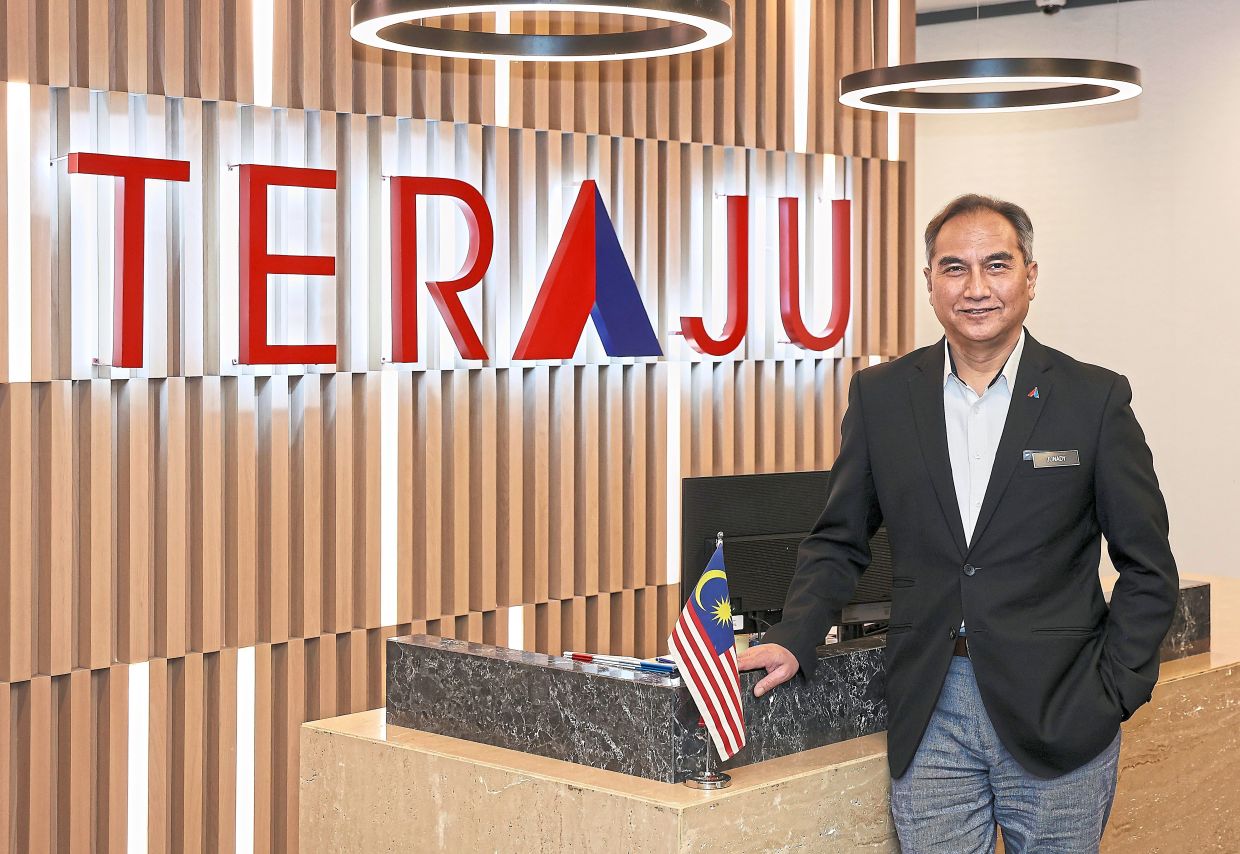
“We were chasing after numbers, after volume. The targets were always about having 1,000 companies or RM1bil in financing,” admits Teraju chief executive officer Junady Nawawi, who has spent close to a decade at the agency across two stints.
“It’s still there, but that is no longer the be-all and end-all. It has become the means or an enabler to achieve a greater end.”
That greater end is value creation, which involves building Bumiputera companies that are not merely surviving on facilitated loans, but are governed, scalable and attractive enough to participate in capital markets.
It is an ambition that sits at the heart of the government’s Bumiputera Economic Transformation Plan 2035 (PuTERA35) agenda, which targets a meaningful uplift in Bumiputera economic participation by 2035.
This is something that Teraju is now actively engineering through a suite of structured programmes designed to take companies from the ground floor all the way to the public markets.
From scattergun to surgical
Junady is candid about Teraju’s own evolution. The agency, which operates as a facilitator rather than a direct lender or equity investor – unlike Ekuiti Nasional Bhd or Perbadanan Usahawan Nasional Bhd – spent years trying to be everywhere at once.
Grants, start-up programmes, equity investment through intermediaries, financing in partnership with banks: Teraju has tried it all, and learned hard lessons along the way.
“We tried the scattergun approach, where we tried to be everywhere, to cover too many bases,” Junady said.
“It is a lot of trial and error that we’ve gone through, and it is through that process that we’ve come to a different landing now.”
The shift is now surgical as Junady explained that Teraju pre-screens applicants before referring them to banking partners, conducting due diligence and diagnostic assessments to determine not just whether a company qualifies for financing, but what else it needs to grow.
Algorithms and AI-assisted tools now underpin this process, replacing the old model of manual, paper processing and filling forms.
Companies that simply need financing are catered for through the Bumiputera Expansion and Catalyst Fund (BECF).
BECF is an RM1.07bil facility established in partnership with financial institutions that negotiates lower borrowing costs and, critically, eliminates the collateral requirement for qualifying applicants.
But for those who show higher potential, Teraju does not stop at the cheque.
Pathway to market
The agency has built what it describes as a full suite of financing and non-financing programmes that work in tandem.
Three non-financing programmes – ASCEND, ENHANCE and XCELERATE – now form a structured growth pathway designed to take companies progressively closer to investor and capital market readiness.
ASCEND targets upper small and low-mid market companies with annual revenues between RM1mil and RM5mil – businesses that show growth potential but face barriers to financing.
The programme coaches participants across five pillars: strategy, financial governance, operations, corporate governance, and sales and marketing, to make them bankable and investable before they progress further up the pipeline.
Meanwhile, ENHANCE targets companies with high potential and minimum annual revenue of RM5mil, focusing on investor readiness, business growth and scalability.
Companies that are not yet ready for bank financing are guided through improvements to their financial statements, corporate management structures and internal controls – the bedrock requirements before any institutional investor or listing exercise can take place.
XCELERATE, on the other hand, is built specifically for preparing companies towards IPO readiness through structured diagnostic assessments, strategic coaching and access to capital market ecosystems.
Developed in partnership with Bursa Malaysia under a memorandum of collaboration, the programme seeks to demystify the capital-raising journey for Bumiputera entrepreneurs – many of whom, Junady notes, are unaware that funding avenues exist beyond government grants and bank loans.
“Beyond that, there is more. You’ve got equity crowdfunding, peer-to-peer financing, angel investors, and even friend and family funding. These are the avenues that most are not aware of.
“The market is ever-evolving and we can see that these gaps still exist. This is the kind of awareness of investor readiness that many do not have, and the kind that we are attempting to help them with.”
It is a gap that Junady frames not as a weakness inherent to Bumiputera entrepreneurs, but as a matter of exposure and financial sophistication.
He draws a vivid analogy: an entrepreneur with a quality product, like kerepek, cannot walk into a business pitch session carrying a packet of snacks and expect investor interest.
However, innovating and repackaging that same product under strong branding and distribution could shift its market value tenfold.
The capability to execute that transformation, both in product and in corporate presentation, is what Teraju is working to instil.
“If they can shift their focus a little bit, then instead of selling it at RM5, they could do it in such a way that they can sell it for RM50. That is the premium value creation,” he said.
Addressing fragmentation
One persistent structural challenge in the Bumiputera business landscape is fragmentation – a large pool of small, subscale companies that individually lack the size or capitalisation to compete meaningfully in open markets.
To address this, Teraju has the Bumiputera Strategic Acquisition Financing (BSAF) – a facility designed to enable acquisitions and corporate consolidation, including as a pathway to public listing.
“The Malaysian market is small. Our population is just over 30 million and the income level is there but not high enough to be competitive,” said Junady.
“Our local companies have got to look outside of Malaysia to bigger markets like Asean and Asean+3, which in total is at least a billion in population and has greater market potential.
“These are the things that we try to inculcate. They’ve got to look beyond. There’s nothing wrong with starting off local, but as they go along, they have to start producing and customising their products and services to cater for overseas markets.”
He explained that BSAF removes a critical friction point by eliminating the need for collateral on acquisition financing, giving Bumiputera companies the corporate firepower to execute strategic moves that were previously out of reach.
The facility is structured not only to support pre-IPO consolidation, but to encourage the kind of inorganic growth that can compress timelines to scale.
Complementing this is the Islamic Working Capital Project Financing (i-WCPF), which disbursed RM158mil in 2025 to support operational liquidity for companies at various stages of growth.
Proof of concept
The clearest evidence that Teraju’s evolved approach is producing results came on June 16, when Elsa Bhd, an integrated technology solutions company, listed on Bursa Malaysia’s ACE Market.
This feat made Elsa the first Bumiputera company, and 32nd overall, to achieve a public listing this year.
Elsa, which is principally involved in the provision of oil and gas (O&G) service and equipment solutions, providing robotics engineering and digital solutions, had already begun pivoting toward non-O&G verticals when Teraju came into its orbit.
Elsa chief operating officer Azril Hassan noted that the timing was significant, as the company also benefited from being the first beneficiary of Teraju’s BSAF.
“Teraju came into our ecosystem at the right time, because it was the same time we were trying to venture into non-O&G.
“Teraju gave us good visibility in the market, in terms of what we can provide to customers. Now, people will also know us for our non-O&G capabilities.”
Elsa’s success demonstrates how Teraju’s support ecosystem aids high-potential Bumiputera companies in accelerating their journey to the capital market.
It proves that structured, diagnostic-led support – from governance strengthening to capital market coaching – can produce Bumiputera companies capable of standing on public markets.
Meanwhile, Junady added that Elsa’s listing marks the first among 20 high-potential new-generation Bumiputera companies identified by Teraju, in line with PuTERA35.
He said that these companies have the capacity to generate a combined market capitalisation of between RM2bil and RM3bil upon listing.
But the vision Junady articulates is broader than listing tallies. It is about building an ecosystem resilient enough to allow entrepreneurs to fail, recover and try again – something he identifies as a cultural gap that Malaysia has yet to fully bridge.
“It could be an Asian thing, but the fear of failure is very high. Whereas, in western markets, if they fail, they just try again, because the ecosystem allows for that,” he said.
“Ultimately, we want to produce a dynamic ecosystem, with Teraju at the epicentre of it. But we need to have that culture and the fundamentals of that economic safety net that enables entrepreneurs to fail and to retry.
“This is our new focus, to cultivate a more dynamic Bumiputera economic narrative.”