
MALAYSIA’s oil and gas (O&G) industry, a pillar of the national economy contributing 8.6% to the gross domestic product (GDP), is reaching a defining turning point.
The industry, particularly the oil and gas services and equipment (OGSE) sector, is still grappling with a “business-as-usual” mindset that industry leaders warn is no longer sustainable.
At PETRONAS’ OGSE Partners Day 2026, held at the Kuala Lumpur Convention Centre on April 23, a clear mandate emerged: the industry must pivot from mere cost-competitiveness to a model driven by technology, environmental, social and governance (ESG) compliance and global scale.
Industry reflection
Opening the session, Malaysia Petroleum Resources Corporation (MPRC) vice president Ezwan Zakaria noted that the sector is currently midway through the National OGSE Industry Blueprint 2021-2030 (OGSE Blueprint).
The blueprint was developed to foster a robust, resilient and globally competitive OGSE sector that contributes to the sustainable development of national priorities.
The economic figures – such as the RM40bil or 2.2% contribution of the OGSE sector towards the nation’s GDP – are significant, with the industry providing livelihoods for approximately 123,000 workers.
However, despite the sector’s importance, structural imbalances persist. Ezwan noted that while there is a high volume of OGSE companies, growth is concentrated at the top of the chain.
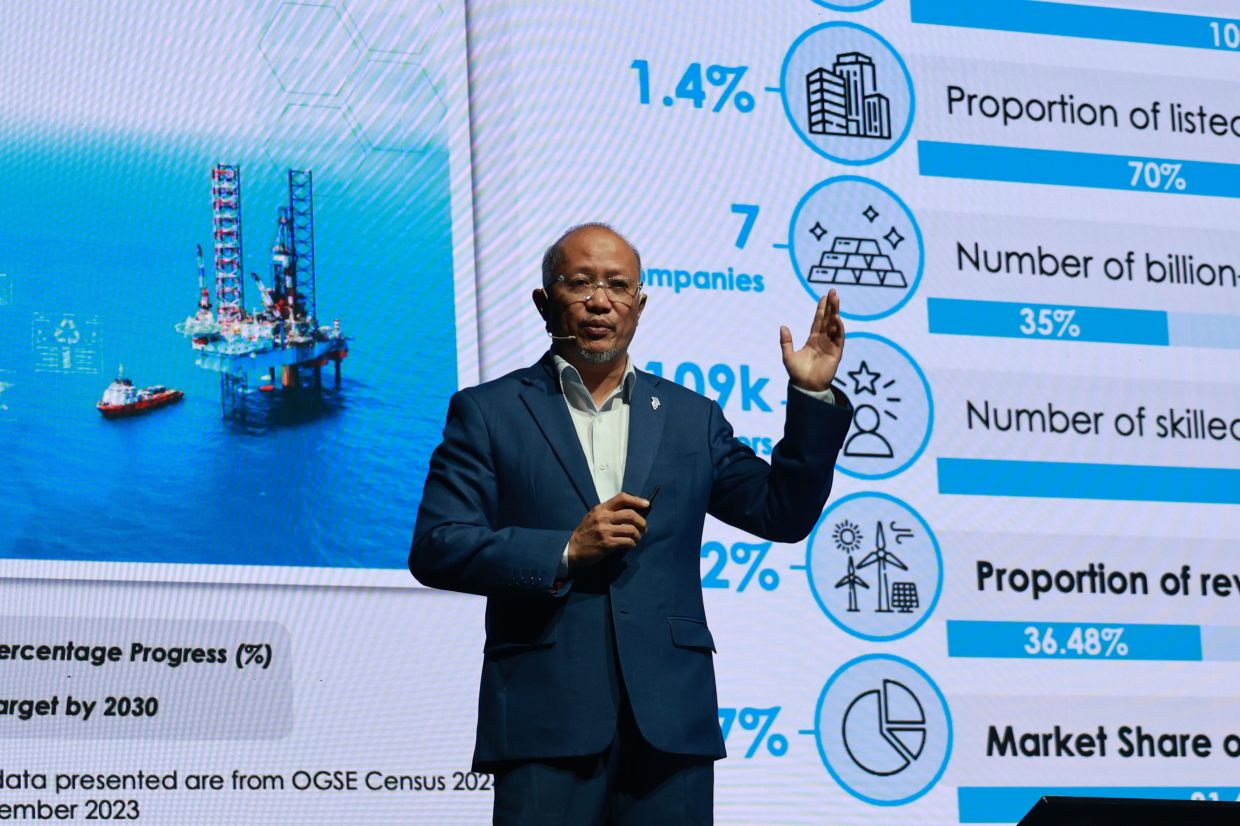
“The OGSE Blueprint targets exports to contribute 50% of the OGSE sector’s total revenue. Current estimates indicate progress at 53% towards this target, although this is based solely on the performance of publicly listed companies,” he said.
“Out of a total population of 1,883 core OGSE companies [as at the end of 2024], only 1.4% are publicly listed. Yet, they contribute more than half of their revenue from exports.”
He emphasised that the OGSE Blueprint was designed to foster growth among small players while also encouraging industry evolution. He noted that the complexity of modern energy projects requires a level of capital and talent that many small companies still lack.
“The industry is technology- and asset-driven, which requires substantial investment. We need the smaller OGSE companies to not just stay comfortable at the SME level. We want to encourage more players to grow, get bigger, get listed and go global,” said Ezwan.
Embracing resilience
At the industry panel forum, titled, Why Malaysian OGSE Must Transform – Resilience, Competitiveness and Sustainability, then Malaysian Oil, Gas and Energy Services Council (MOGSC) president Syed Saggaf Syed Ahmad addressed the financial scars left by a decade of market volatility.
“Personally, I feel that the industry has not fully recovered from the 2014 oil price crash – and that impact is still cascading till today,” he said.
“We keep hearing the word ‘competitive’ being mentioned. But I need to stress that ‘competitive’ does not mean ‘cheap’. That is the reason why some companies have not recovered from 2014.”
For the industry to survive, Syed Saggaf further explained that the relationship between major operators and vendors must evolve, progressing towards more equitable contracting practices, where risks are appropriately shared across the value chain.
“We need to ensure that we take care of each other, and that does not happen enough. If the big players look after the smaller ones, we can create resiliency within the industry. If the OGSE ecosystem fails, the industry will be finished,” he said.
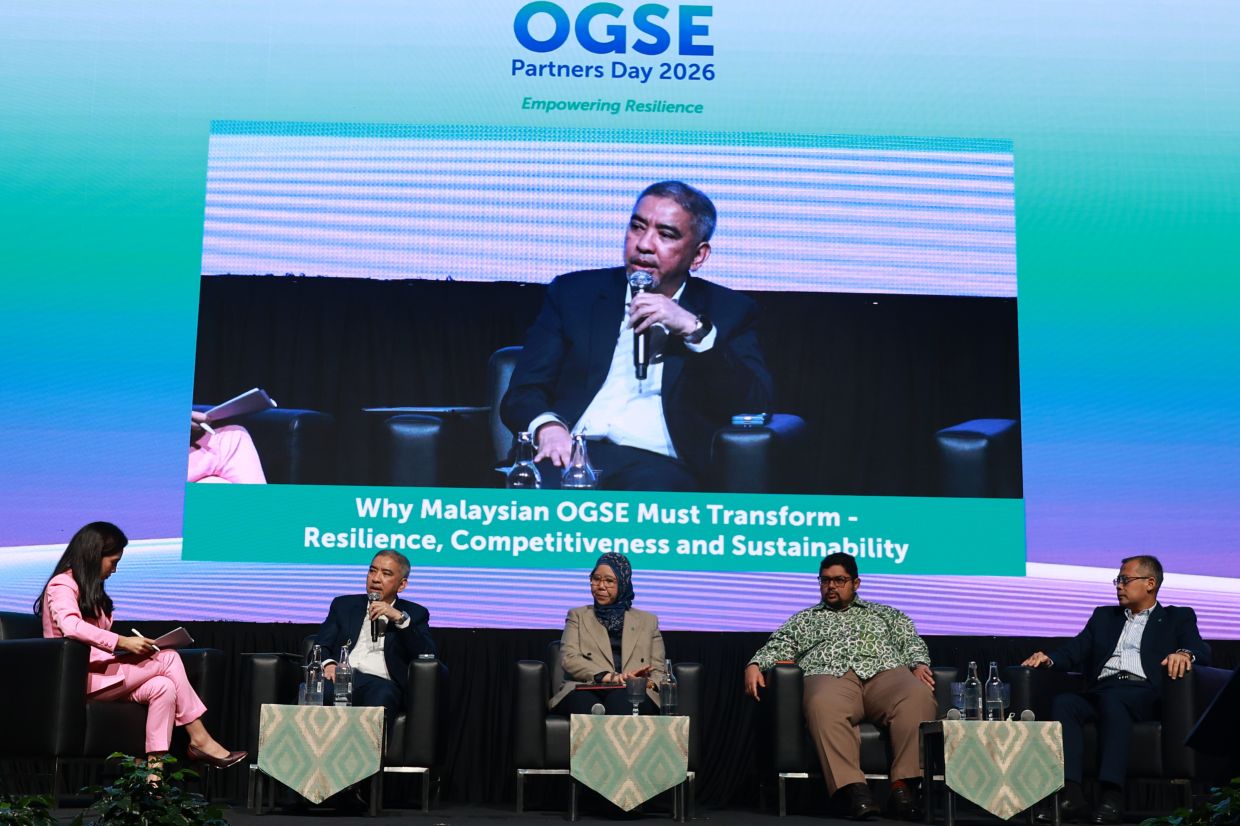
He also noted that OGSE companies should be looking outside of the country for opportunities, highlighting the success of risk-taking firms.
“Exporting our services and products is not a luxury anymore; it has become a necessity,” he said.
Global standing
The need for this shift is emphasised by how Malaysia compares to other oil-producing nations.
PETRONAS Group Procurement (GP) senior general manager Mohd Razali Kamin pointed out that while the nation’s production levels are similar to those of Indonesia, Norway and the United Kingdom – at about two million barrels of oil equivalent per day – the local OGSE sector remains inward-looking.
“The export ratio of these countries is higher than ours. This indicates that we still rely on domestic activities,” he said.
Mohd Razali noted that this disparity stems from a lack of integration with industry players reluctant to expend effort beyond their comfort zones within the standardised work and equipment categories (SWEC) framework.
“In the OGSE sector, 20% of companies serve 80% of the spend. It is highly concentrated, whereby a few strong players dominate, while others are relatively small and less capable.
“But if we really want to reshape the industry, we need to find a way to make the remaining 80% of companies grow to become like the top 20%.”
Accelerated delivery
Malaysia Petroleum Management (MPM) senior general manager Nurunnajwa Mohd Aras highlighted that MPM as the Shaper, Accelerator and Regulator of Malaysia Upstream Oil and Gas Resources, is driving a systemic shift to reduce by half the timeline from resource discovery to first production – from 100 months to less than 50 months.
She explained that acceleration is not merely about moving faster, but also about moving away from the traditional way of doing things.
“In today’s landscape, project value is increasingly defined by speed. Achieving this, however, requires stronger collaboration, strategic partnerships and greater discipline across the entire ecosystem,” she said.
Nurunnajwa also highlighted PETRONAS’ Capital Project Investment Destination (CAPE) 2030 Masterplan, a long-term transformation blueprint aimed at strengthening Malaysia’s project delivery ecosystem, enhancing OGSE competitiveness and positioning the country among the region’s top quartile performers by 2030.
The masterplan outlines a phased transformation journey spanning engineering, fabrication, marine logistics and digital integration, alongside rigorous productivity monitoring across the value chain.
A key ambition under the masterplan is to achieve a 30% productivity increase by 2030, through integrated planning, automation and artificial intelligence (AI), while fostering a more resilient, efficient and future-ready OGSE ecosystem.
This initiative also supports Malaysia’s broader aspiration of sustaining two million barrels of oil equivalent per day (MMboe/d) production and strengthening the nation’s position as a preferred destination for capital project investments.
Borderless growth
Concluding the panel session, MPRC president and chief executive officer Mohd Yazid Ja’afar brought the focus back to the immediate pressure of global trade.
With the liberalisation of the market under the Comprehensive and Progressive Agreement for Trans-Pacific Partnership (CPTPP) approaching, the Malaysian market would become more open to international competitors, and local companies would be less protected.
“Based on what we are seeing on the ground, it is not going to get easier. There will be more uncertainty in the years ahead as things are changing fast – faster than most companies can adapt,” he said.
“If we rest on our laurels, betting on the same old way of doing things, we will not be here in the future.”
Mohd Yazid added that despite the uncertainties, the local OGSE sector is poised to contribute more to the national economy if companies are nimble enough to seek alternative opportunities.
“There’s nothing stopping us from growing our contribution to the country. If the domestic market is too small, then we need to look outside, beyond our borders. Let’s go regional, go global,” he said.