




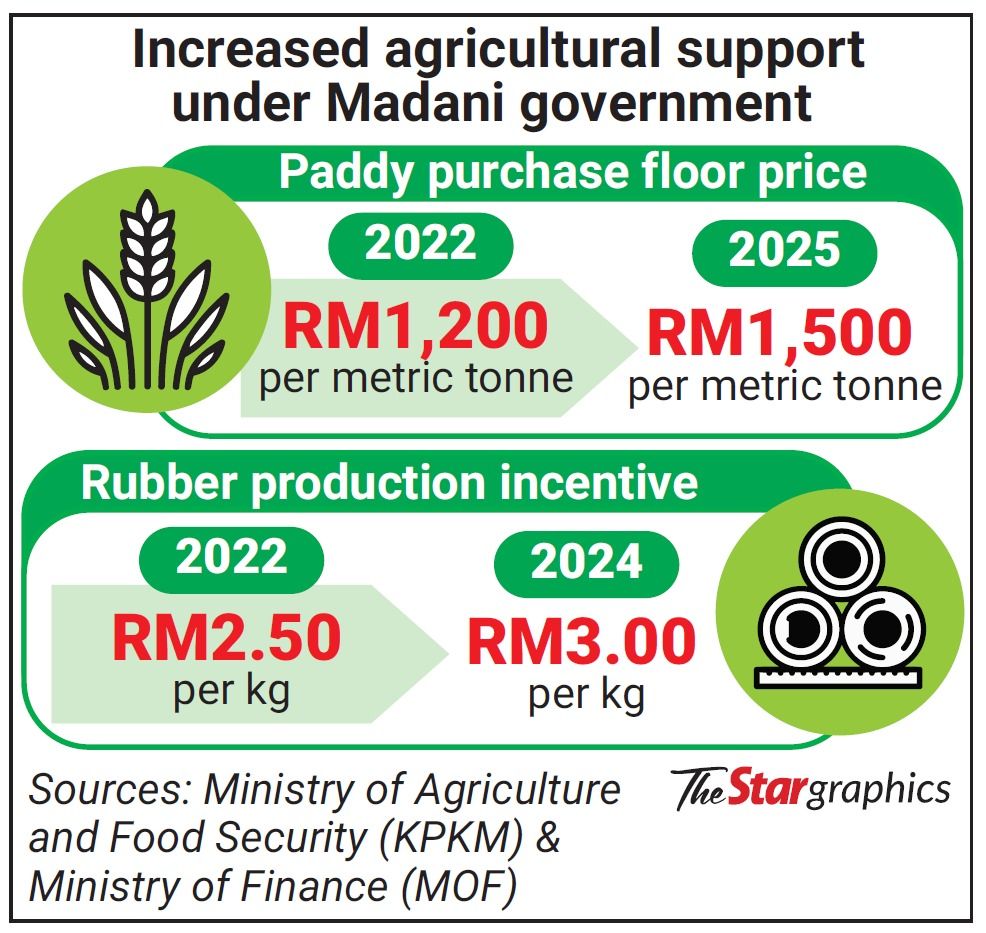
PETALING JAYA: Padi farmers are getting a firmer income reference, with the padi floor price climbing steadily in recent seasons from RM1,200 to RM1,300 and now RM1,500 per tonne.
The increase, together with the RM200 ploughing incentive and pesticide subsidy, forms part of a wider package aimed at cushioning padi farmers before and after harvest.
Pertubuhan Persaudaraan Pesawah Malaysia (PeSAWAH) chairman Abdul Rashid Yob said the support has been welcomed on the ground.
“We are grateful for the incentives the government has given us. The floor price has moved from RM1,200 to RM1,300 and now to RM1,500, and that is a positive trend for us,” he said.
This is in light of rising production costs.

Abdul Rashid estimated that producing one kilogramme of padi now cost about RM1.50, placing the floor price at around the farmers' breakeven point.
He said PeSAWAH continued to engage the Agriculture and Food Security Ministry on further calibrating support, including extending the diesel fleet card mechanism already used by fishermen to padi-sector machinery, to help ease padi farmers' rising operational costs.
The group has also proposed modernising the delivery of the RM2.62bil annual padi-sector subsidy through a digital voucher or e-wallet system, which it said would improve transparency and let farmers choose suppliers and inputs suited to their own land.
A similar combination of immediate protection and industry-led modernisation is emerging in the rubber sector.
The RM3 per kilogramme activation threshold for the Rubber Production Incentive (IPG) cushions smallholders when farmgate prices decline, while the RM800 Monsoon Season Aid (BMT) supports them during heavy rains.

Persatuan Kebangsaan Pekebun-Pekebun Kecil Malaysia (NASH) president Adzmi Hassan described the RM3 threshold as a very positive step.
“It becomes a safety net when rubber prices fall, and gives smallholders the confidence to continue tapping instead of leaving their holdings idle,” he said, adding that NASH was thankful the BMT was raised from RM600 to RM800.
Building on these safeguards, NASH has proposed the Tabung Pembangunan Pekebun Kecil Negara, which could use matching grants to draw private and institutional investment into smallholder development, as well as Harvester on Wheel, a digital platform pairing smallholders with registered tappers by location.

Putra Business School agricultural economist Prof Datuk Dr Mad Nasir Shamsudin said the measures reflected a deliberate approach to supporting farmers.
“The padi measures form a complementary policy package that addresses farmers' financial constraints across different stages of the production cycle, while balancing producer and consumer welfare.
"For rubber, the IPG is an important economic safety net, and together with the BMT, it is highly critical as a first line of defence against declining production,” he noted.
He said longer-term development should include sustainable structural reforms that included replanting with high-yielding clones, mechanisation and digital technologies to reduce labour dependence.
Across both sectors, experts opined that existing assistance provided the immediate economic baseline, with proposals from PeSAWAH and NASH pointing to a more productive, digitally connected agricultural economy ahead.



