




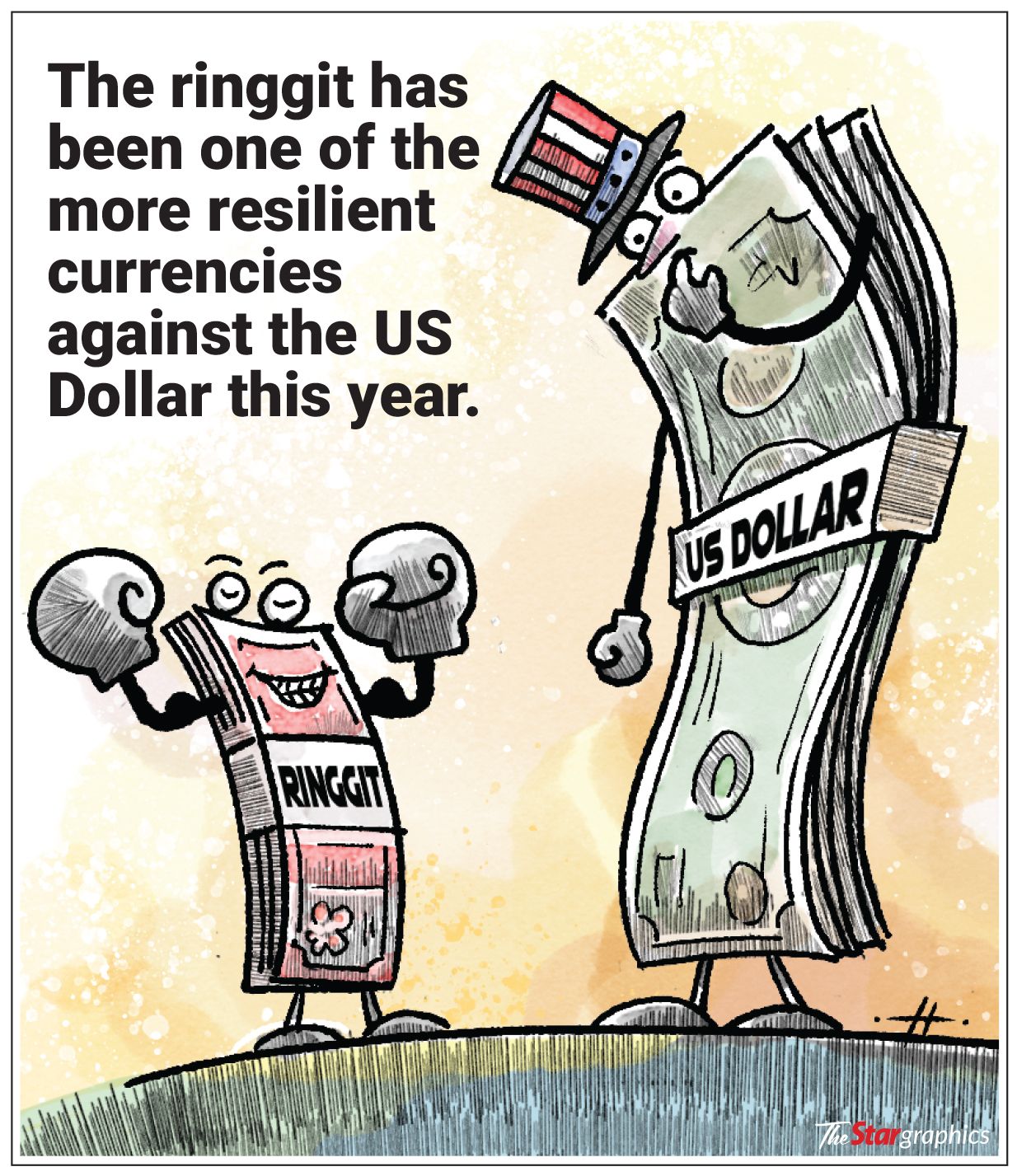
PETALING JAYA: Despite the hawkish US Federal Reserve, the ringgit is emerging as one of Asia’s standout currencies and is outperforming regional peers, driven by solid domestic demand and contained inflation (1.9% as at June 2026).
However, while solid macroeconomic fundamentals, continued trade surplus, sustained Foreign Direct Investment (FDI) inflows, and strong accumulation of foreign reserves would continue to support the ringgit, the ongoing military conflict in West Asia, shifts in US interest rate expectations, and elevated US Treasury yield leading to a wider yield differential between the US and Malaysia could limit the ringgit’s strength, noted economists.

He estimated the end-2026 ringgit to trade between RM4.00-4.10 against the US dollar.
The ringgit started the year on a winning streak. It charged ahead from around RM4.06 in early January and even broke past the RM4.00 barrier, hitting a seven-year high of roughly RM3.88 in late February.
However, between March and June, the ringgit lost some ground, dipping to its lowest point of RM4.14 in June partly due to the global conflicts in West Asia.
Even with the mid-year dip, the ringgit held its ground due to Malaysia exporting microchips, tech components and energy products, which also included foreign companies pouring billions into Malaysian factories, data centres, and AI infrastructure.
Economists say a rise in US interest rates would normally place some downward pressure on the ringgit because higher US yields may attract short-term capital towards dollar-denominated assets.

“Short-term currency movements are driven largely by financial expectations and speculation rather than by economic fundamentals alone. A US rate increase could initially strengthen the dollar, but the eventual impact on the ringgit would depend on what markets had already priced in, Malaysia’s export performance, capital inflows and confidence in the domestic economy.
Therefore, higher US rates would be a negative risk for the ringgit, but not necessarily enough to reverse its underlying trajectory, he said.
Conversely, he said a stronger ringgit is neither universally good nor universally bad.
“It lowers the ringgit cost of imported food, machinery, intermediate inputs and energy, improving consumers’ purchasing power and reducing production costs for import-dependent businesses.
“On the other hand, it may reduce the ringgit value of exporters’ foreign revenues and place pressure on companies competing mainly through low prices,” he explained.
But there is no precise “sweet spot” that policymakers can calculate, he said.
“Malaysia may be in a relatively favourable position if the ringgit remains firm without appreciating so rapidly that it creates unnecessary disruption for exporters.
“The priority should be currency and monetary stability, rather than targeting either an artificially strong or artificially weak exchange rate,” he said.
Meanwhile, MBSB Research believes a stronger ringgit would likely depend on improved capital flows, stronger growth fundamentals and continued confidence in the government’s fiscal consolidation.


