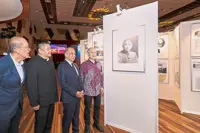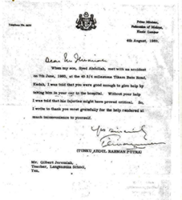
“A LEADER takes people where they want to go. A great leader takes people where they don’t necessarily want to go, but ought to be.” This statement by Rosalynn Carter sums up the life and work of Tunku Abdul Rahman Putra Al-Haj whose 118th birthday we commemorate today.
Tunku is best known as our nation’s founding father and the driving force behind the peaceful transition of power from British colonialism to Malayan independence. But we forget the other scintillating aspects of his multifaceted personality.
Those who knew Tunku well describe him as a person who was simple, humble, dedicated and incorruptible. In his personal life, Tunku was not trapped by dogma. He did not allow the noise of other opinions to drown out his own inner voice. As a leader, he found the smartest people he could surround himself with from the various communities to lead the nation.
Tunku was a visionary with a noble dream of “unity in diversity” for our beloved land – a dream that was ahead of its time. A great mediator and reconciler, Tunku brought diverse people together in 1957 when we gained independence, and again in 1963, when Malaysia was formed. Interracial peace and harmony were his legacies to the nation.
The Constitution of 1957 that he and his colleagues in the Alliance helped the Reid Commission to draft, walked the middle path. It incorporated many indigenous features of the Malay archipelago. Among them were the unique system of multiple Malay monarchs united by a Conference of Rulers, Malay reserve lands, Islam as the religion of the Federation but freedom of religion for all other communities, and affirmative action provisions to preserve the special position of the Malays and (in 1963) of the natives of Sabah and Sarawak.
At the same time, the Malay-Muslim native features of the Constitution were balanced by many provisions suitable for our multiracial and multireligious society. The electoral process and the chapter on fundamental liberties grant rights to all citizens. At the federal level, membership of the judiciary, the Cabinet, Parliament, the public services and the special Commissions under the Constitution are open to all citizens.
Though Islam is the religion of the Federation, Malaysia is not a theocratic state. The Constitution is supreme. All religious communities are allowed to profess and practise their faiths in peace and harmony.
Article 153 on the special position of Malays is hedged in by limitations. For example, along with his duty to protect the Malays and natives of Sabah and Sarawak, the King is enjoined to safeguard the legitimate interests of all communities.
In 1963, Tunku’s statesmanship succeeded in transforming the Federation of Malaya into the Federation of Malaysia with special autonomy for Sabah, Sarawak and Singapore.
In addition to the above legal provisions, the political coalitions under Tunku were built on an overwhelming spirit of accommodation and moderateness among the races, and an absence of the zeal and ideological convictions that have left a heritage of bitterness in other plural societies.
The overall spirit of the 1957 and 1963 Constitutions was one of tolerance, moderation and compassion. This was Tunku’s enduring contribution.
At the international level Tunku was the main architect of our foreign policy and felt strongly about regional cooperation in South-East Asia. Unknown to some, he played a leading role in the establishment of the Organisation of Islamic Countries and was its first secretary-general.
As we contemplate Tunku’s life and sterling leadership, it is sad to note that from being a plural society par excellence up to the 1990s, we have become a society buffeted by the divisive problems of race, religion and region. But there is no need to despair. Mistakes have the power to turn us into something better than we were before. Sometimes it is by losing our way that we learn where to go.
PROF EMERITUS DATUK DR SHAD SALEEM FARUQI , Member of the Board of Trustees, Yayasan Tunku Abdul Rahman
Already a subscriber? Log in
Get 20% OFF The Star Digital Access
Cancel anytime. Ad-free. Unlimited access with perks.