



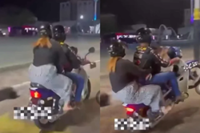
ANYONE who has driven on a Malaysian highway at night in recent months has probably experienced it: a sudden blast of white light from the vehicle ahead that leaves you squinting, blinking and wondering whether the car in front is braking or reversing.
The culprit is a growing trend among car and motorcycle owners of swapping their standard red rear lights for clear or translucent white ones, known as "albino" lights, in the belief that they make their vehicle look more modern and stylish.
But are these trendy albino lights actually approved by the Road Transport Department (JPJ)?
Verdict:

FALSE
Albino lights, which are aftermarket replacement rear which are clear or translucent rather than red, have never received technical approval from JPJ.
Transport Minister Anthony Loke Siew Fook confirmed on June 11 that the installation of albino lights on vehicles is done voluntarily by owners without any form of approval from JPJ.
"As of now, no technical approval has been given for the installation of these lights. They are installed voluntarily by vehicle owners.
"If they are found to disturb or affect other road users, enforcement action will be taken," said Loke.
He said the Transport Ministry is taking the trend seriously and is currently studying its impact before any further decision is made on their use.
Loke noted that albino lights are increasingly being seen on lorries and other vehicles on highways, adding to growing complaints from other motorists.
The safety concerns are not trivial.
Manan Supri, founder and road safety adviser of the Road Safety Experts Association, said the use of white brake lights on vehicles is not just a pointless accessory but one that actively increases the risk of road accidents.
He explained that red was chosen as the universal colour for brake lights based on international safety standards, not as a design preference.
Red does not cause glare, provides the clearest contrast in dark conditions and is recognised worldwide as a signal to stop.
"The use of white albino lights can cause glare that disturbs the vision of the driver behind. It endangers road users by causing delayed reactions because the brake signal is unclear, and creates confusion with reverse lights or other lights," said Manan.
He said the danger is especially acute at night, in dark conditions or in bad weather when visibility is already limited.
A sudden flash of white light from albino brake lights can temporarily blind a driver, and even a few seconds of impaired vision at high speed is enough to significantly increase the risk of a rear-end collision.
"In heavy traffic or at high speed, even if this disruption lasts only a few seconds, it is already enough to increase the risk of a rear-end collision," he said.
The experience is familiar to many Malaysian road users.
One motorist described having to pull over to the side of the road after being hit by albino light glare while riding a motorcycle.
"My eyes felt extremely sore and everything suddenly went dark after the bright light pierced my pupils. I had to stop my motorcycle at the roadside until my vision recovered.
"When exposed to albino light for an extended period, my head felt dizzy to the point where it affected my riding," the road user said.
Under the Road Transport Act 1987, vehicle lighting must comply with specific colour requirements.
Night-time running lights and brake lights must emit red light, signal lights must be amber and reverse lights must be white.
Any modification that changes the colour or intensity of the original specification is not permitted.
A JPJ officer who goes by the name Rahman Potente on TikTok explained that one of the key requirements for any vehicle to use albino lights is the presence of a factory-fitted reflector on the rear bumper, since this provides a fallback safety feature if all lights fail.
Albino lights do not have this reflective property, and vehicles that do not have factory-fitted reflectors are not permitted to use them.
Manan urged vehicle owners to comply with approved safety standards and to avoid installing lights that do not meet the original factory specifications of their vehicle.
"Vehicle lighting systems must comply with approved homologation specifications. To ensure the safety of all parties, avoid installing lights that do not follow the original specifications," he said.
Sources:
2. https://www.facebook.com/
3. https://www.facebook.com/


