
PETALING JAYA: A growing preference for independently planned, smaller-group travel is reshaping the country’s tourism transport sector.
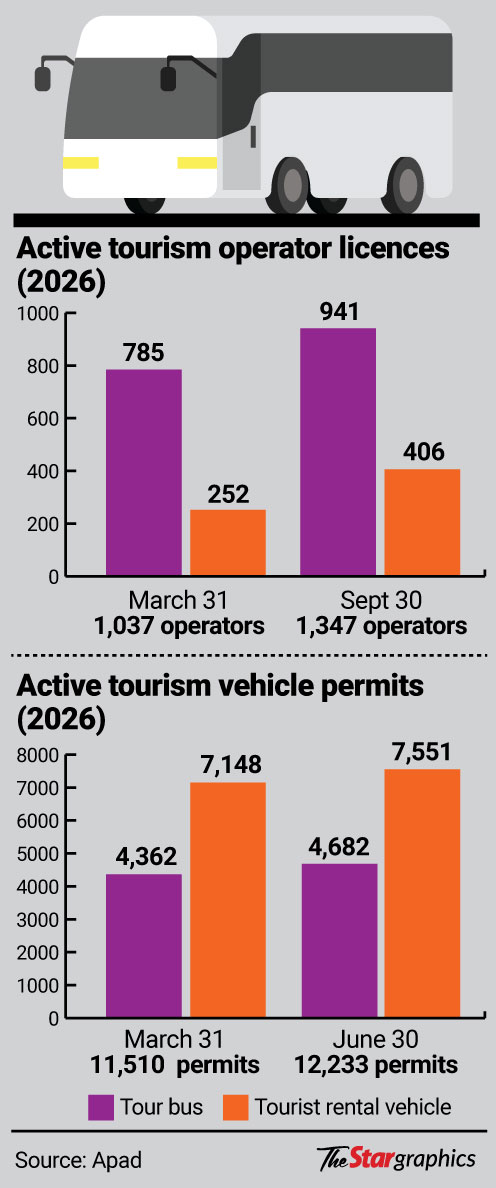
Statistics from the Land Public Transport Agency (Apad) showed that active tourism transport operator licences increased by 30%, from 1,037 as at March 31 this year to 1,347 as at Sept 30.
The increase was largely driven by chauffeur-driven vehicle operators, whose licences rose from 252 to 406 during the same period, while sightseeing bus operator licences increased from 785 to 941.
Malaysian Muslim Travel Agency Association president Muhammad Syazri Afiq Rosli said travel patterns had become increasingly diverse, particularly among younger travellers, couples and small families seeking greater flexibility.
“Tourists seeking greater flexibility now have more options to arrange their own trips without being tied to a group tour schedule,” he said.
Muhammad Syazri added that visa-free travel arrangements and the growing availability of online booking platforms had made it easier for tourists to plan their own itineraries, compare prices and book accommodation, transport and activities independently.
He said an increase in tourist arrivals did not necessarily translate into higher demand for large tourism buses, as travellers increasingly preferred smaller groups and customised experiences.
“Operators need to adjust their fleet capacity and products to match demand, including offering options for smaller groups,” he said.
Syazri also noted that the shift towards independent travel did not mean demand for organised tours or tourism transport services was declining.
“Tourists may also travel in smaller groups while still using travel agencies, tour vans or private tour packages.
“As such, business opportunities remain, but service offerings may need to be adapted to suit changing demand,” he said.
Meanwhile, Muhammad Syazri said operators are also grappling with rising costs, inconsistent bookings and a shortage of experienced drivers.
“Operators must continue to bear vehicle loan repayments, insurance, maintenance costs and workforce commitments even when vehicles are not carrying passengers.
“Fuel cost pressures also make pricing more difficult.
“If operators absorb the increase entirely, profit margins are affected.
“If the cost is passed on to customers, tour packages may become less competitive,” he said.
Malaysian Inbound Tourism Association president Mint Leong said tourism bus operators continue to face cost pressures, particularly due to the absence of diesel subsidies.
“As we do not receive diesel subsidies for tour buses, there has been a noticeable drop in the number of operators.
“If we want to promote tourism, we need to support group travel, which remains an important market,” she said.
Leong said tourism buses remain important for organised group travel, particularly among elderly travellers who prefer travelling in groups.
“Tourism buses do not receive the same grants as some other bus sectors or transport modes that carry tourists.
“The government should look into providing more support and reducing bureaucratic processes,” she added.