PETALING JAYA: Malaysia’s durian farming is facing an uncertain season as an unpredictable climate of hot weather, haze and heavy rain raise concerns over fruit development and quality.
Agriculture Department director-general Datuk Nor Sam Alwi cautioned that prolonged hot and dry conditions linked to El Nino pose a potential risk to Malaysia’s durian production, particularly for orchards with limited access to reliable water sources.
“The impact will depend on the duration and severity of the dry conditions, their timing in relation to flowering and fruit development, local water availability and the effectiveness of mitigation measures implemented by farmers,” she said in an interview.
ALSO READ : Hot and dry spells more manageable than wet weather
Nor Sam said a moderate dry spell may help trigger flowering in durian, but prolonged drought should not be regarded as beneficial.
“Prolonged water deficit can adversely affect tree health, fruit retention and yield.”
Severe water stress during flowering and fruit setting may cause flower abortion and premature fruit drop.
Adequate soil moisture is important during fruit setting and early fruit development.
Water stress at these stages can reduce fruit growth, increase fruitlet abortion or result in smaller fruits.
Nor Sam said acute water stress could also cause irregular or deformed fruit shapes, as well as pulp disorders.
This is mainly due to disrupted uptake and translocation of essential nutrients, she said.
The wider effect could include lower marketable yield, reduced farm income and less consistent fruit quality.
Orchards facing prolonged rainfall deficits, limited water supplies, poor soil water-holding capacity, restricted rooting conditions or inadequate irrigation and water-storage facilities are generally more vulnerable.
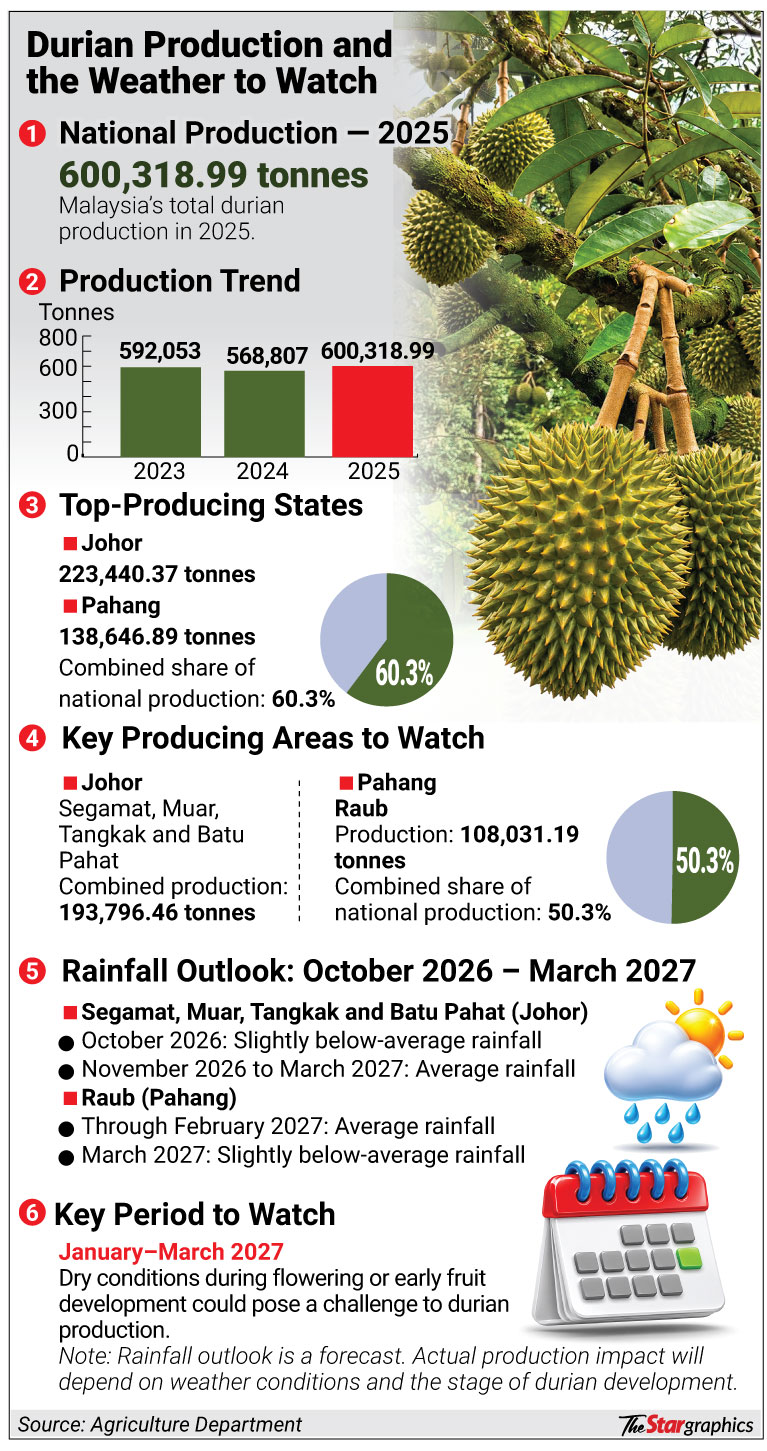
Nor Sam said Johor and Pahang required close monitoring because of their importance to national durian production.
Key producing areas include Raub in Pahang, and Segamat, Muar, Tangkak and Batu Pahat in Johor.
Based on the Malaysian Meteorological Department’s Oct 5 long-range outlook, the four Johor districts received slightly below-average rainfall in October, before rainfall returned to average levels from this month until March next year.
Raub was forecast to receive average rainfall until February 2027, followed by slightly below-average rainfall in March.
Nor Sam said the outlook showed that monitoring must be location-specific, as drought exposure and water availability could differ even among major producing areas.
She said January to March next year would require particular attention where dry conditions coincide with flowering or early reproductive development.
Dry weather after the main June-to-September harvest period should not automatically be treated as a loss to fruit that has already been harvested, she added.
Nor Sam said that efficient irrigation, soil-moisture conservation, sound orchard management and early detection of water stress could help growers reduce the risk during extended dry periods.
However, she said it was not possible to give a scientifically reliable estimate of potential production losses for 2027 based solely on the El Nino forecast.
Such an assessment would require verified information on affected orchard areas, rainfall and soil-moisture deficits, crop growth stages, water availability, historical yield responses and actual damage.
She said annual durian production was influenced by a range of factors, including seasonal fruit-bearing patterns, orchard maturity, crop management, pest and disease incidence, and weather conditions.
“As such, observed changes should not be attributed to El Nino or any single climatic event without supporting evidence.”
Nor Sam said the department had received reports of water shortages from durian growers, including requests for tube wells.
However, she said any tube well proposal required technical assessment of site suitability, groundwater availability and feasibility.
She urged growers to assess water availability early, maintain pumps and irrigation systems.
Farmers can also use the department’s Smart Irrigation Management System at sims-doa.my to support irrigation planning, alongside field observations and advice from agricultural officers.