
PETALING JAYA: The Barisan Nasional-Perikatan Nasional seat-sharing arrangement in the coming Melaka polls is significant as it tests whether both coalitions can translate tactical cooperation into electoral gains despite their different political bases, say analysts.
Political analyst Prof Datuk Dr Sivamurugan Pandian said Barisan has a more established multiracial coalition structure while Perikatan with PAS in particular, relies heavily on its Malay-Muslim support.

“Seat-sharing is the easy part, transferring votes is the real challenge,” he said in an interview.
Sivamurugan added that disputes over seat allocation could weaken campaign coordination and expose the lack of trust between the parties.
“If every party prioritises its own electoral survival, cooperation becomes transactional rather than strategic.
“The danger is not merely who contests which seat but whether conflicting interests lead to three-cornered fights, mixed messages and voter confusion,” he said.
Sivamurugan also said the Melaka polls would test the limits of political cooperation with Barisan and Pakatan Harapan set to face off in 15 state seats.
He said the multiple contests would push both coalitions to double their efforts in winning over voters at the state level, while preserving their working relationship in the federal government.
However, Sivamurugan said electoral rivalry does not necessarily mean the collapse of the federal pact but the 15 direct contests exposed the limits of the unity government.
“Both sides must distinguish between state-level competition and national interests.
“The real test is whether they can compete during the campaign without allowing political attacks to undermine cooperation at the federal level,” he said.
Sunway University political scientist Prof Wong Chin Huat said it is normal for parties in a coalition government to contest against one another at different levels of government, citing Germany as an example.
“All you need is professionalism, and voters can play a stabilising role by penalising those who fail to play professionally,” he said.
Wong also said both Umno and PAS have a largely overlapping base, which are Malay-Muslim nationalists and conservatives.
“Hence, they are natural competitors. The Melaka deal shows PAS’ magnanimity to work with Umno.
“Out of 24 seats winnable for Barisan-Perikatan, PAS will contest only three seats.
“The other four are DAP’s strongholds, which can only be won if the party is abandoned by its base,” he said.
Political analyst Lau Zhe Wei said such electoral arrangements are not unprecedented, pointing to the Johor and Negri Sembilan state elections as examples of parties navigating political cooperation alongside electoral competition.
He said ideological differences are unlikely to be the main obstacle, with seat allocation being a more immediate concern for parties negotiating electoral cooperation.
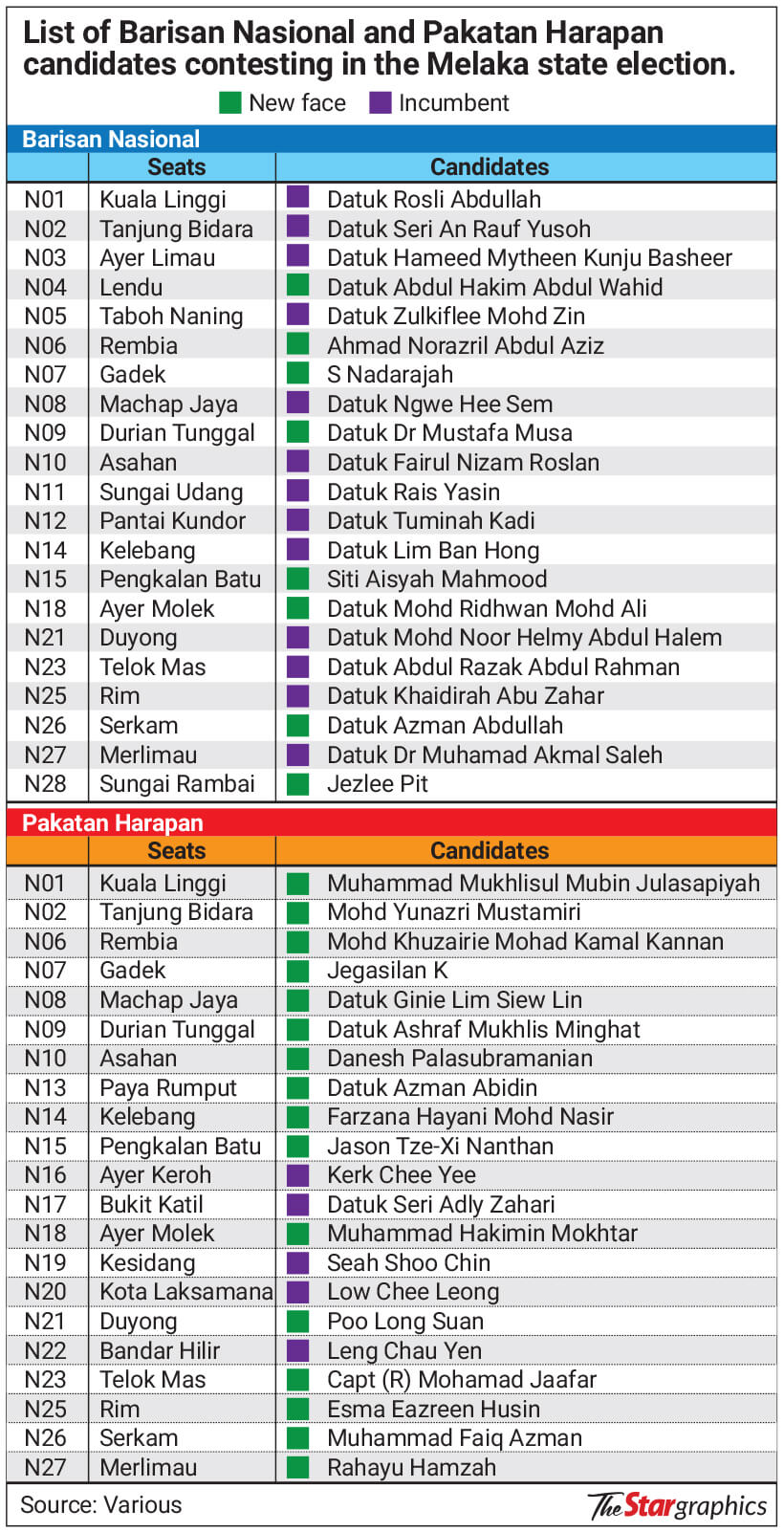
The candidate announcements on Saturday saw Barisan and Pakatan fielding 21 candidates each.
Among Barisan’s candidates who will be defending their seats are caretaker Melaka Chief Minister Datuk Seri Ab Rauf Yusoh in Tanjung Bidara, Umno Youth chief Datuk Dr Muhamad Akmal Saleh in Merlimau and Datuk Noor Helmy Abdul Halem in Duyong.
Pakatan will be retaining five of their incumbent assemblymen.
They are Datuk Seri Adly Zahari (Bukit Katil), Kerk Chee Yee (Ayer Keroh), Seah Shoo Chin (Kesidang), Low Chee Leong (Kota Laksamana) and Leng Chau Yen (Bandar Hilir).
Barisan is also introducing eight new faces, namely Datuk Abdul Hakim Abdul Wahid (Lendu), Ahmad Norazril Abd Aziz (Rembia), S. Nadarajah (Gadek), Datuk Mustafa Musa (Durian Tunggal), Siti Aisyah Mahmood (Pengkalan Batu), Datuk Mohd Ridhwan Mohd Ali (Ayer Molek), Datuk Azman Abdullah (Serkam) and Jezlee Pit (Sungai Rambai).
Pakatan, meanwhile, will be fielding 16 candidates including newbies or those making a political comeback.
They include former assemblywoman Datuk Ginie Lim Siew Lin, who is contesting Machap Jaya, as well as 26-year-old Farzana Hayani Mohd Nasir in Klebang.
This state election will also see Barisan fielding three women candidates, while Pakatan has five.
Sivamurugan said women’s representation remains more of a promise than a priority, with parties needing to do more to show their commitment.
“Fielding candidates is a start but the real test is whether parties are willing to give women winnable seats and genuine leadership opportunities.
“Representation must go beyond numbers to political commitment,” he added.
Nusantara Academy for Strategic Research senior fellow Dr Azmi Hassan said the number of women candidates is unsurprising, given the substantial role played by the women’s wings in both coalitions.
In terms of young candidates, he said Pakatan’s decision to field Farzana Hayani again, five years after she first contested in the 2021 state election, showed the party’s willingness to give younger candidates a second chance.
He said Farzana Hayani, who was the youngest candidate in the previous line-up while still studying, had retained the party’s confidence despite losing the election.
“The decision reflected how established parties could make room for younger candidates alongside more experienced and well-known personalities.
“Pakatan’s decision to field Farzana Hayani again also highlights the opportunity for young women to be represented in a field dominated by men,” he added.