PETALING JAYA: A camera or a new wardrobe bought in instalments may seem affordable when payments are spread over several months, but when multiple Buy Now, Pay Later (BNPL) commitments pile up, consumers risk overspending and stretching their finances.
Marketing executive Hasni Fahmi, 30, spends about RM400 a month on home appliances and gadgets through BNPL.
His biggest purchase was a RM4,000 mirrorless camera, which he paid for over three months to preserve cash for investments. He has never missed a repayment.
Finance consultant Arjun Kumar, 26, spends RM400 to RM600 monthly on gadgets, clothes and other non-essential items, with outstanding payments of about RM1,200 across platforms. He has missed an instalment after losing track of its due date.
“Sometimes, having the option to pay later makes me feel that I can afford something more easily, even when I should probably wait until I have saved enough money,” Arjun said, adding that BNPL has sometimes left him with less money for savings and daily expenses.
The risks are becoming more relevant as BNPL usage grows. Transactions surged 23.9% to 173.9 million in the first half of 2026, compared with 140.4 million in the second half of 2025, according to figures presented in Parliament.
Asst Prof Dr Lee Weng Chang of Xiamen University Malaysia’s School of Economics and Management said the increase is more closely linked to changing spending habits and easy access to credit than rising living costs alone.
He said Malaysia’s national savings rate stood at 21.6% of gross domestic product (GDP) in 2025, while household debt reached 84.4% of GDP in 2026.
Although these figures did not establish the causes of BNPL adoption, they provided broader context for household borrowing and consumption.
Lee cautioned that smaller instalments could make purchases appear more affordable than they actually are, encouraging overspending.
“The main risk is not BNPL itself, but the possibility of consumers treating accessible credit as an extension of their income,” he said.
He called for stronger affordability assessments that take into account borrowers’ income, existing debts and repayment history.
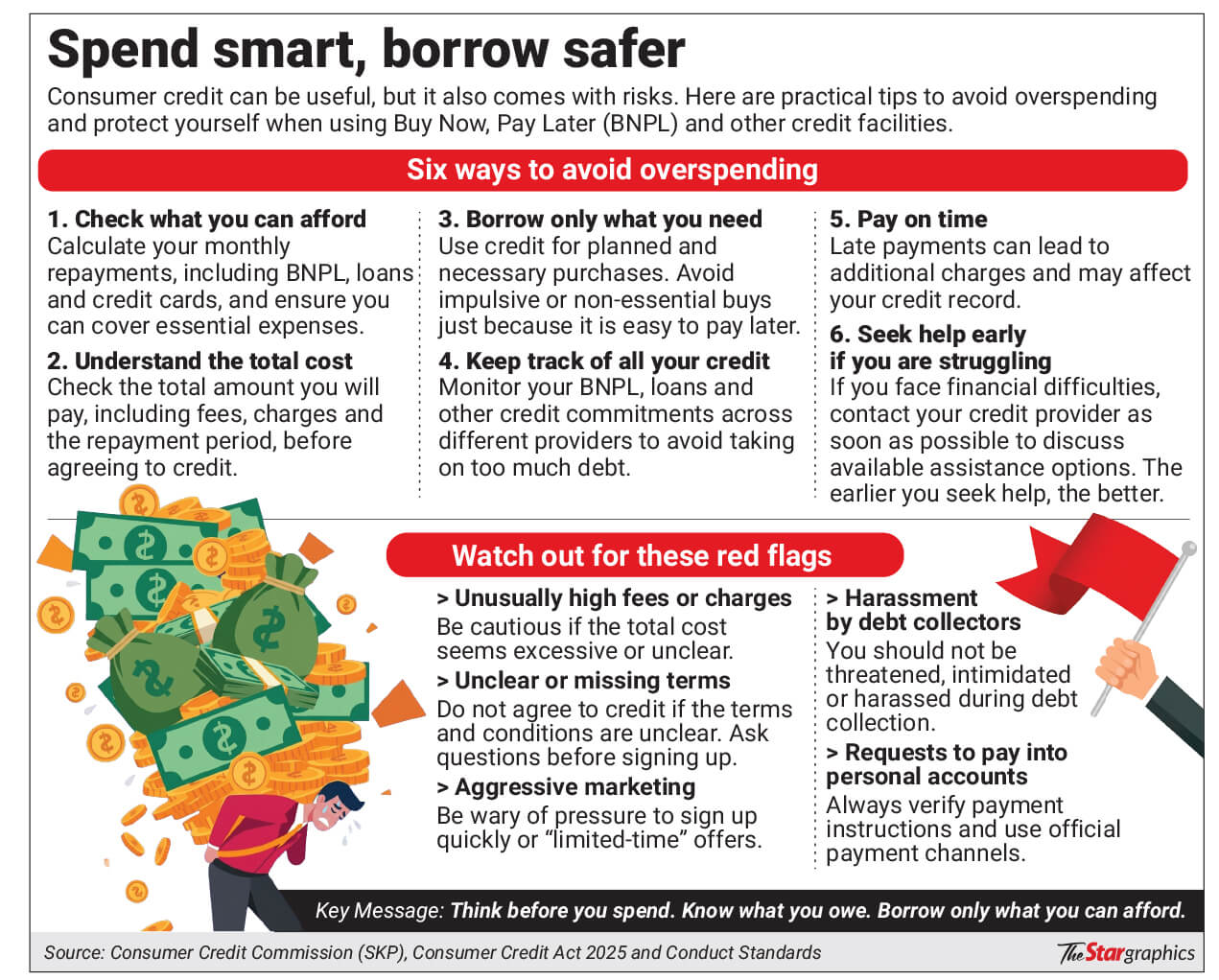
Spending limits should reflect repayment capacity, while clearer fee disclosures and financial education could help consumers make informed decisions, said Lee.
Assoc Prof Foo Lee Peng, who is chairperson of the Centre for Business and Policy Research at Tunku Abdul Rahman University of Management and Technology, said shopping campaigns such as 11.11 and 12.12, which offer additional BNPL vouchers, could encourage impulse buying.
She said instalments from multiple purchases could quickly accumulate, particularly for consumers with irregular or limited incomes.
“Five purchases requiring RM80 each per month would create a RM400 monthly commitment, which may become difficult to manage if earnings fall,” she said.
Foo advised consumers to check the full purchase cost, repayment terms and combined monthly commitments against their income after essential expenses.
“Consumers who are already struggling with repayments should be offered repayment assistance rather than a higher spending limit,” she added.