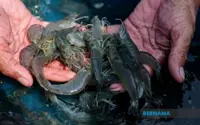
KUALA LUMPUR: Water treatment, sanitation equipment and staff supervision have been boosted at the National Fishermen Association’s (Nekmat) Badong shrimp farm following previous outbreaks of Early Mortality Syndrome (EMS) and Enterocytozoon hepatopenaei (EHP), says the association.
Nekmat general manager Azrin Shah Ismail said standard operating procedure was implemented at the pond preparation stage, including disinfecting high-density polyethylene geomembrane liners, treating culture water and cleaning equipment.
He added that using approved dosages of treatment agents and probiotic bacteria helped prevent disease and reduce the risk of mortality among shrimp fry.
“Although the project uses mechanisation, such as automatic feeders to facilitate daily pond maintenance, monitoring by skilled workers remains essential to improve harvest quality,” he said in a written response to Bernama yesterday.
EMS causes early mortality in shrimp, while EHP infection can stunt their growth.
Azrin Shah said previous outbreaks of EMS and EHP during farming operations had resulted in gradual shrimp mortality and stunted growth.
At the national level, the Fisheries Department announced on June 13 that biosecurity controls at the country’s entry points were being strengthened to reduce the risk of introducing aquaculture diseases, including EMS and White Spot Syndrome Virus, which could affect the sector’s productivity.
Under the third phase of the project’s expansion, one of the 10 ponds has been designated for water treatment to supply treated seawater to the remaining nine culture ponds.
Beyond disease prevention, Azrin Shah said feed was a major component of production costs, while shrimp fry was currently sourced from producers around Nenasi and Kuala Rompin.
“Feed typically accounts for 30% to 40% of total production costs,” he said, adding that feed was purchased at between RM4.80 and RM5.20 per kilogramme.
On the possibility of establishing an in-house hatchery, he said it would require substantial investment, specialised expertise and a suitable location, particularly one with access to seawater.
However, the Nekmat project is confined to Lot 5 in Badong.
“Establishing a hatchery is a sound strategy as it allows control over the entire aquaculture production chain while ensuring a supply of high-quality fry,” he said.
On fishermen’s participation in aquaculture, he said saltwater farming would be better promoted through group-based entrepreneurial programmes or involvement at the marketing stage, given the high capital requirements and operational risks.
In contrast, freshwater aquaculture involving tilapia and catfish could be started with lower capital, with some fishermen already undertaking it individually with family members, added Azrin Shah.