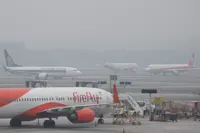
PETALING JAYA: Cloud seeding may provide only temporary relief from the worsening haze in Sarawak, as the real solution lies in tackling the fires generating the smoke and the dry conditions that allow them to spread, say experts.
Universiti Kebangsaan Malaysia climatologist Prof Dr Fredolin Tangang said the effectiveness of cloud seeding depended heavily on the availability of suitable clouds.
“Cloud seeding usually does not work if we don’t have many clouds, a typical condition during El Nino,” he said in an interview yesterday.
On Tuesday, Deputy Prime Minister Datuk Seri Dr Ahmad Zahid Hamidi said the government will carry out cloud-seeding operations from today to Sept 5 in 13 areas in Sarawak, Kedah and Perlis.
Fredolin said the current haze should also be viewed against the backdrop of the developing 2026/2027 El Nino, with dry conditions expected to persist over Kalimantan and southern Sumatra from September to November, keeping the risk of forest and peatland fires high.
“When a strong El Nino occurs, much of the southern part of South-East Asia typically experiences reduced rainfall. Soils and vegetation become progressively drier.
“Peatlands lose moisture and become increasingly susceptible to fire.
“As long as the fires continue, the threat of transboundary haze will not go,” he said.
Authorities need to move from reacting to haze episodes to preventing them, as the development of El Nino could be monitored months in advance, he added.
“An El Nino forecast issued six to nine months in advance should translate into action six to nine months in advance – not action taken only after major fires have already started.”
He called for early identification of high-risk areas, better management of peatland water levels, tighter control of open burning and the pre-positioning of firefighting teams and water resources.
Universiti Malaya meteorologist Prof Datuk Dr Azizan Abu Samah described the cloud seeding exercise as “just a placebo”.
He said there were already sufficient haze particles in the atmosphere to act as cloud-seeding nuclei, while the scale of the smoke plume meant rainfall over a relatively small area would not provide lasting relief.
“I drove from Kuala Lumpur to Jitra on Aug 30; all the way, I could see the haze. Some areas have less concentration, some areas appear thicker.
“My point is that the smoke plume from the burning in Sumatra is more than 300km long.
“Even if rain temporarily washed haze particles out of the atmosphere, prevailing winds could bring the smoke back within hours,” he said.
“So let’s say it rained in Ipoh and the haze concentration cleared a bit due to washout by the rain cloud, which may affect around 50km, which is the normal thunderstorm size; it will last maybe one to two hours before the prevailing wind brings the haze smoke back.”
He said the fires that generate the haze needed to be addressed at the source.
“Sad to say, due to the scale, there is no quick fix available, but to wait for the switch of the monsoon wind from south or south-westerly to easterly and north-easterly,” he added.
Both Fredolin and Azizan agreed that cloud seeding could not be viewed as a standalone solution, reiterating that tackling the fires and dry conditions driving the haze was crucial to addressing the problem.