
PETALING JAYA: Stronger regulation of private optometry and eyewear premises is needed to ensure eye care does not become secondary to the sale of spectacles and contact lenses, says the Association of Malaysian Optometrists.
Its president Ahmad Fadhullah Ahmad Fuzai said the Health Ministry’s proposal to bring optometry and primary eye-care premises under the Private Healthcare Facilities and Services Act 1998 (Act 586) will address gaps in the current regulatory framework.
He said while the Optical Act 1991 regulates individual practitioners, it does not provide the same level of oversight over the premises, including their clinical layout, equipment and workflow.
“Act 586 can shift the focus from regulating the practitioner to also ensuring that the premises meet proper healthcare standards.
ALSO READ: Rules to govern eye-care services
“This would allow the ministry to establish minimum requirements for equipment, patient records, hygiene and clinical procedures, as well as inspect premises and take action against those who fail to comply,” he said.
There are currently around 3,000 to 3,500 optical shops in Malaysia, providing services mainly in fitting and dispensing of eyeglasses and contact lenses based on prescriptions or examinations.
Ahmad Fadhullah said optometry practices should, among others, have equipment such as slit-lamp biomicroscopes, ophthalmoscopes or fundus cameras and tonometers to enable proper eye-health screening and referrals when necessary.
“The need for proper assessment is particularly important when outlets prioritise refraction or sales over comprehensive eye examinations.
“Refraction-only practices may miss early signs of conditions such as glaucoma, diabetic retinopathy and macular degeneration, which could lead to irreversible vision loss if not detected early,” he said.
Refraction services refer to the identifying and measuring of conditions like nearsightedness, farsightedness and astigmatism.
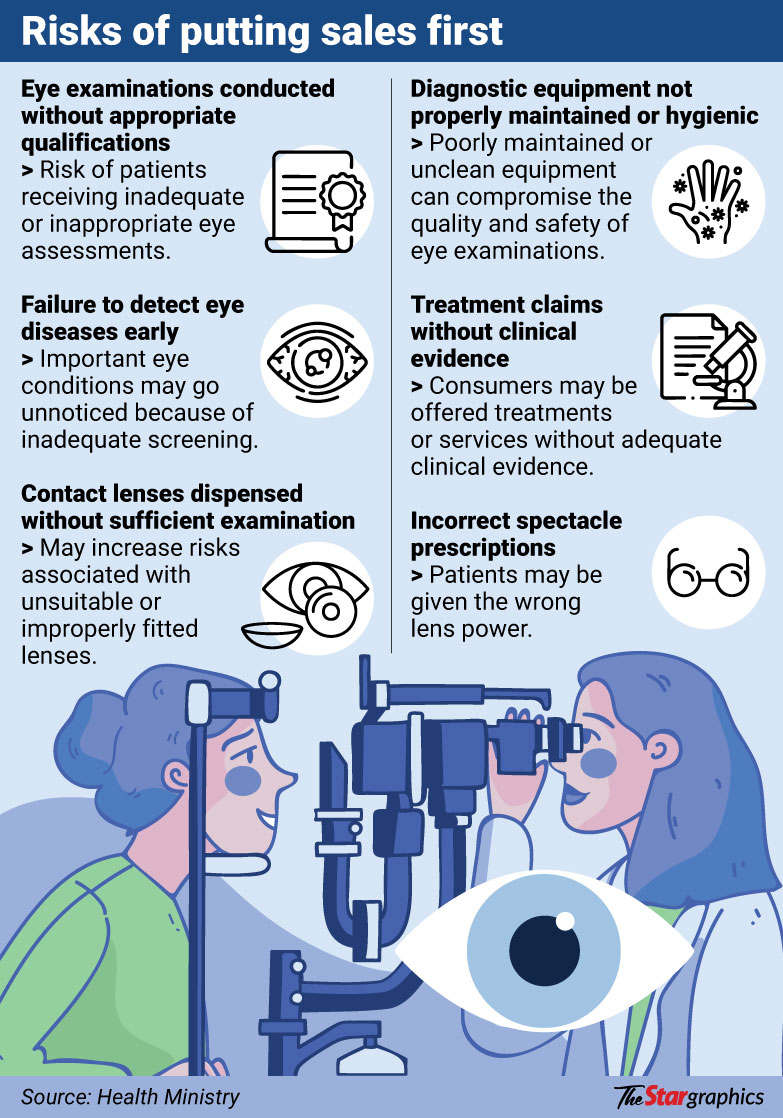
Ahmad Fadhullah also highlighted the risks associated with improper contact lens fitting, including corneal infections, ulcers and potentially permanent vision loss, and urged consumers to look beyond an automated spectacle-power test when choosing an optometry centre.
“A proper eye examination should include assessment of eye health, consultation and appropriate follow-up, rather than simply determining the strength of the glasses,” he said.
Optician Gan Ching Leong said regulation would help strengthen public confidence in the profession, provided that the required facilities are properly maintained and used.
“It is a good initiative. Regula-tion must ensure there is a trained person to handle and maintain the facilities, rather than companies simply setting them up for compliance.
“Eye care should be the primary role of an optometry practice, while sales of products are secondary,” he said.
Gan said proper eye assessments are also important as optometry practices are often the first point of contact for people with vision problems.
“With proper assessments, an optometrist can advise patients on their condition and make the appropriate referral to other eye-care or medical professionals,” he said.
For children, the lack of proper eye assessments can mean missed opportunities to assess risk factors, monitor progression and discuss evidence-based myopia-control options.
“Parents should also be wary of unproven treatments and choose practices that can properly assess myopia and explain scientifically supported management options,” he said.
Optometrist Wong Jun Yuan said any regulation should recognise optometry as an independent healthcare profession and be tailored to its specific clinical needs.
“The important question is not if optometry services should come under the Private Medical Practice Control Section but if the regulatory framework is appropriate for optometry,” he said.
Wong also stressed that contact lenses, which are medical devices, should only be dispensed with proper examination and fitting.
“Without proper examination and fitting by a qualified professional, consumers may receive an inappropriate lens power or material, or a poorly fitted lens, while the health of the cornea may not be assessed,” he said.
Wong said inadequate examinations on diseases like myopia did not necessarily cause the condition to worsen but could result in its progression going unnoticed.
“If a child only receives a basic spectacle-power measurement, the practitioner may fail to detect meaningful progression, identify risk factors or discuss evidence-based myopia-control options,” he said.