




PETALING JAYA: Malaysia's rise to 15th place in the 2026 International Institute for Management Development (IMD) World Competitiveness Ranking sends a strong signal that the country is becoming a more competitive and business-friendly economy, economists say.
They said recent policy reforms, coupled with improvements in government and business efficiency, as well as efforts to streamline investment approvals, accelerate digitalisation and strengthen fiscal management, were among the key factors behind Malaysia's strongest competitiveness showing in recent years.
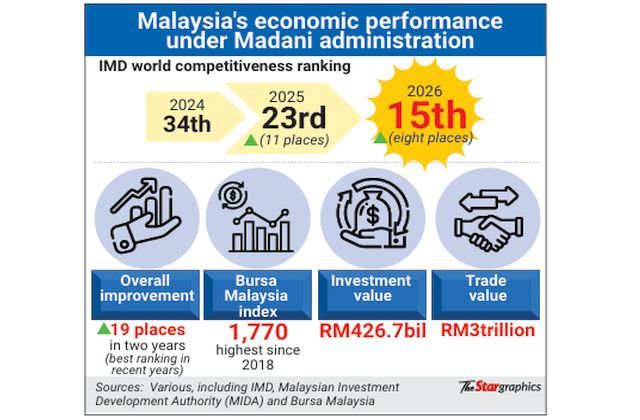
Malaysia climbed eight places in the latest IMD ranking to 15th among 70 economies, its best performance in recent years.
Last year, it rose 11 places to 23rd among 69 economies from 34th out of 67 economies in 2024.
Director of the economic studies programme at the Jeffrey Cheah Institute of Sunway University, Prof Dr Yeah Kim Leng attributed the improvement primarily to stronger government and business efficiency, two areas that recorded significant gains in the latest rankings.

He said government efficiency climbed 11 places, while business efficiency surged 16 places, reflecting improvements in policy implementation and the overall operating environment.
"The public can reasonably expect these gains to materialise over the medium term. Improved competitiveness signals to global investors that Malaysia is an efficient, low-risk and business-friendly environment, leading to increased foreign and domestic investment.
"This infusion of capital stimulates broader economic growth, which historically translates into higher demand for skilled labour, upward wage adjustments and a more vibrant ecosystem for start-ups and small and medium-sized enterprises (SMEs).
"While the effects are cumulative rather than immediate, the trajectory points firmly towards a more prosperous and opportunity-rich economy for all Malaysians," he said.
Yeah said the ranking, which is closely watched by international investors, reinforced Malaysia's favourable policy environment, sound economic fundamentals and promising growth prospects.
"It will certainly enliven the investment landscape, as global investors are typically more attracted to countries that demonstrate strong improvements in competitiveness," he said.
The IMD ranking assesses economies across four pillars, including economic performance, government efficiency, business efficiency and infrastructure.
According to IMD, improvements in all four areas contributed to Malaysia's stronger performance this year.
Universiti Teknologi Mara senior lecturer Dr Mohamad Idham Md Razak said the higher ranking indicated that recent efforts to strengthen the economy and improve the business climate were gaining traction.

"This achievement is meaningful for Malaysia as it reflects improving fundamentals in areas such as macroeconomic stability, policy direction and the business environment," he said.
He said government initiatives to streamline investment approvals, improve regulatory clarity, reduce bureaucratic hurdles and strengthen infrastructure readiness had likely boosted investor confidence.
"Malaysia's improved ranking suggests that recent efforts to stabilise growth, attract investment and enhance the ease of doing business are bearing fruit.
“However, it is important to remember that these rankings are relative measures, and Malaysia continues to compete with other economies that are also pursuing reforms," he said.
While a higher competitiveness ranking would not deliver immediate benefits, Mohamad Idham said it could produce meaningful long-term gains.
"In principle, stronger competitiveness should attract more foreign and domestic investment, leading to job creation, technology transfer and higher economic growth.
“Over time, this can support better-quality jobs and potential wage increases, particularly if investments are concentrated in higher value-added sectors," he said.


