



KLANG: Transit-oriented development (TOD) projects must be fast-tracked on land surrounding rail stations such as along the Shah Alam Line (LRT3), with affordable housing taking priority, says the Prime Minister.
Speaking at the launch of the RM16.63bil Shah Alam Line (LRT3), Datuk Seri Anwar Ibrahim said the TOD initiative would complement the new rail line linking Bandar Utama and Johan Setia, which is expected to improve connectivity for about two million people living along the corridor.
He said land owned by Prasarana Malaysia Bhd around LRT and MRT stations should no longer be underutilised but instead be developed by incorporating public housing, adequate parking facilities and commercial space for small businesses.
“I want the secretaries-general of the Transport Ministry and the Finance Ministry, together with Prasarana, to expedite this so that the development aspect is handled by a separate sector, allowing Prasarana to focus on what it has been entrusted to do – ensuring an efficient, reliable and fast public transport system,” he said in his speech yesterday.
The priority, added Anwar, should be affordable housing rather than luxury developments, with retail lots also provided for small traders and entrepreneurs.
“I don’t think five-star housing should be built there.
“It should be housing for the people, together with shops for small- and medium-scale businesses,” he said.
Integrating housing with rail stations, he noted, would lower commuting costs, encourage greater use of public transport and unlock the commercial value of strategically located government land.
He also called on the Selangor government and local authorities to expedite planning approvals, adding that the TOD projects should become a benchmark for faster execution involving federal, state and local agencies.
The federal government, he said, would also accelerate the redevelopment of land owned by agencies such as the Road Transport Department and the Customs Department for affordable housing projects, including in Larkin, Johor Baru.
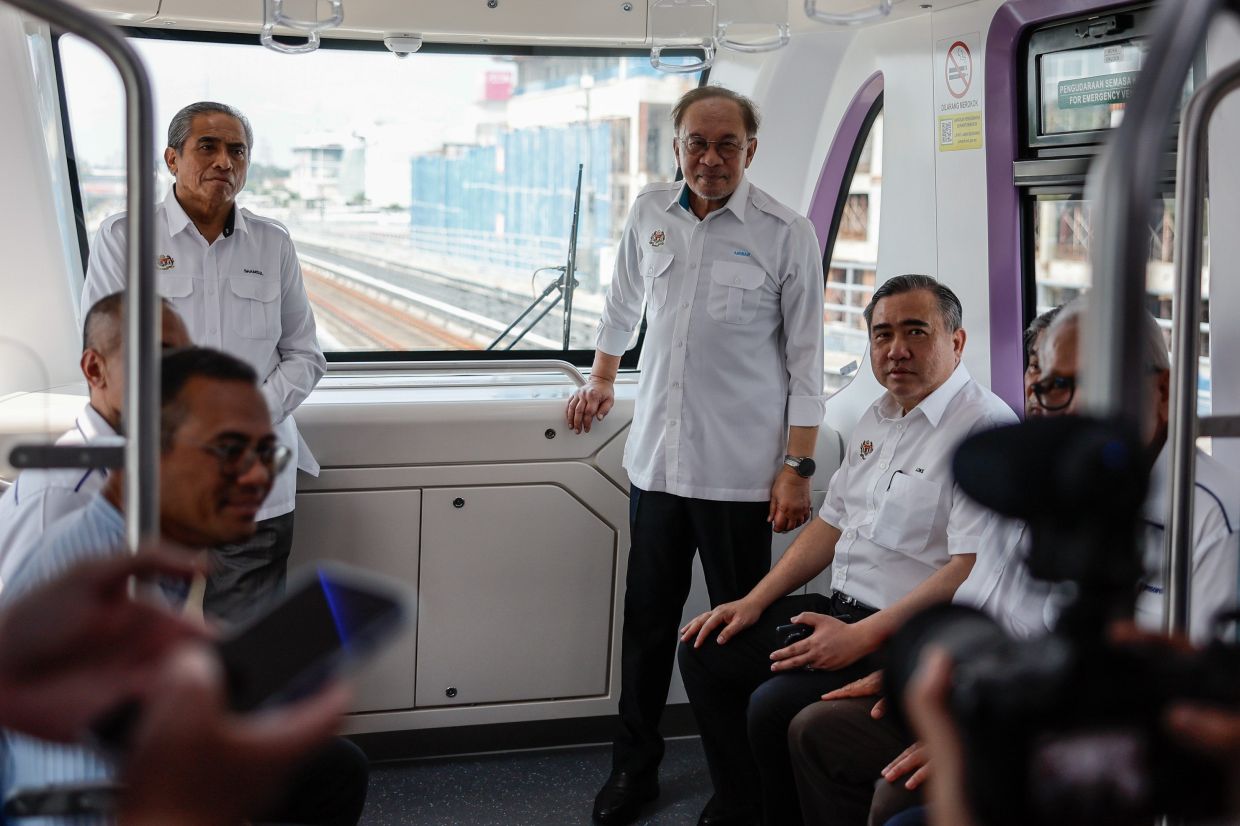
Earlier, the Prime Minister officially launched the 37.8km Shah Alam Line, Malaysia’s newest LRT service, which comprises 20 stations, including 2.5km of underground alignment.
Strengthening connectivity across Shah Alam, Klang and Bandar Utama through interchanges with the Kelana Jaya LRT and Kajang MRT lines, the line is expected to carry 67,000 passengers daily in its first year of operations, rising to over 117,000 within five years.
Anwar said the project demonstrates the government’s commitment to expanding public transport infrastructure through close collaboration with the private sector as Malaysia pursues developed nation status.
The RM16.63bil project included RM11.43bil in construction costs, with the remainder covering land acquisition, variation orders and related expenses.
Anwar said the government had set aside an additional RM4.7bil under Budget 2024 to upgrade the project by reinstating five previously deferred stations – Tropicana, Raja Muda, Temasya, Bukit Raja and Bandar Botanik – as well as funding seven additional train sets, supporting systems and the expansion of the Johan Setia depot.
Construction of the five stations is expected to begin at the end of this year.
Separately, Prasarana will procure 150 electric buses and build two bus depots at a cost of RM600mil to strengthen first- and last-mile connectivity for the LRT3 network while supporting the country’s net-zero carbon ambitions.
The Prime Minister said that while such allocations are necessary to improve public transport, the government also has to balance spending on other priorities, including flood mitigation, rural development and poverty eradication.
He also reminded Prasarana and the Transport Ministry to uphold strong governance and prevent leakages, saying the country could not afford world-class infrastructure delivered at inflated costs.
The Shah Alam Line operates with 22 three-car trains, each capable of carrying up to 624 passengers at a maximum operating speed of 80 kph.
Services will run at eight-minute intervals during peak hours and every 10 to 15 minutes during off-peak periods.
It is also Malaysia’s first rail project to adopt U-Trough technology, using precast U-shaped girders that speed up construction, reduce disruption and incorporate built-in noise barriers.
