
PETALING JAYA: The Public Service Department has issued a new directive on asset declaration for civil servants including a revised threshold for shareholding in companies and the approvals mechanism.
Public Service Department director-general Tan Sri Wan Ahmad Dahlan Abdul Aziz said in a circular dated June 16, this measure aims to strengthen integrity, accountability and transparency in the civil service, while ensuring that it keeps up with current developments.
According to the latest directive, the shareholding limit in a private company shall not exceed 5% of paid-up capital or RM300,000, whichever is lower.
“However, the cumulative value of shareholdings in more than one company shall not exceed RM300,000.
“Officers wishing to exceed these limits shall apply for approval.”
Similarly, an officer’s cumulative shareholding in public listed companies shall not exceed RM300,000. Share ownership which exceeds the limit will require approval.
The latest directive also included other assets, including shares and digital assets approved by the Securities Commission.
For equity crowdfunding platforms, the share ownership is limited to RM10,000 per company and a total investment of RM50,000 within a 12-month period, or as per limits prescribed by the Securities Commission from time to time.
Digital asset ownership, cooperative shares, unit trusts and shares in government companies are capped at RM300,000.
“Notwithstanding the limits prescribed for each investment instrument, except those in paragraph 23(iii)(a) and any limits imposed by the government under other regulations, the cumulative value of ownership or acquisition of shares, debentures, bonds, sukuk or other securities shall not exceed RM300,000,” the circular read.
“Where an officer has the means and wishes to acquire shares, debentures, bonds, sukuk or other securities beyond the limits prescribed in paragraph 23 (except paragraph 23(iii)(a) and limits imposed under other regulations), the officer shall obtain approval from the Approving Officer in accordance with paragraph 26,” it added.
Under the previous regulation where the holding of e-shares, including debentures, bonds and other securities, was capped at 5% of the paid-up capital or RM100,000 at the current market value, whichever is lower, in any one company incorporated in Malaysia as well as company, corporation or enterprise established by the federal or state governments.
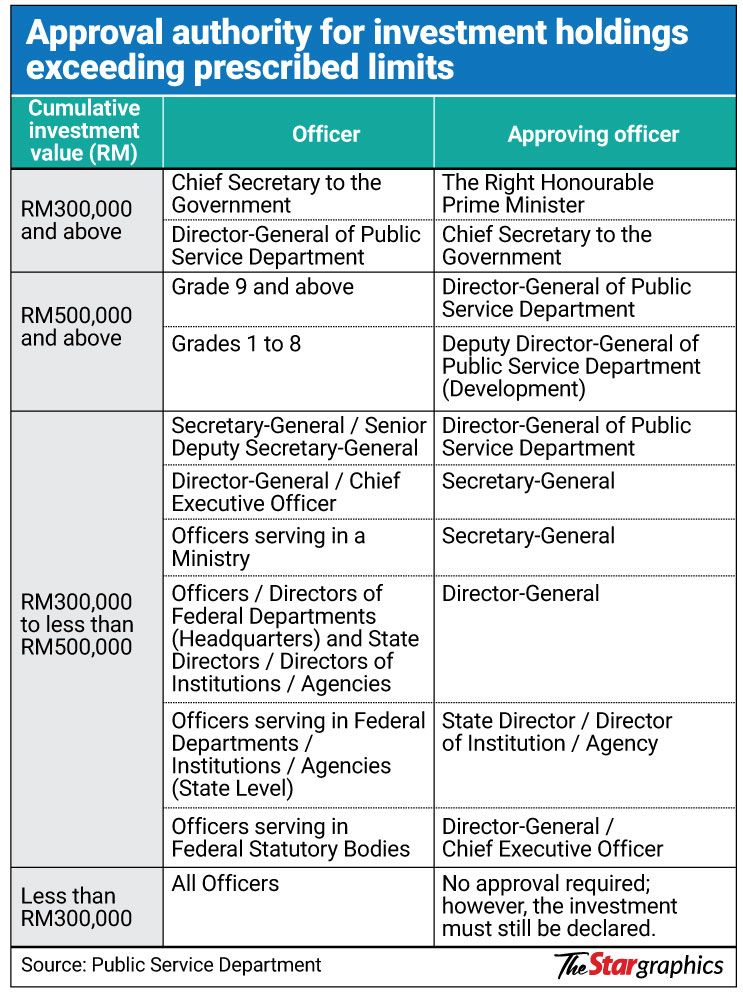
Assets below RM300,000 will not require approval but it must still be declared.
For example, if the asset owner is the chief secretary of the government, the approving officer for assets exceeding RM300,000 will be the prime minister.
For directors-general, the approving authority would be the chief secretary to the government.
“Officers appointed as Chairman or Members of the Board of Directors of public corporate entities such as Government-Linked Investment Companies Government-Linked Companies, Companies of the Minister of Finance (Incorporated), Companies Limited by Guarantee, Federal Statutory Bodies and State Statutory Bodies shall declare the income received from their membership of such entities every June and December.”
The income in question includes Fixed Monthly Allowances, bonuses, incentives, shares, dividends and any other forms of income.
“An officer who receives any dividend or investment return exceeding six times his or her emoluments shall declare such receipt to the Head of Department through the HRMIS System, Asset Declaration Submodule Function Monthly Income Module,” it added.
A dedicated secretariat will examine the asset declaration application; submit a recommendation for the head of department to acknowledge the officer’s asset declaration; notify the officer of the head of department’s decision regarding the asset declaration; record the decision relating to the asset declaration in the officer’s service records; and report to the head of department where there are indications of misconduct or concerns regarding the officer’s integrity.
The head of department is responsible for determining whether an officer has the financial capacity to own the declared assets and whether it was acquired by legal means, among others.
“In considering an officer’s asset declaration, the Head of Department may request additional information where necessary,” the circular read.
Where, after consideration, the head of department is not satisfied with the officer’s asset declaration, the matter shall be reported to the Integrity Unit or any other unit responsible for integrity matters for further action.
Where the head of department is satisfied with the declaration, the head of department shall acknowledge the asset declaration as soon as possible and no later than 30 days after complete information has been provided.”