PETALING JAYA: From smartphones and laptops to power banks and smart devices, lithium-ion batteries (LIBs) are widely used in everyday life.
The concern is that such batteries can pose risks if handled carelessly, damaged or disposed of irresponsibly.
Fire and Rescue Department director-general Datuk Seri Nor Hisham Mohammad said that LIBs can pose risks such as fire, heat exposure, electrocution, electrical short circuits and explosions caused by gas accumulation.
Besides these dangers, he added that such batteries could produce toxic smoke during thermal runaway.
“LIB fires are usually difficult to control and extinguish, requiring large quantities of water for suppression.
“Even then, they may reignite unexpectedly long after the initial thermal event has occurred,” he said when contacted.
He noted that the mismanagement, handling and disposal of LIBs are among the main concerns.
“This is due to the misconception that LIBs are similar to nickel-cadmium or lead-acid batteries.
“There must be greater and more regular awareness campaigns on the matter, alongside stricter enforcement at premises that recycle such batteries or engage in similar activities,” he said.
Besides consumer devices, Nor Hisham said the LIBs used in most electric vehicles (EVs) also pose unique challenges for firefighters.
“The batteries are installed at the base of the vehicle, which makes it difficult to apply water jets effectively.
“Such fires can last for hours and pose a risk of electrocution to firefighters due to the high voltages involved,” he said, adding that there was also the risk of reignition.
To better prepare firefighters, Nor Hisham said the department began sending personnel for various LIB fire-handling courses in 2024.
He noted that to date, a total of 837 firefighters have undergone training to handle LIB fires, particularly those involving EVs.
Besides training, he said the department has also introduced fire safety requirements for the installation of LIB storage systems at data centres, power generation plants, construction sites and EV charging facilities.
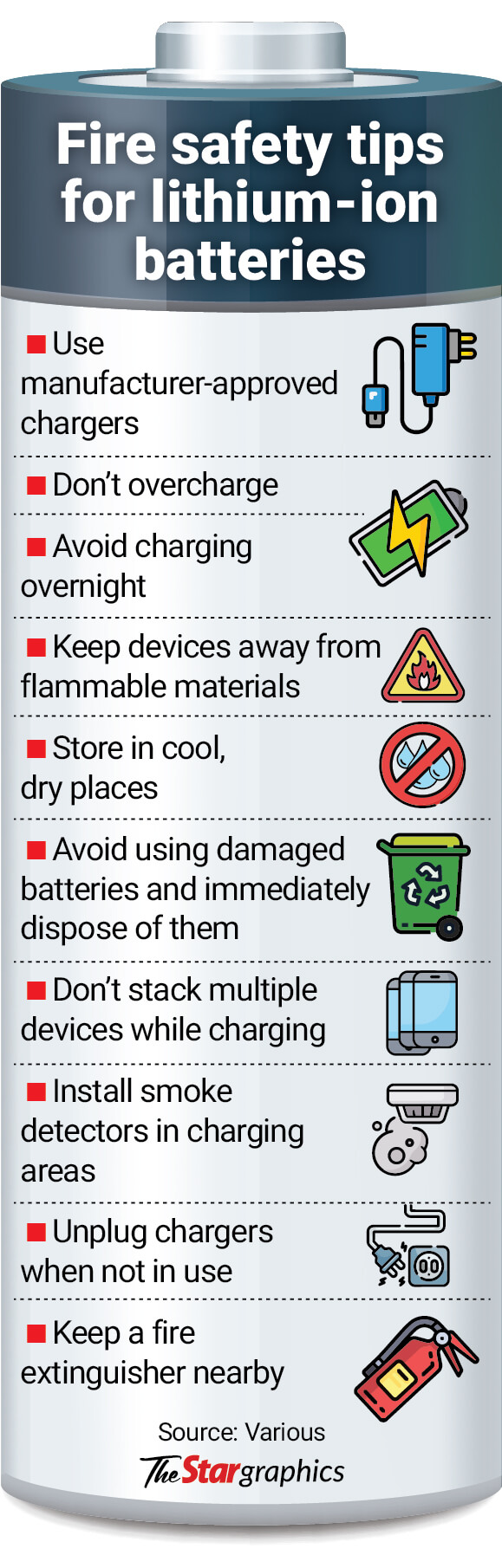
Nor Hisham urged the public to take precautionary measures when handling products containing LIBs and to use only certified products.
“Always stay alert to warning signs. Devices and batteries must be recycled properly.
“Evacuate immediately if there is a fire and, where possible, educate others on safe practices,” he said.