
PETALING JAYA: Child welfare experts and advocates are urging mandatory child safety standards in residential buildings, stressing that tougher regulations are essential to prevent children from falling from high‑rise homes.
They argue that Malaysia’s current safety standards are inadequate and were not designed with children in mind, leaving many families reliant on parental supervision as the primary safeguard.
Experts point to Singapore as a successful model for emulation.
The city-state mandates built-in high-rise safeguards, including window restrictors and safety barriers, reinforced by continuous public safety campaigns and strict legal enforcement.
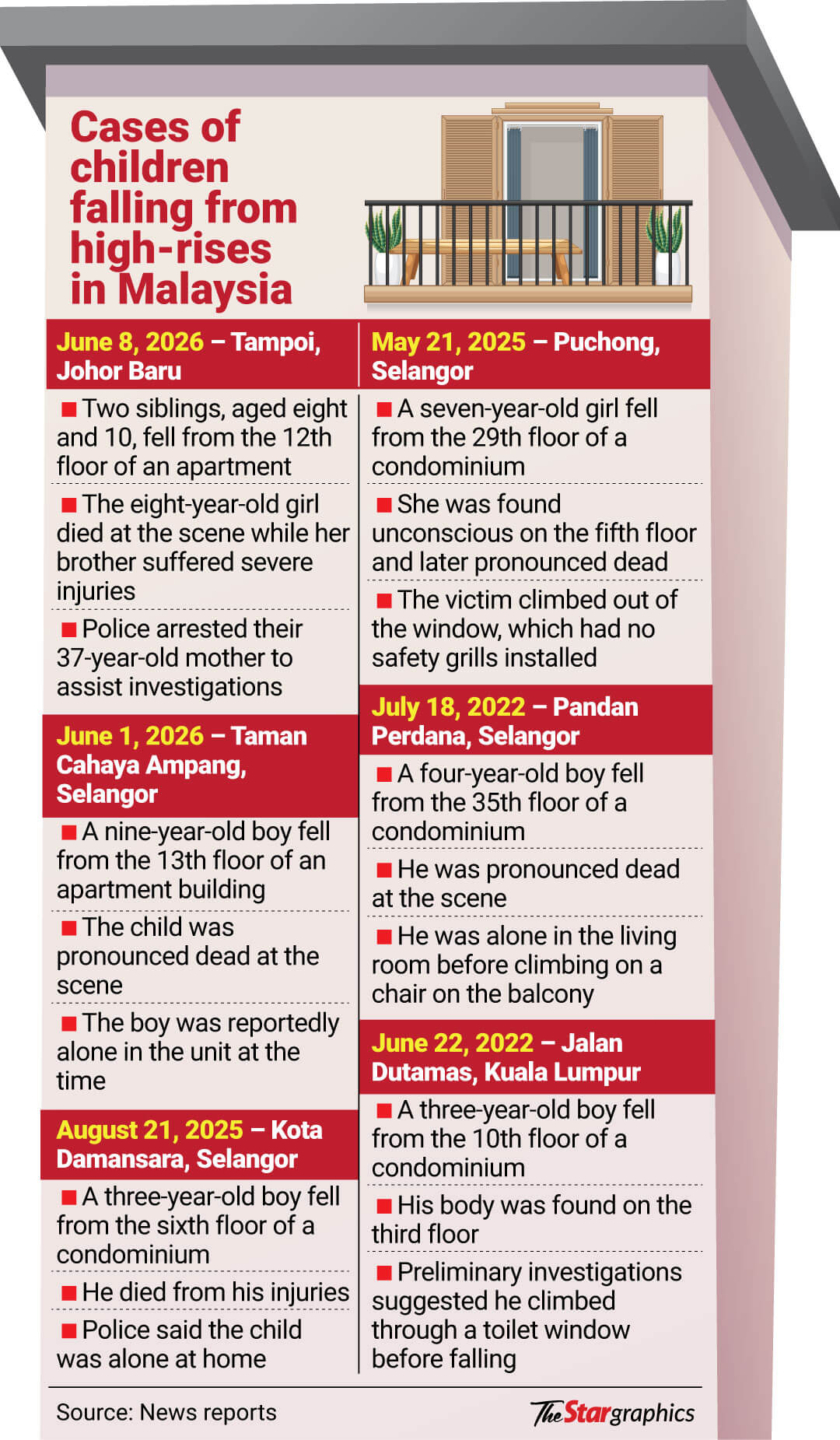
The urgency is driven by two recent high-rise falls involving young children.
An eight-year-old girl died and her 10-year-old brother was seriously injured after falling from the 12th floor of an apartment in Johor Baru on Monday, while a nine-year-old boy died after falling from the 13th floor of an Ampang apartment last week.
Child rights activist Datuk Dr Hartini Zainudin said many such cases share common risk factors, including low window sill heights, climbable balcony railings, furniture placed near windows and absence of window restrictors.
“The risk isn’t carelessness. It’s a built environment that was never designed with children in mind,” she said when contacted.
Hartini urged parents to take immediate precautions, such as moving furniture away from windows and installing safety grilles or locks.
However, she said parental vigilance should not be a family’s sole line of defence.
Current building regulations address structural integrity and fire safety but lack provisions for child fall prevention.
“The solutions exist. What’s missing is the requirement to use them,” she said.
Hartini advocated for child-safe railing and window specifications to be enforced in new developments while urging retrofitting programmes to support existing high-rises.
Malaysian Council for Child Welfare chairman Datuk Dr Raj Abdul Karim said child falls are typically driven by a combination of factors – a lack of supervision, natural curiosity, furniture placed near windows and inadequate building design.
She said Malaysia’s Uniform Building By-Laws 1984 fails to mandate child-specific safety features.
“The current framework was not written with children in mind,” she said.
Raj called for a complete overhaul of building standards including window restrictors, safety grilles, elevated and non-climbable balcony designs, and secure locks on sliding doors.
She said safeguarding children required collective accountability from lawmakers and developers down to building managers and parents.
“These tragic, unnecessary deaths are entirely preventable.”
Early Childhood Care and Education Council president Datuk Dr Chiam Heng Keng said parents and developers are both responsible for childproofing residential spaces.
She said children are naturally curious and often unaware of danger, making proper safety measures essential.
Chiam called on approving authorities to enforce strict child-safety requirements, echoing praise for Singapore’s regulatory model.
“If proper requirements are in place, developers will follow.”
Human Rights Commission of Malaysia chief children’s commissioner Dr Farah Nini Dusuki urged federal and state authorities to enact specific laws safeguarding children in high-rise homes.
She called for a comprehensive review of existing building guidelines as a means of establishing minimum safety design standards for child-friendly residential homes.