Protection officers must attend mandatory course by 2028
PETALING JAYA: Radiation Protection Officers (PPS) at licensed healthcare premises must attend a mandatory training course as part of the requirement for applying for an operating licence.

“This requirement applies to all government and private medical facilities under the Atomic Energy Licensing Act 1984 (Act 304),” the circular said.
Dr Mahathar said this came about after a previous circular was reviewed, and based on feedback and discussions during the 9th Meeting of the Radiation Advisory Committee held in February.
ALSO READ: Concerns over cost and time impact on GPs
“All new government and private medical facilities must ensure the PPS appointed have attended the course as a requirement for applying for an operating licence,” he said.
Prospective candidates are also required to attend physical courses at training centres accredited by the Health Ministry according to the risk categories of the service.
Existing personnel and prospective candidates must attend the Phase 1 course before a stipulated deadline, failing which they will be required to go through the full course and sit for an examination.
“Each government and private medical facility is only permitted to send one candidate to attend training throughout the implementation of Phase 1,” he said.
There are three categories of training.
Category 1 is the high-risk one and involves premises possessing either radioactive materials, therapeutic radiation generators as well as radiation generators utilising radioactive materials such as positron emission tomography-computed tomography (PET-CT) and/or single photon emission computed tomography (SPECT).
Moderate-risk facilities come under Category 2. These are premises possessing fluoroscopy-type radiation generators and/or computed tomography units for diagnostic purposes.
Category 3 is the low-risk one. It involves premises with diagnostic radiation generators other than those in Category 1 and Category 2. It includes apparatus for dental and veterinary purposes such as general radiography, intra-oral, cone beam computed tomography (CBCT) and mammography.
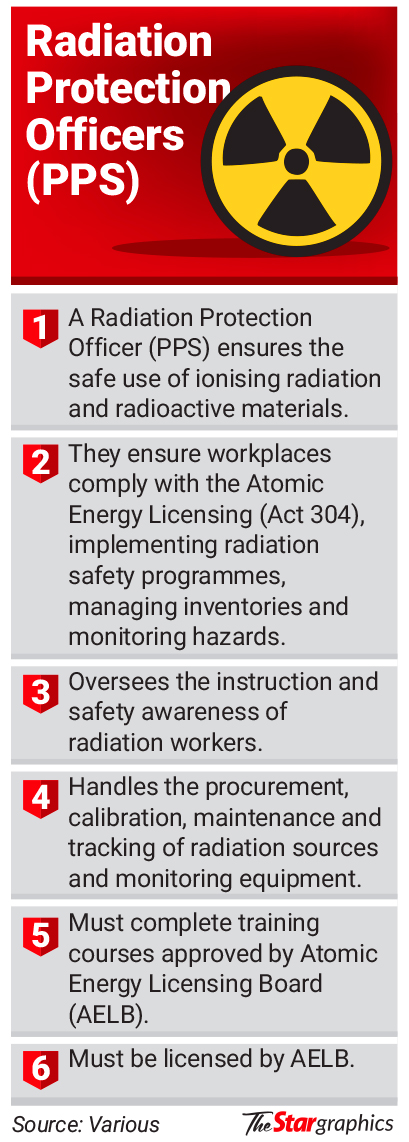
A PPS manages the technical aspects, procedures and radiation protection measures in hospitals or clinics.
All government and private healthcare premises that possess radiation apparatus for medical purposes are required to employ one or more qualified and competent PPS.
For a person to be appointed as a PPS, he or she must have the relevant theoretical training, both technical and non-technical, as approved by the Atomic Energy Licensing Board, covering practical radiation protection and regulatory requirements with respect to the irradiation facility for which they are appointed.