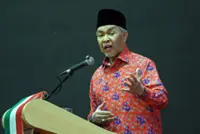
KUALA LUMPUR: Malaysia’s relatively low inflation is expected to help the country weather the energy supply shock, even as global oil prices are projected to remain higher longer amid the ongoing Middle East conflict, says Datuk Seri Abdul Rasheed Ghaffour (pic).
The Bank Negara Governor said the central bank is projecting headline inflation to average between 1.5% and 2.5% this year, noting that the present situation reflects a supply-driven shock, with developments in global energy markets beginning to feed into domestic price dynamics.
“What we are facing right now is really a supply shock, and it is good to see how this fits into our domestic prices,” he told CNBC in an interview held in Washington DC.
Abdul Rasheed is part of the Malaysian delegation, led by Finance Minister II Datuk Seri Amir Hamzah Azizan, attending the 2026 Spring Meetings at the International Monetary Fund and World Bank Group headquarters in the US capital.
He said oil prices are expected to remain elevated for an extended period, even if the war ends within the next few weeks.
“Although oil prices have gone up, we still have fuel subsidies for a group of the population under Budi95. That will, in a way, dampen the transmission of global cost conditions into domestic prices,” he added.
He highlighted that Malaysia’s role as a net energy exporter also helps cushion the current supply shock.
“The strengthening of the ringgit will also have some impact in terms of dampening the transmission of prices, but we are watching this very closely,” he added.
Abdul Rasheed noted that the tourism sector has recorded a strong recovery, surpassing pre-pandemic levels in both arrivals and spending, thus helping to lift the economy.
He said that Malaysia’s economy is supported by stronger-than-expected growth and resilient fundamentals amid global uncertainties.
“The country’s growth performance in the third and fourth quarters of last year exceeded projections, with the economy expanding by 5.2%.
“We are entering this from a position of strength. It does help us but more importantly, we do have strong fundamentals that will help us weather this situation,” he added.
Abdul Rashid also pointed out that key growth drivers remain intact, with private consumption and investment continuing to show robustness.
“In terms of the drivers of growth, what we saw last year in terms of private consumption and investment was still robust.
“Despite all the uncertainty that we discussed last year, exports performed rather well,” he said.
On export performance, Abdul Rasheed said it was particularly supported by sustained demand for electrical and electronics, driven by rapid developments in artificial intelligence.